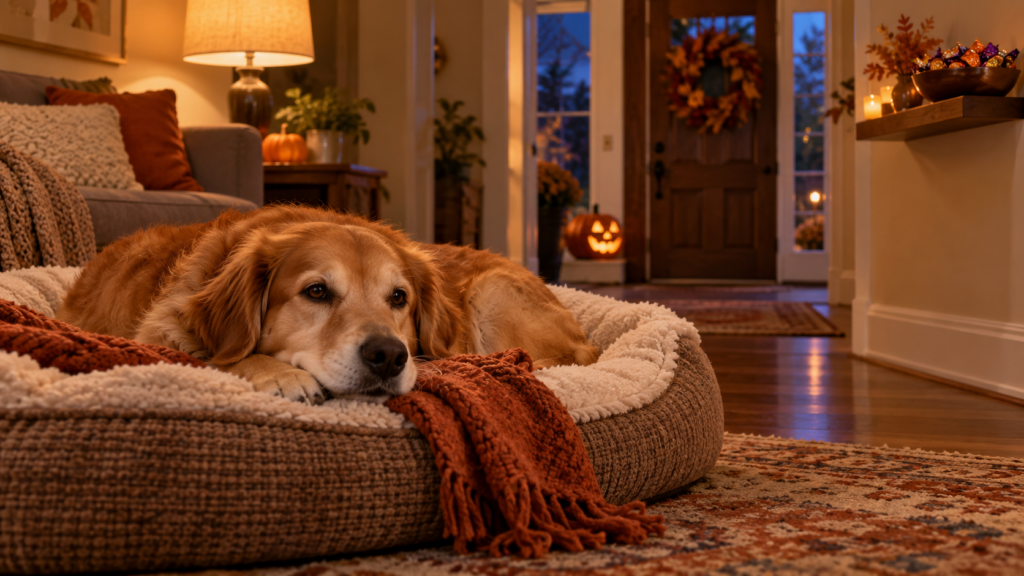
A Holiday With Several Distinct Pet Hazards
Halloween brings a specific cluster of pet safety concerns that don’t arise the same way during other fall holidays—candy accessible in unusual quantities, a steady stream of costumed strangers at the door, and decorations that can pose their own hazards. With the holiday approaching, it’s worth reviewing the specific risks this particular celebration creates for pets sharing the household.
Chocolate Remains the Most Significant Candy Hazard
Chocolate contains theobromine, a compound toxic to dogs and cats that their bodies metabolize far more slowly than humans do, allowing it to build up to dangerous levels even from a moderate amount of ingestion. Darker, more concentrated chocolate—baking chocolate and dark chocolate specifically—contains considerably higher theobromine concentrations than milk chocolate, meaning even a relatively small amount of dark chocolate can pose a more serious risk than a larger quantity of milk chocolate would.
Symptoms of chocolate toxicity can include vomiting, diarrhea, restlessness, increased heart rate, and in more severe cases, tremors or seizures. Given Halloween’s characteristic abundance of chocolate candy scattered around a household in bowls, trick-or-treat bags, and pockets, this holiday represents a genuinely elevated exposure window compared to most of the rest of the year.
Xylitol Poses an Even More Acute Danger
Xylitol, a sugar substitute increasingly common in sugar-free candy and gum, is extremely dangerous to dogs specifically, capable of causing a rapid, severe drop in blood sugar and, in some cases, liver failure from a remarkably small ingested amount. Unlike chocolate toxicity, which generally requires a more substantial quantity to become dangerous, xylitol poisoning can occur from ingesting just a piece or two of sugar-free gum or candy, making it one of the more acutely dangerous substances a dog might encounter in a Halloween candy stash.
Checking ingredient labels on sugar-free treats, and keeping any xylitol-containing products entirely out of reach rather than simply “up high” in a way a determined dog might still access, is a genuinely important precaution during a season when these products are more prevalent throughout many households.
Wrappers and Small Items Present a Separate Mechanical Risk
Beyond the toxicity concerns from the candy itself, wrappers, sticks from lollipops, and small plastic toys sometimes included in trick-or-treat hauls can pose a choking or intestinal obstruction risk if ingested, separate from any chemical toxicity. Keeping trick-or-treat bags and candy bowls in locations genuinely inaccessible to pets, rather than assuming a bowl on a counter or table is sufficiently out of reach, addresses both this mechanical risk and the toxicity concerns simultaneously.
The Steady Stream of Visitors Creates Its Own Stress
Beyond candy-related hazards, Halloween’s characteristic pattern of frequent doorbell rings and costumed visitors can create genuine stress for many pets, particularly those already prone to anxiety around strangers or loud noises. This repeated door activity, occurring over an extended evening rather than a single event, can be considerably more stressful for a sensitive pet than an isolated doorbell ring might be on an ordinary day.
For pets who show anxiety around visitors or unfamiliar costumes—some dogs react with particular alarm to people in masks or unusual outfits, since these visual cues can disrupt normal recognition patterns—keeping them in a separate, quiet room away from the front door during peak trick-or-treating hours can reduce cumulative stress considerably compared to allowing repeated exposure to the doorbell and visitor activity throughout the evening.
Bolting Risk Increases With Frequent Door Opening
The repeated opening of the front door throughout Halloween evening creates elevated opportunity for a pet to bolt outside, particularly amid the general excitement and distraction of costumed visitors and candy distribution. Ensuring your pet has secure, well-fitted identification—a collar with current tags and a registered microchip—provides an important safety net specifically for this elevated escape-risk evening, and keeping pets confined to a separate space during peak trick-or-treat hours reduces this bolting opportunity considerably.
Costume Considerations for Pets Who Wear Them
If you’re dressing your own pet in a costume for the occasion, choosing options that don’t restrict movement, vision, breathing, or the ability to open their mouth fully are worth prioritizing over purely aesthetic considerations. A brief trial period before the actual holiday, allowing your pet to acclimate to wearing the costume in a low-stress setting, helps identify whether they’ll tolerate it reasonably well or whether the costume is producing genuine distress that outweighs the novelty for the pet themselves, even if not for the person choosing the outfit.
Decorations Carry Their Own Set of Hazards
Halloween decorations—candles, certain plants used in seasonal displays, and small decorative items—can present additional hazards worth considering, from fire risk if a curious pet knocks over a lit candle to ingestion risk from small decorative pieces. Placing decorations in locations genuinely inaccessible to pets, rather than simply assuming decorative placement alone provides adequate protection, rounds out a comprehensive approach to a holiday that concentrates several distinct pet safety considerations into a single evening.
A Holiday Worth a Bit of Extra Planning
Halloween’s combination of candy abundance, frequent visitors, and unusual sensory experiences creates a genuinely distinct set of pet safety considerations compared to most other points in the calendar. A bit of proactive planning—secure candy storage, a quiet space away from door activity, and confirmed identification—goes a long way toward making the holiday enjoyable for the humans in a household without creating unnecessary risk or stress for the pets sharing it.
10/11