A Belief That Predates Modern Science by Centuries
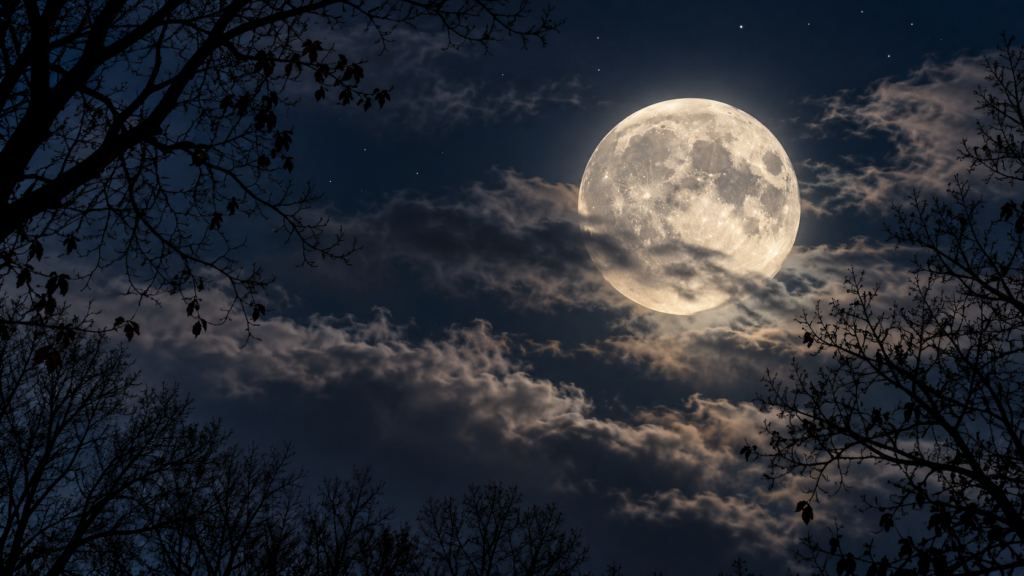
As Halloween season brings more attention to full moons and their associated folklore, it’s worth examining one of the most persistent and widely believed pieces of weather- and behavior-related folklore: the idea that a full moon measurably influences human behavior, emergency room visits, crime rates, and even weather patterns. This belief has remarkably deep cultural roots—the word “lunacy” itself derives from “luna,” the Latin word for moon—but the actual evidence behind it is considerably weaker than the persistence of the belief would suggest.
Myth: Full Moons Increase Emergency Room Visits and Crime
This is perhaps the most commonly cited version of full moon folklore, frequently repeated by police officers, emergency room staff, and others who work in fields where a belief in “full moon effects” has become something of an occupational tradition. However, numerous rigorous studies examining hospital admission data, emergency room visits, and crime statistics have consistently failed to find a statistically significant correlation between full moon phases and increases in these events.
This persistent belief despite the lack of supporting evidence is a well-documented example of confirmation bias: because people expect full moon nights to be unusually chaotic, unusual incidents that occur during a full moon are more likely to be noticed, remembered, and attributed to the moon, while equally chaotic incidents occurring during other moon phases don’t receive the same memorable framing, creating a skewed impression of correlation that doesn’t hold up when actual data is examined systematically.
Myth: Full Moons Affect Human Behavior Through Gravitational Pull
Some versions of full moon folklore attempt to provide a scientific-sounding mechanism, suggesting the moon’s gravitational influence on the human body—given that the human body is largely water, similar to the oceans the moon’s gravity visibly affects through tides—could explain behavioral changes during a full moon. This explanation doesn’t hold up to scrutiny of the actual physics involved. The moon’s gravitational effect on a body of water requires an enormous mass of water, like an ocean, to produce a measurable tidal effect; the gravitational pull on a much smaller body of water, like the fluid within a single human body, is astronomically weaker and has no meaningful measurable effect.
Additionally, tidal gravitational effects depend on the moon’s phase relative to its distance from Earth and its alignment with the sun, not simply whether the moon appears full from Earth’s perspective—meaning even the gravitational premise itself misunderstands how lunar gravitational influence actually works.
Myth: Full Moons Cause Increased Sleep Disturbances
This particular claim has actually received more genuine scientific attention than most full moon folklore, and the results have been mixed rather than a clean confirmation or denial. A handful of studies have found modest associations between full moon periods and slightly altered sleep patterns—somewhat reduced sleep duration or delayed sleep onset—though other studies attempting to replicate these findings have found no significant effect. Given this inconsistent research record, this particular claim remains genuinely unsettled rather than clearly confirmed or debunked, unlike the crime and emergency room claims, which have much more consistent evidence against them.
Why Full Moons Do Genuinely Affect Some Things
It’s worth noting that full moons do have real, well-established effects on certain phenomena, which may contribute to why the broader folklore persists. Full moons genuinely do produce somewhat higher ocean tides (called spring tides, unrelated to the season) due to the alignment of the sun, moon, and Earth during full and new moon phases. Full moons also provide significantly more natural nighttime illumination than other moon phases, which has documented historical effects on nocturnal wildlife behavior and, in the pre-electric-light era, likely affected human activity patterns and sleep in ways that modern artificial lighting has since largely eliminated.
These genuine, well-documented effects on tides and nighttime illumination may have contributed to the broader cultural association between full moons and unusual events, even though the effects don’t extend to the crime, emergency room, and general behavioral claims that constitute most modern full moon folklore.
Why the Myth Persists Despite the Evidence
Full moon folklore benefits from a particularly durable combination of factors: a memorable, visually striking astronomical event that people can easily observe and track, genuine (if narrow) associated effects on tides and illumination that lend some superficial credibility to broader claims, and the confirmation bias dynamic where people selectively notice and remember events that confirm their existing expectations while overlooking the many full moons that pass without any notable increase in unusual behavior.
A Beautiful Astronomical Event, Without the Behavioral Powers
The full moon remains a genuinely striking sight worth appreciating on its own merits, and its real, measurable effects on ocean tides and nighttime illumination are interesting enough without needing to attribute additional behavioral or weather-related powers that the available evidence simply doesn’t support. As Halloween approaches and full moon folklore inevitably resurfaces, it’s a good moment to appreciate the moon for what it actually does, rather than the considerably more dramatic effects popular belief has long attributed to it.