A Holiday Weekend Under a Dome of Polluted Air
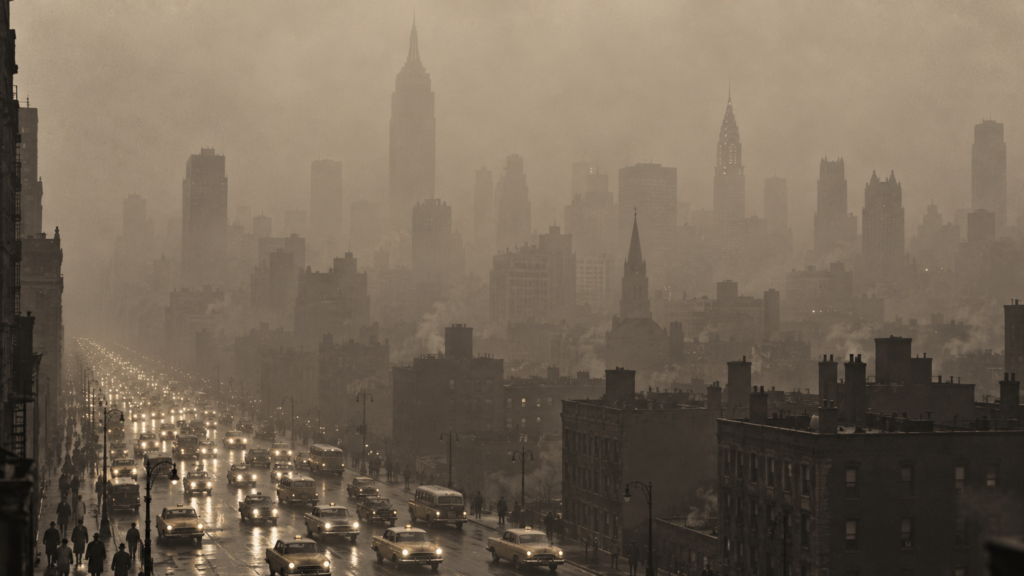
In late November 1966, a heavy layer of smog settled over New York City and stayed through the Thanksgiving holiday weekend. For several days, the air turned hazy and acrid, eyes watered, and people with heart and lung conditions struggled to breathe. A later analysis estimated that the episode contributed to roughly 170 more deaths than would normally have been expected during that period, making it one of the worst air pollution events in American history.
The smog didn’t come from a storm. It came from the absence of one, and the way calm, stable weather can trap whatever a city puts into its air.
The Weather Behind It: A Temperature Inversion
Under normal conditions, air near the ground is warmer than the air above it, and warm air rises, carrying pollutants upward where they can disperse. During a temperature inversion, that arrangement is reversed. A layer of warmer air sits above cooler air near the surface, acting like a lid. The cool air below is denser and doesn’t rise, so there’s little vertical mixing, and anything released into it stays close to the ground.
In November 1966, a large high-pressure system settled over the Northeast, bringing light winds and a strong inversion. With little wind to sweep pollutants away and no rising air to disperse them, emissions from the city built up day after day.
What Was in the Air
New York in the 1960s released enormous quantities of pollution. Buildings burned coal and heavy oil for heat, municipal incinerators burned trash, power plants and industrial facilities operated inside and around the city, and traffic added exhaust. Under the inversion, concentrations of pollutants like sulfur dioxide and fine particles climbed to hazardous levels, creating the dense, irritating haze.
Officials issued warnings, asked residents and businesses to cut back on burning and other polluting activities, and took temporary steps such as limiting the use of incinerators. The weather finally changed when a shift in the wind and the arrival of a new air mass broke up the inversion and cleared the air.
Counting the Cost
Counting deaths from air pollution is difficult, because people don’t die with a label that says “smog,” and the effects often come through worsened heart and respiratory illness. Researchers who later studied death records for the period found an increase in mortality during the smog compared with similar days, and estimated that about 170 additional deaths occurred. The most vulnerable were older adults and people with existing heart and lung disease.
Part of a Larger Story
The 1966 episode was one in a series of air pollution disasters that shaped public attitudes in the mid-twentieth century. In 1948, a smog trapped by an inversion in Donora, Pennsylvania, sickened thousands of residents and killed about 20. In 1952, a similar event in London was linked to thousands of deaths and prompted Britain to pass its Clean Air Act. In each case, an inversion and still air held pollution in place and turned an everyday environmental problem into an emergency.
A Turning Point for Air Quality
The New York smog added to growing public concern in the United States about the health effects of air pollution. In the years that followed, federal legislation strengthened air quality rules, including the Air Quality Act of 1967 and the landmark Clean Air Act of 1970, which established national air quality standards and a framework for enforcing them. Cities and states, New York among them, tightened rules on burning fuels, incinerators, and industrial emissions, and the shift away from coal and heavy oil for heating helped improve conditions over time.
Air quality monitoring and public alerts also became more routine. Today, air quality forecasts and index readings, which warn people when conditions are unhealthy, are a direct descendant of the recognition that weather and pollution can combine into a health emergency.
Why It Still Matters
The 1966 smog is a reminder that weather and air quality are linked. Calm, stable conditions with a temperature inversion can trap pollutants close to the ground in any city, even though the sources of pollution have changed and many of the worst offenders have been cleaned up. Modern smog episodes, whether in valleys that trap cold air or in cities under stagnant high pressure, follow the same basic physics. Understanding the connection is one reason forecasters now include air quality information alongside temperature and precipitation.