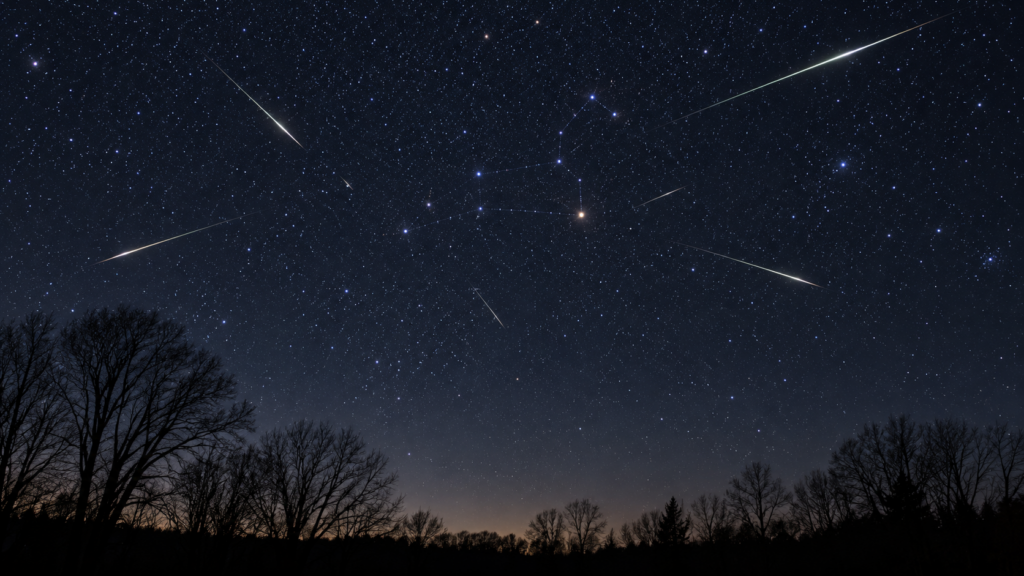
A November Meteor Shower With a Reputation
Each year in mid-November, Earth passes through a stream of debris left behind by a comet, and the result is the Leonid meteor shower, which peaks around November 17 and 18. In a typical year, the Leonids are a modest shower, producing perhaps 10 to 15 visible meteors per hour under dark skies. But this shower has a history unlike almost any other, because every few decades it has produced a meteor storm so intense that it changed how people understood shooting stars.
Where the Meteors Come From
The Leonids come from comet Tempel-Tuttle, which orbits the sun about every 33 years. As the comet swings through the inner solar system, the sun’s heat causes it to shed dust and small bits of ice and rock. Over time, this debris spreads out along the comet’s orbit, forming a long stream of particles. When Earth crosses this stream each November, the particles slam into the upper atmosphere and burn up in streaks of light.
The shower is named for the constellation Leo, because the meteors appear to radiate outward from a point in that part of the sky, a perspective effect similar to the one seen in other showers.
Among the Fastest Meteors
The Leonids are known for their speed. The particles strike Earth’s atmosphere head-on, nearly opposite to Earth’s own motion, at around 70 kilometers per second, which is roughly 44 miles per second. That’s faster than most other meteor showers, and it means that Leonid meteors are often bright and leave glowing trails, called persistent trains, that can linger for a second or more after the meteor itself has vanished.
When the Leonids Became a Storm
The shower’s fame comes from the occasions when Earth passes through an especially dense clump of debris, usually shortly after the comet itself has made a close pass. In November 1833, observers across North America witnessed one of the most remarkable displays in recorded history, with meteors falling so thickly that some people described it as a rain of fire. The event is credited with helping launch the modern scientific study of meteors, as researchers realized the shower was connected to a particular point in the sky and recurred at predictable intervals.
Storms recurred in 1866 and again in 1966, when observers in parts of the United States reported tens of thousands of meteors per hour for a short time. More recently, in the early 2000s, several years of enhanced activity delighted observers worldwide, with some peaks of thousands of meteors per hour.
Why Storms Are So Hard to Predict
Predicting meteor storms is genuinely difficult. The debris trails from the comet are narrow and tend to be pulled slightly off course by the gravity of planets over time, so whether Earth crosses a dense part of the stream in a given year depends on the exact positions of the trails and the planet. Scientists have made substantial progress in modeling the trails, and predictions in the early 2000s were broadly successful, but forecasts remain uncertain.
The comet’s most recent pass by the sun was in 1998, and in the years since, Earth has not encountered a major storm. In typical years, the shower returns to its normal, modest level.
Getting the Best View
Meteor watching is simple. Find a place away from city lights with a wide view of the sky, and give your eyes at least 20 to 30 minutes to adjust to the dark. No telescope or binoculars are needed. The Leonids tend to be most active after midnight, when the side of Earth you’re on is facing forward in its orbit, into the direction of the debris stream. Dress warmly, since November nights can be cold, and bring a reclining chair or blanket.
The brightness of the Moon matters. A bright Moon in the sky can wash out fainter meteors, so check the phase and rise time of the Moon for the night you plan to watch. Cloud cover is the other major factor, so look at a nighttime cloud forecast before heading out.
Looking Up
Even in an ordinary year, a Leonid shower offers a chance to watch some of the fastest, brightest meteors of the season and to connect with a shower that has shaped the history of astronomy. And because the tracks of comet debris are always shifting, there’s always a chance that a given year will bring more than expected.