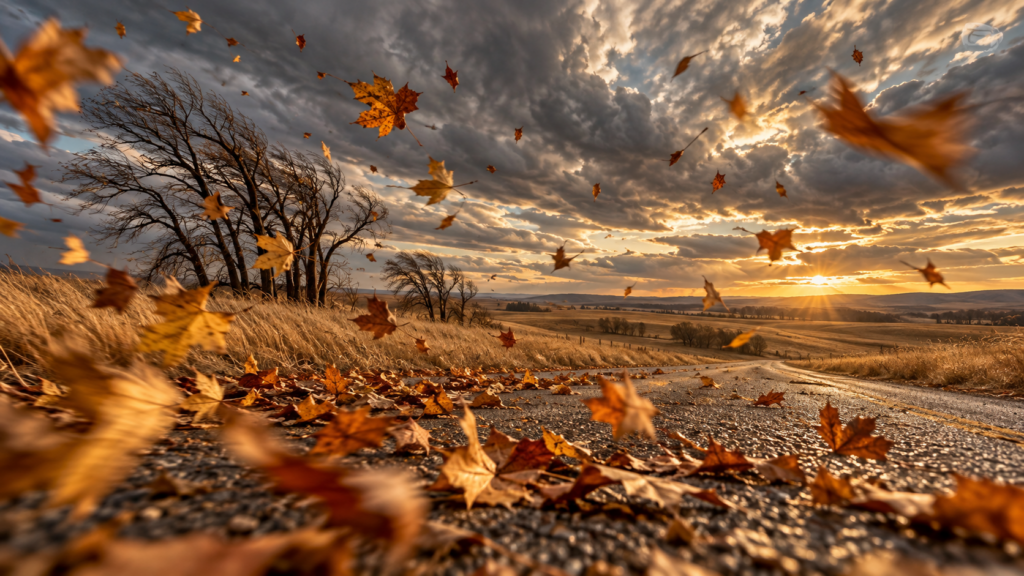
A Season of Gusts and Swirling Leaves
If it feels like the wind picks up every November, you’re not imagining it. In much of the country, late fall and early winter bring some of the year’s strongest and most persistent winds, from the gusty afternoons that scatter leaves across lawns to the howling nights that rattle windows. The explanation comes down to a few big changes in the atmosphere that arrive at the same time.
Wind Is Air Moving Down a Pressure Gradient
At its simplest, wind is air moving from areas of higher pressure toward areas of lower pressure, and the bigger the pressure difference over a given distance, the stronger the wind. Meteorologists call this change in pressure across distance the pressure gradient. When a high-pressure system sits close to a low-pressure system, the isobars, the lines of equal pressure on a weather map, crowd together, and the winds between them intensify.
So the question becomes why pressure gradients tend to sharpen in late fall.
Bigger Temperature Contrasts Drive Stronger Systems
The engine behind most weather in the middle latitudes is the temperature difference between cold polar air and warm tropical air. In summer, that contrast is relatively modest. As autumn progresses, the Arctic cools quickly while the tropics stay warm, and the gap widens.
A stronger temperature contrast intensifies the jet stream, the fast river of air high above the surface, and fuels more vigorous low-pressure systems. These storms and the cold fronts trailing them create tighter pressure gradients, and the result is stronger winds. This is the same seasonal shift that makes late fall a time of more frequent, more powerful storms.
More Storms, More Fronts, More Wind
With the jet stream in a more active position, low-pressure systems arrive more often. Each one brings a passing cold front, and the frontal passage is often accompanied by a burst of strong, gusty winds as colder air surges in behind it. On many November days, the wind shifts and strengthens when a front moves through, then settles down until the next system approaches.
Because these systems follow one another in quick succession, the windy periods can feel nearly constant, particularly in open areas like the Great Plains and the Great Lakes region.
Daytime Mixing Brings Strong Winds to the Ground
Winds are generally stronger higher in the atmosphere, where there’s less friction from the ground. During the day, sunshine heats the surface and the air near it, and that warming creates turbulence that mixes the lower atmosphere. This mixing pulls faster-moving air from aloft down toward the surface, which is why wind gusts often peak in the afternoon.
Even though the sun is weaker in November, this mixing still works on sunny days, and when a strong system is passing, the stronger winds aloft are especially effective at reaching the ground. At night, the air near the surface tends to stabilize and decouple from the faster flow above, so winds often ease after sunset, unless a storm system is driving them.
Bare Trees Mean Less Friction
There’s a smaller contributing factor as well. When trees lose their leaves, the landscape becomes smoother from the wind’s point of view. A leafless forest offers less resistance to airflow than a fully leafed one, so winds near the surface can be slightly stronger than they would be in summer under the same large-scale conditions. This effect is modest compared with the influence of the big weather systems, but it contributes to the feel of a wide-open, windswept landscape.
What About the Windy City?
Chicago’s famous nickname is often assumed to refer to its weather, but the origin is debated and may have more to do with the city’s talkative politicians and boosters. The Great Lakes region does see strong winds in fall and winter, but cities such as Wichita, Amarillo, and Great Falls often record higher average wind speeds than Chicago does.
Preparing for Windy Weather
Strong winds are more than a nuisance. They can bring down tree limbs, knock out power, and make driving difficult for high-profile vehicles. Securing outdoor furniture and decorations, checking for dead or weakened limbs near the house, and keeping an eye on wind advisories in the forecast are sensible habits for the season ahead.
A Predictable Feature of the Season
The wind that picks up in November is the result of a sharper contrast between warm and cold air masses, a more active jet stream, and the mixing of faster winds down to the surface. Understanding the cause won’t calm a gusty afternoon, but it helps explain why this stretch of the calendar so reliably feels breezy and why it tends to keep getting windier as the cold season approaches.