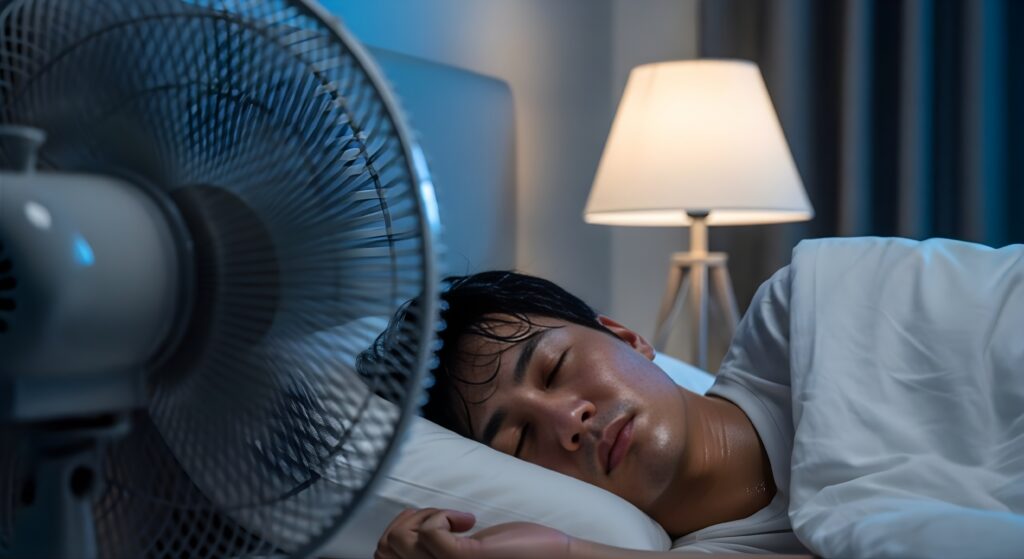
May Nights Are Getting Warmer. Your Sleep Is Noticing.
Sleep that was solid through the cool nights of March and April starts to fragment in May. You wake more often, feel less rested despite adequate hours in bed, and notice that the bedroom that felt comfortable a few weeks ago now feels stuffy and too warm. This isn’t insomnia in the clinical sense — it’s a direct physiological response to rising nighttime temperatures, driven by one of the most fundamental mechanisms of human sleep.
Understanding what happens to your body temperature during sleep, and why warm ambient temperatures interfere with that process, explains why hot nights feel so much worse than hot days for overall wellbeing — and points toward interventions that go beyond simply adjusting the thermostat.
The Body Must Cool Down to Fall Asleep
The connection between body temperature and sleep is one of the most robust findings in sleep science: falling asleep requires a drop in core body temperature, and staying in deep sleep requires maintaining that lowered temperature through the night.
In the hours before sleep, the body initiates a process called distal vasodilation — blood vessels in the hands and feet widen, allowing heat to radiate outward from the skin surface. This heat loss from the extremities drives a drop in core body temperature of approximately 1°F to 2°F from the daytime peak. This cooling is not a consequence of falling asleep — it is a prerequisite. The temperature drop signals the brain that it’s time to sleep, triggering the cascade of hormonal and neurological changes that initiate sleep onset.
During the night, core body temperature continues falling, reaching its minimum in the early morning hours — typically around 4 a.m. to 5 a.m. — before beginning to rise again as the body prepares for waking. The deepest, most restorative sleep stages — slow-wave sleep and the first REM cycles — occur during the period of lowest core temperature. The brain performs its most important consolidation and restoration work precisely during this window of maximum thermal depression.
When the ambient temperature is too warm, this entire sequence is disrupted. The body cannot effectively radiate heat from the skin surface into already-warm air, the core temperature drop that initiates and sustains deep sleep is blunted, and sleep architecture shifts toward lighter stages that provide less restoration.
What Warm Nights Do to Sleep Architecture
Sleep is not a uniform state. It cycles through distinct stages — light NREM sleep, deep slow-wave sleep, and REM sleep — in roughly 90-minute cycles throughout the night, with each stage serving specific restorative functions.
Slow-wave sleep, sometimes called deep sleep or Stage 3 NREM, is the most physically restorative stage: tissue repair, immune function, and growth hormone secretion all peak during slow-wave sleep. It predominates in the first half of the night and is the stage most sensitive to thermal disruption. When bedroom temperatures are elevated, slow-wave sleep time decreases measurably — research has documented reductions in slow-wave sleep at temperatures above 75°F compared to the optimal sleeping range of 65°F to 68°F.
REM sleep — the stage most associated with memory consolidation, emotional processing, and dreaming — is also temperature-sensitive, though for a different reason. During REM sleep, the brain temporarily suspends the body’s normal thermoregulatory mechanisms, relying entirely on the ambient environment to maintain temperature. In a warm environment, this means body temperature can rise during REM periods, which the brain responds to by shortening or fragmenting REM episodes. This reduction in REM time impairs the memory consolidation and emotional regulation that REM sleep provides.
The practical result of these disruptions is sleep that provides inadequate physical restoration and impaired cognitive processing — leaving people who sleep in warm rooms feeling tired, emotionally reactive, and mentally foggy even after a full night in bed.
Why Humidity Compounds the Problem
Temperature alone makes sleep harder. Humidity makes it dramatically worse through the same mechanism that makes exercise harder in humid conditions: impaired evaporation.
The body dissipates heat during sleep primarily through radiation from skin surfaces and through sweating. In dry conditions, sweat evaporates efficiently, removing heat and helping maintain the cooler core temperature that deep sleep requires. In humid conditions, sweat cannot evaporate into already-saturated air and instead remains on the skin surface as uncomfortable dampness that provides no cooling benefit.
This is why a 72°F night at 80 percent humidity produces significantly worse sleep than a 72°F night at 40 percent humidity, despite identical temperatures. The effective cooling available to the body in the humid condition is substantially less, core temperature remains higher, and sleep architecture is disrupted proportionally.
May’s rising humidity — dew points climbing from the low 40s of March toward the mid-50s and 60s of late spring — means that the ambient conditions for sleep are deteriorating on two fronts simultaneously: warmer temperatures and higher humidity are both moving in the wrong direction for sleep quality through the month.
The Optimal Sleeping Environment
Sleep research consistently identifies an optimal bedroom temperature range of 65°F to 68°F for most adults, with some individual variation — older adults and people with certain metabolic conditions may prefer slightly warmer conditions, while others sleep best at the cooler end of the range or below it.
The research on humidity and sleep is less precisely quantified, but the general principle is clear: lower humidity within the normal indoor range (30 to 50 percent relative humidity) supports better sleep than higher humidity by allowing more effective evaporative cooling.
Achieving these conditions in May requires active management as outdoor temperatures and humidity rise. Air conditioning is the most effective tool, capable of controlling both temperature and, to some extent, humidity simultaneously. For those without air conditioning or seeking to minimize its use, several complementary strategies can approximate the conditions that support good sleep.
Practical Interventions Beyond the Thermostat
Cooling the body before bed. A warm shower or bath 60 to 90 minutes before sleep accelerates the distal vasodilation process — the skin’s blood vessels dilate in response to the warm water, and as the body cools afterward, heat loss from the skin surface is enhanced. Counterintuitively, a warm shower before bed produces better sleep than a cold one, because the rapid cooling after the warm shower accelerates the core temperature drop that initiates sleep. A cold shower provides brief cooling but doesn’t trigger the same vasodilation response.
Sleeping with extremities uncovered. Because heat loss occurs primarily through the hands and feet during sleep, keeping these areas uncovered — even if the torso is under a light sheet — maximizes the body’s ability to radiate heat and supports the core temperature drop that deep sleep requires. Many people find that keeping feet outside the covers on warm nights noticeably improves sleep comfort without needing to lower the room temperature further.
Cooling the sleep surface. The mattress and bedding in contact with the body trap heat. Switching to moisture-wicking, breathable bedding — natural fibers like cotton and linen generally perform better than synthetics in warm conditions — reduces heat accumulation at the sleep surface. Cooling mattress pads that circulate chilled water or use phase-change materials are more expensive options but produce measurable improvements in sleep quality in warm conditions.
Strategic ventilation timing. As covered in the spring cleaning piece, the coolest outdoor air of the day occurs in the early morning hours just before sunrise. Opening windows in the hour before sunrise and closing them once outdoor temperatures begin rising traps cooler air in the bedroom for as long as possible through the morning. Running a fan to exhaust warm indoor air and draw in cool outdoor air during this window can drop bedroom temperature by several degrees.
Sleeping lower in the house. Hot air rises, and bedrooms on upper floors of a house are consistently warmer than ground-floor rooms. During heat waves or persistently warm May nights, sleeping on a lower floor — even temporarily on a couch or air mattress — can provide meaningfully cooler sleeping conditions without any change in HVAC settings.
The Cumulative Effect
Individual warm nights produce noticeable but recoverable sleep impairment. The more significant concern is the cumulative effect of weeks of marginally disrupted sleep — the gradual accumulation of slow-wave and REM sleep deficits that builds through May and June as nights stay progressively warmer.
This cumulative sleep debt produces effects that can be difficult to attribute to sleep specifically: increasing irritability, declining cognitive performance, reduced exercise recovery, and blunted immune function. People experiencing these effects in late spring often attribute them to stress, allergies, or the demands of a busy season without recognizing that the warm nights of May are quietly eroding their sleep quality night after night.
Treating the sleep environment as a serious health variable — not just a comfort preference — and making the adjustments to maintain adequate sleep conditions through the warming months is one of the more impactful and underappreciated health interventions available in spring and early summer.