A Seasonal Shift in the Sky Itself
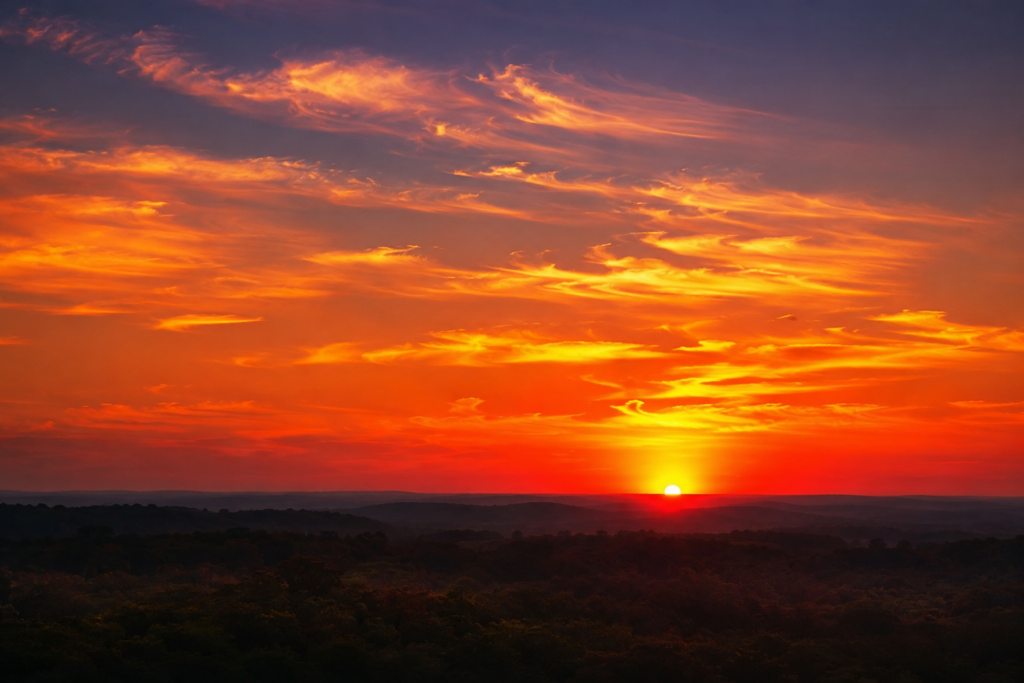
If sunsets have seemed especially striking lately—deeper oranges, richer reds, sometimes an almost glowing quality low on the horizon—there’s real atmospheric science behind it. Late summer brings a specific combination of humidity, atmospheric particles, and sun angle that consistently produces more vivid sunset color than many other times of year, and understanding the mechanism explains exactly what’s happening in the sky each evening.
It All Starts With Scattered Light
Sunset colors are a product of a phenomenon called Rayleigh scattering, the same effect responsible for the sky’s blue color during the day. Sunlight contains the full visible spectrum, but as it travels through the atmosphere, shorter wavelengths of light—blues and violets—scatter more easily off air molecules than longer wavelengths like orange and red. During the day, when sunlight travels a relatively short path through the atmosphere to reach your eyes, this scattering makes the sky appear blue, since scattered blue light reaches your eyes from all directions.
At sunset, the sun’s light has to travel a much longer path through the atmosphere—up to 40 times longer than at midday—because of the low angle the sun makes with the horizon. Over that much longer path, most of the blue and violet light scatters away before it ever reaches your eyes, leaving primarily the longer, warmer wavelengths—oranges and reds—to make it through directly. This is the baseline mechanism behind every sunset, but it doesn’t fully explain why some sunsets are dramatically more vivid than others.
Humidity and Haze Add Fuel to the Effect
Beyond the basic scattering that happens on any clear evening, additional particles suspended in the atmosphere—water droplets, dust, pollen, and various aerosols—scatter and reflect light in ways that can intensify sunset color considerably. Late summer air tends to carry more of these particles than many other seasons, partly due to elevated humidity supporting more suspended moisture, and partly due to increased dust, pollen, and particulate matter kicked up by agricultural activity, wildfire smoke transported from distant fires, and general late-summer atmospheric haze.
This additional scattering material acts almost like a filter, further emphasizing the warm wavelengths already dominating the low-angle sunlight, which is part of why late-summer sunsets often display a more saturated, sometimes almost luminous quality compared to the crisper, cooler-toned sunsets typical of drier, clearer seasons like autumn or winter.
Wildfire Smoke Can Produce the Most Dramatic Displays
One of the more striking contributors to vivid late-summer and early-fall sunsets is smoke transported from wildfires, sometimes originating thousands of miles away. Fine smoke particles are especially effective at scattering light in ways that intensify red and orange tones, and significant wildfire smoke events have historically produced some of the most vivid, almost otherworldly sunset displays on record, even in regions far removed from the fires themselves.
This is why sunset intensity can sometimes serve as an informal, indirect indicator of smoke or particulate transport happening well outside your immediate area—an especially deep, saturated sunset on an otherwise unremarkable evening sometimes reflects atmospheric conditions originating hundreds or even thousands of miles upwind.
Cloud Height and Structure Shape the Display
The clouds present during a given sunset also play a significant role in how the color actually appears. High, thin cirrus clouds tend to produce some of the most vivid sunset displays, since their altitude allows them to catch and reflect sunlight even after the sun itself has dropped below the horizon from a ground observer’s perspective, extending and often intensifying the display. Lower, thicker clouds can block this effect entirely or produce more muted, diffuse coloring depending on their density and how much direct light manages to pass through or reflect off their undersides.
A sky with scattered high clouds and a relatively clear path toward the horizon in the sunset direction tends to produce the most reliably vivid displays, since it combines an unobstructed path for the reddened light with cloud surfaces positioned to catch and reflect that light back toward the ground.
The Sky’s Version of Late-Summer Character
The vivid sunsets that tend to characterize this stretch of the calendar aren’t a coincidence or simply a matter of noticing more because the season feels contemplative—they’re a genuine product of the specific combination of humidity, particulate load, and sun angle that late summer atmospheric conditions consistently produce. Understanding the mechanism doesn’t make the display any less striking, but it does explain why this particular stretch of the year tends to deliver some of the most reliably memorable evening skies.