A Winter Chore That’s Easy to Get Wrong
The first icy morning of the season tends to arrive before anyone has restocked the garage, and the bag of ice melt that gets grabbed in a hurry isn’t always the right one for the job. Different de-icers work at different temperatures, affect concrete and landscaping differently, and carry different risks for pets. Sorting this out now, while it’s calm and the shelves are full, makes the first freeze far less of a scramble.
How De-Icers Actually Work
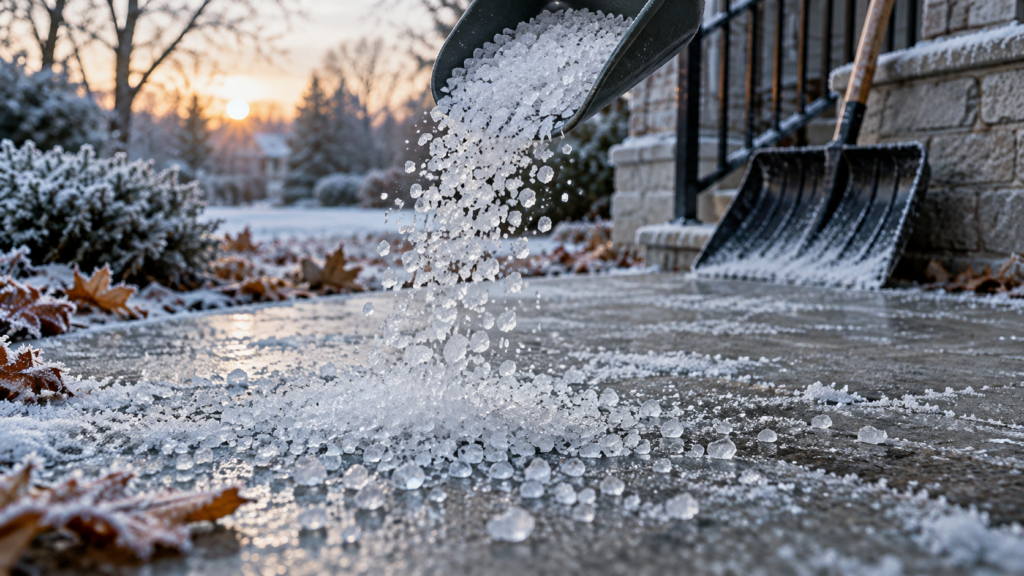
Ice melt products don’t warm the ice. They lower the freezing point of water, so the ice and snow turn to liquid brine at temperatures where plain water would stay frozen. Every product has a practical lower limit, and below it, the product stops being effective no matter how much you spread. That limit is the most useful number to check on the label.
Comparing the Common Options
Rock salt, or sodium chloride, is the cheapest and most widely available choice. It works reasonably well until temperatures fall to about 15 degrees Fahrenheit, then loses effectiveness quickly. It can also harm nearby grass and shrubs, and it’s rough on metal and on some masonry.
Calcium chloride is effective at much lower temperatures, down to about minus 25 degrees, and works faster because it releases heat as it dissolves. It costs more and can still irritate skin and damage plants if overused.
Magnesium chloride works down to roughly 5 degrees and is often considered gentler on plants and concrete than rock salt, though it isn’t harmless in large amounts. Products that blend several of these ingredients try to balance cost and cold-weather performance.
Sand and similar gritty materials don’t melt anything. They add traction, which can be valuable on very cold days when chemical de-icers stop working, but they need to be swept up in spring and can clog drains.
Protecting Concrete and Hardscape
Freezing and thawing already stresses concrete, and de-icers can make that worse by encouraging more melting and refreezing cycles on the surface. Concrete that is less than a year old is especially vulnerable, since it hasn’t fully cured, and many manufacturers advise avoiding de-icing chemicals on new concrete during its first winter. Sealing existing concrete walkways and driveways with a quality concrete sealer before the weather turns can reduce water absorption, which is the root of much freeze damage.
Pavers, natural stone, and decorative surfaces vary in how well they tolerate different products, so check the manufacturer’s guidance for yours.
Timing and Technique Matter as Much as the Product
The most effective approach is to shovel first and treat second. Removing as much snow as possible means you need far less product, and the de-icer works on the thin layer that remains. Spreading it on top of deep snow wastes material and tends to produce slush that refreezes.
Applying a small amount before a storm arrives, sometimes called anti-icing, can keep ice from bonding to the pavement in the first place, making later shoveling much easier. More isn’t better: a light, even scattering works as well as a heavy pile, and extra product only increases runoff, plant damage, and cost.
Thinking About Pets, Plants, and Runoff
Many de-icers can irritate paws and cause stomach upset if licked, and some are more harmful than others. Look for products labeled as pet-friendly if animals will be crossing treated areas, and wipe paws after walks. Keep bags stored where pets and children can’t reach them.
Runoff carries these chemicals into lawns, garden beds, and storm drains, so consider keeping products away from the edges of planting beds and using the smallest effective amount.
Other Prep Worth Doing Now
Stock up on a snow shovel in good condition, and check that handles and blades are sound. Note where downspouts discharge, since water that drains across a walkway and refreezes is a common source of dangerous ice. Redirecting a downspout or extending it away from the path can prevent a recurring problem all winter.
A Small Stockpile That Pays Off
A single trip to buy the right de-icer, along with a decent shovel and a bag of sand for the coldest days, covers most of what a winter will throw at a walkway. Doing it before the first freeze means fewer slips, less damage to concrete and plants, and one less thing to deal with on a cold, icy morning.