A Genuine Puzzle Hiding in Plain Sight
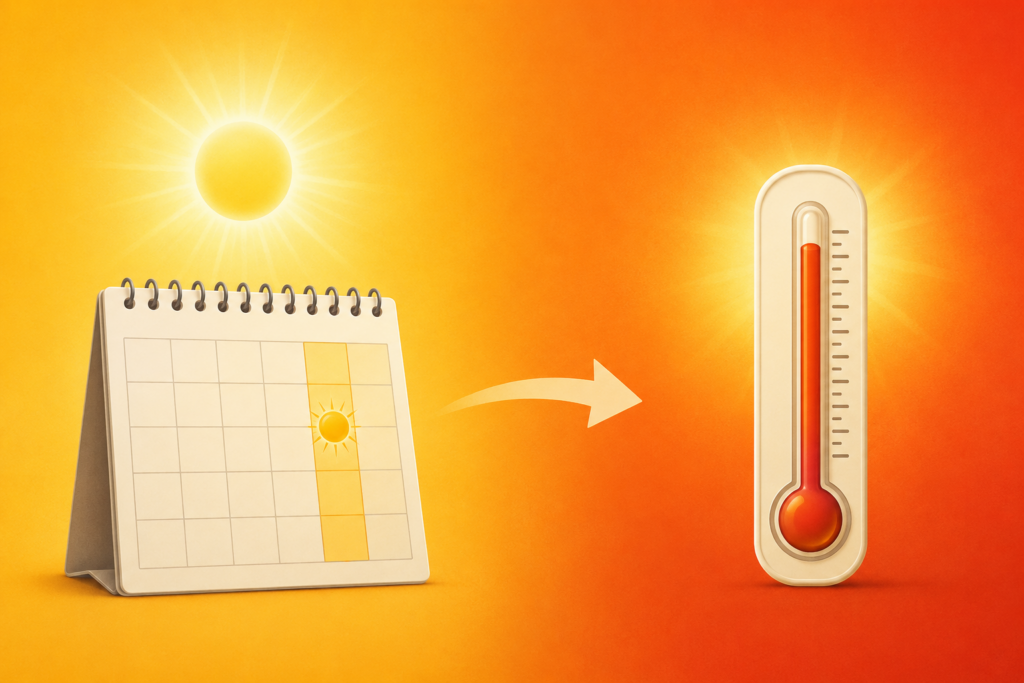
The summer solstice arrives in late June, delivering the year’s longest day and the most direct, intense sunlight the Northern Hemisphere receives all year. And yet for most of the United States, the hottest days of summer typically arrive not in June, but in late July and August—sometimes a full six to eight weeks after the sun’s peak intensity has already passed. This delay, often called seasonal lag or thermal lag, is one of the more counterintuitive patterns in ordinary weather, and understanding it explains a lot about why late summer feels the way it does.
The Sun’s Energy and the Ground’s Temperature Aren’t the Same Thing
The core of the puzzle is a distinction between the amount of solar energy arriving at Earth’s surface and the actual temperature that energy produces. These two things track together roughly, but not precisely, because temperature depends not just on how much energy is arriving each day, but on the balance between energy coming in and energy already stored up from previous days, weeks, and months.
At the summer solstice, incoming solar energy is at its yearly maximum. But the land, oceans, and atmosphere haven’t yet caught up to that input—they’re still in the process of absorbing and accumulating heat from the weeks of strong sunlight leading up to the solstice. Even as daily incoming energy begins to decline slightly after the solstice, it’s still arriving in large enough quantities that the overall system keeps gaining heat faster than it loses it, and temperatures continue climbing for weeks afterward.
Water Is the Slowest-Warming Part of the System
Water has an unusually high heat capacity, meaning it takes a large amount of energy to raise its temperature compared to land or air. Oceans, lakes, and even soil moisture absorb enormous quantities of solar energy throughout late spring and early summer, but they release and reflect that heat back into the surrounding air only gradually, over a period of weeks.
This is why coastal and lake-adjacent regions often experience their warmest water temperatures—and the humid, oppressive air masses that come with them—well after the solstice, frequently peaking in August. The same slow-warming property that keeps large bodies of water cooler than the air in spring keeps them warmer than the air in early autumn, extending the warm-air influence they provide well past the point of peak sunlight.
Land Warms Faster, But the Atmosphere Still Takes Time to Catch Up
Land surfaces warm and cool much faster than water because they hold far less heat capacity, which is part of why daily temperature swings are sharper away from large bodies of water. But even land-dominated regions experience thermal lag, because the atmosphere as a whole—not just the ground directly beneath the sun—needs time to accumulate the heat that produces sustained hot weather.
Air masses that settle over a region carry heat that has built up over days or weeks of persistent warm weather elsewhere. High-pressure systems that produce the multi-day heat waves typical of late summer often draw on air that has been warming for an extended stretch, compounding the direct effect of any single day’s sunshine with the accumulated warmth of the preceding weeks.
Why This Matters for How You Experience Late Summer
Understanding thermal lag explains several things that otherwise seem odd: why swimming conditions in lakes and oceans are often best in August rather than June, even though June has more daylight; why the year’s most intense, prolonged heat waves cluster in late July and August rather than immediately after the solstice; and why the transition into genuinely hot weather often feels gradual and cumulative rather than tied to any single dramatic shift in the calendar.
The sun’s energy input peaked weeks ago, but the systems that translate that energy into the temperatures you actually feel—oceans, soil, and the broader atmosphere—are still catching up, and typically don’t finish catching up until well into what already feels like the depths of summer.
The Hottest Stretch Is Still the System Settling Its Account
Thermal lag is a reminder that weather doesn’t respond instantly to astronomical events. The solstice marks a peak in incoming solar energy, but the temperatures that follow are the result of an extended accumulation process that takes the better part of two months to fully play out. If August feels like the true peak of summer’s intensity, that’s not a coincidence or an exception to how the seasons work—it’s exactly what the physics of heat accumulation predicts.