A Catastrophe That History Largely Forgot
On the night of October 8, 1871, a wildfire swept through the small logging town of Peshtigo, Wisconsin, and the surrounding forest region, killing an estimated 1,200 to 2,500 people in a matter of hours—making it, by a wide margin, the deadliest wildfire in American history. That same night, the Great Chicago Fire broke out roughly 250 miles away, and the more famous urban disaster, occurring in a major city with far greater press coverage, has overshadowed Peshtigo in public memory ever since, despite Peshtigo’s dramatically higher death toll.
A Landscape Primed for Catastrophe
The upper Midwest had experienced an unusually severe drought throughout the summer and fall of 1871, leaving the region’s extensive forests and the logging debris scattered throughout them exceptionally dry. Peshtigo sat in the heart of an active logging region, and the practice of the era involved leaving substantial quantities of cut timber debris—branches, sawdust, and discarded wood—scattered across the landscape after harvesting, creating an enormous reservoir of dry, highly combustible fuel throughout the surrounding forest.
Small fires, some deliberately set to clear land for agriculture or logging operations, were common and generally considered manageable during this period. But the combination of severe drought and an approaching weather system would transform what might have remained scattered, containable fires into something categorically different.
A Cold Front That Turned Fire Into a Firestorm
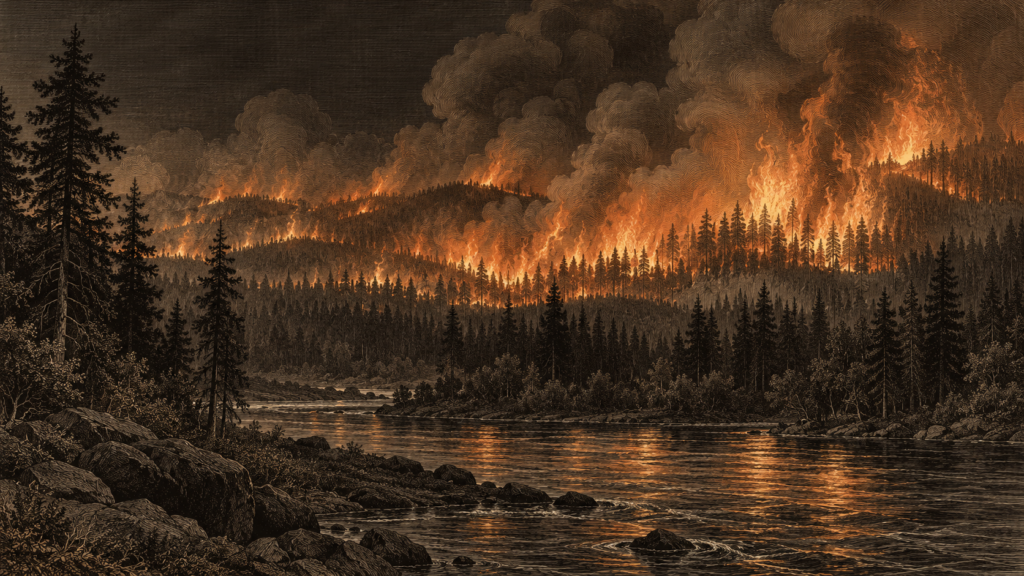
On October 8, a cold front moved through the region, and the strong, gusty winds associated with its passage are believed to have rapidly intensified numerous existing small fires, merging them into a single massive firestorm. Firestorms represent an extreme fire behavior category distinct from ordinary wildfire: the fire becomes large and hot enough to generate its own powerful winds, drawing in surrounding air with such force that it creates a self-sustaining, increasingly intense cycle of combustion, essentially generating its own weather system.
Witness accounts described winds strong enough to uproot trees and hurl flaming debris significant distances ahead of the main fire front, igniting new fires far beyond where the fire’s direct spread would otherwise have reached. Some survivor accounts describe what sounded like a tornado or a freight train immediately preceding the fire’s arrival, consistent with the kind of violent, self-generated wind patterns a genuine firestorm can produce.
A Death Toll That Reflects the Fire’s Speed and Ferocity
The fire’s extraordinarily high death toll relative to its geographic scope reflects both its terrifying speed and the limited options available to residents caught in its path. Many victims died attempting to flee, overtaken by a fire moving faster than they could outrun. Others sought refuge in the Peshtigo River itself, standing in the water for hours as the fire raged on both banks, and even this desperate measure didn’t guarantee survival, as the intense heat radiating from the firestorm reportedly caused some deaths even among those submerged in the river.
The town of Peshtigo itself was almost completely destroyed, along with numerous surrounding communities, and the fire’s reach extended across a substantial area of northeastern Wisconsin and into Michigan’s Upper Peninsula, making it not just deadly but geographically extensive as well.
Why Chicago Overshadowed a Deadlier Disaster
The Great Chicago Fire, which broke out the same night, killed a far smaller number of people—estimates generally range from 250 to 300 deaths—but occurred in a major American city with established newspapers, telegraph infrastructure, and a population capable of documenting and publicizing the disaster extensively. Peshtigo, by contrast, was a remote logging town with limited infrastructure, and communication about the fire’s true scale was significantly delayed, in part because the same fire had damaged telegraph lines in the region.
This disparity in documentation and publicity meant Chicago’s fire became deeply embedded in American cultural memory, while Peshtigo’s substantially higher death toll received comparatively little national attention at the time and has remained less widely known in the century and a half since, despite representing the deadlier of the two same-night disasters by a significant margin.
What Peshtigo Revealed About Fire Behavior
The Peshtigo Fire became an important, if belatedly studied, case in understanding firestorm dynamics and the specific combination of drought conditions, available fuel load, and wind patterns capable of producing fire behavior far more extreme and far faster-moving than ordinary wildfire spread. The disaster contributed to a gradually developing understanding, over subsequent decades, of how logging practices that left extensive debris fuel loads across a landscape could dramatically elevate wildfire risk during drought conditions, influencing forestry and land management practices that developed in the decades that followed.
A Reminder That Scale Doesn’t Always Determine Memory
The Peshtigo Fire stands as a stark example of how a disaster’s place in collective memory doesn’t always correspond to its actual human toll. As America’s deadliest wildfire, it deserves recognition alongside the more famous urban fire that shared its exact date, and understanding the atmospheric and landscape conditions that produced it offers genuine insight into how quickly ordinary fire risk can escalate into catastrophic firestorm behavior when drought, fuel, and wind align in the wrong combination.