An Invisible Factor in Your Heating Costs
As heating season approaches, most homeowners think about their furnace, but insulation—quiet, invisible, and easy to forget about once it’s installed—plays an equally significant role in how much it actually costs to keep a home warm through the coming months. Inadequate or degraded attic insulation is one of the more common, and more fixable, sources of unnecessary heat loss in older homes, and checking it now, before consistently cold weather arrives, gives you time to address any shortfall before it starts costing money.
Why Attic Insulation Matters So Much Specifically
Heat rises, and in a home without adequate attic insulation, a significant proportion of generated heat escapes directly upward and out through the roof rather than staying in the living space where it’s needed. The Department of Energy has estimated that inadequate insulation and air leakage are responsible for a substantial share of the energy loss in a typical home, and attics represent one of the largest single opportunities to address this loss, given how much surface area a roof typically represents relative to a home’s other exterior surfaces.
This is why attic insulation upgrades are consistently cited among the most cost-effective home energy improvements available, often delivering a faster return on investment than many other home efficiency upgrades, since the investment is largely one-time while the energy savings accrue every single heating season going forward.
How to Check Your Current Insulation Level
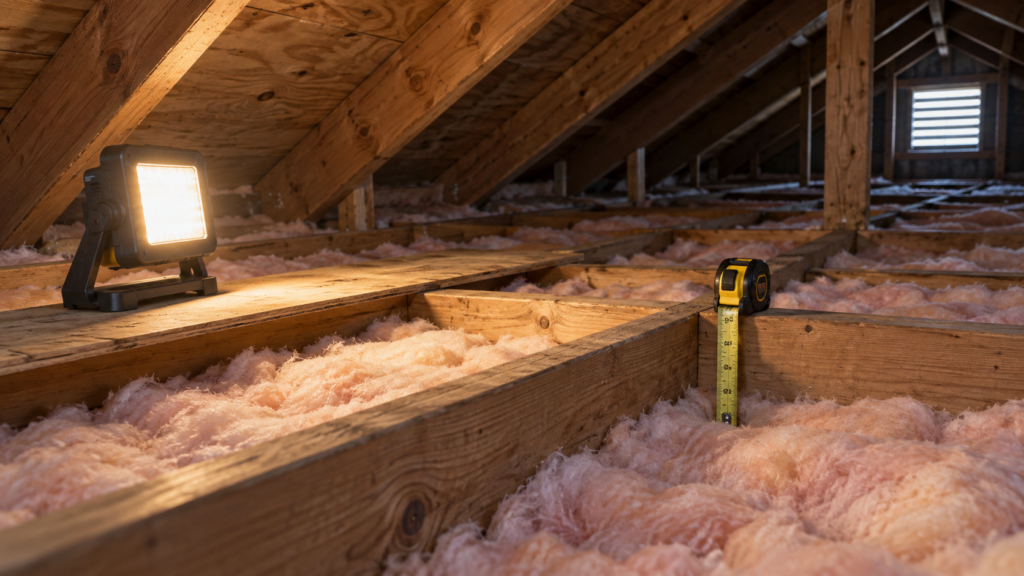
A rough visual inspection can reveal a surprising amount about whether your attic insulation is adequate. If you can see the attic floor joists clearly, with insulation sitting well below the top of those joists, that’s a fairly reliable sign of insufficient insulation depth. Well-insulated attics in most climate zones typically have insulation depth well above the joists themselves, essentially burying them from view.
For a more precise assessment, measuring the actual insulation depth with a ruler or tape measure and comparing it against your region’s recommended R-value (a measurement of insulation’s resistance to heat flow) provides a more concrete answer than visual inspection alone. Recommended R-values vary meaningfully by climate zone, so checking your specific region’s Department of Energy recommendation, rather than assuming a single national standard applies uniformly, gives a more accurate benchmark for your particular situation.
Signs of Inadequate Insulation Beyond the Attic Itself
Several indirect signs elsewhere in your home can also suggest inadequate attic insulation, even without climbing up to inspect it directly. Ice dams forming along roof edges during winter—a pattern where snow melts unevenly on the roof due to heat escaping through an inadequately insulated attic, then refreezes at the colder eaves—are a classic indicator of insufficient insulation combined with attic ventilation issues. Rooms directly beneath the attic that feel noticeably colder than the rest of the house during winter, or unusually high heating bills relative to a similarly sized home in your area, can both point toward attic insulation as a contributing factor worth investigating.
Don’t Overlook Air Sealing Alongside Insulation
Insulation alone doesn’t address every source of attic-related heat loss—air leaks around recessed lighting fixtures, attic access hatches, plumbing and electrical penetrations, and the gap where interior walls meet the attic floor can all allow warm air to escape regardless of how much insulation sits above them. Addressing these air leaks, often with simple caulk or spray foam sealant, before adding or upgrading insulation ensures the insulation itself performs as effectively as intended, since insulation primarily slows heat transfer through materials but doesn’t fully block the more direct heat loss that occurs through actual air movement via unsealed gaps.
When Professional Help Makes Sense
While checking insulation depth and looking for obvious air leaks is a reasonable DIY assessment, adding significant new insulation, particularly blown-in insulation that requires specialized equipment, or addressing extensive air sealing throughout an attic space, often makes more sense as a professional project. Many utility companies also offer home energy audits, sometimes at reduced cost or free, that can provide a more comprehensive assessment of your home’s insulation and air sealing needs than a homeowner’s visual inspection alone would reveal, including infrared imaging that can pinpoint specific problem areas invisible to the naked eye.
An Investment That Pays Off Every Season Going Forward
Unlike many home maintenance tasks that need to be repeated annually, adequate attic insulation is largely a one-time investment that continues paying dividends every heating season afterward. Checking your current insulation situation now, while there’s still time to address any shortfall before the coldest months arrive, is a practical way to ensure your heating system isn’t working harder than necessary to compensate for heat that’s simply escaping through an under-insulated attic.