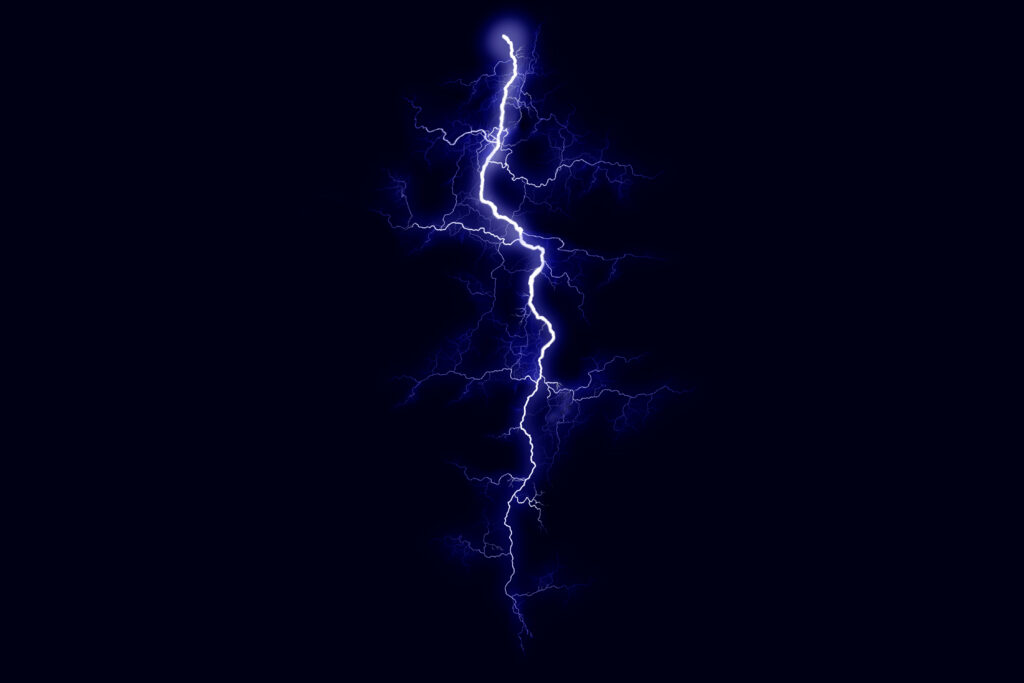
The Question Everyone Has Watched the Sky and Never Answered
Lightning is one of the most visually arresting phenomena in nature — a bolt of electrical energy that crosses miles of air in a fraction of a second, briefly outshining the sun in its immediate vicinity, producing a shockwave that travels for miles as thunder. It kills approximately 20 people per year in the United States and injures hundreds more, making it one of the more consequential weather hazards despite receiving less attention than tornadoes and hurricanes.
And yet the question of how it actually works — the specific physics of how a thunderstorm builds up enough electrical charge to bridge miles of air — is something most people have never had answered. The lightning myths piece covered what to do about lightning. The thunderstorm science piece covered how storms form. This piece covers the physics of the lightning itself: how charge separates inside a cloud, how the bolt finds its path, and why lightning strikes where it does.
The Charge Separation Problem
Air is normally an insulator — it does not readily conduct electricity. For lightning to occur, something must build up a sufficient electrical potential difference — voltage — to overcome air’s insulating resistance. The voltage required to produce a lightning bolt is in the range of hundreds of millions of volts. Building this charge inside a thunderstorm requires a specific physical mechanism.
The mechanism is the collision of ice and water particles inside the thunderstorm’s updraft. In the middle and upper regions of a mature thunderstorm, where temperatures are well below freezing, three types of particles coexist: large, soft ice particles called graupel that are heavy enough to fall through the updraft, smaller ice crystals that are light enough to be carried upward by the updraft, and supercooled water droplets that remain liquid despite being at temperatures well below freezing.
When graupel particles collide with smaller ice crystals in the presence of supercooled water, charge is transferred between them. The graupel acquires negative charge and falls toward the lower part of the storm. The ice crystals acquire positive charge and are carried upward to the storm’s top by the updraft. After tens of minutes of this process operating continuously throughout the storm’s volume, the lower part of the storm accumulates a large region of negative charge while the upper region accumulates positive charge.
This separation of charge — with negative charge concentrated in the middle and lower storm, and positive charge at the top — creates the enormous electrical potential difference that drives lightning. The magnitude of the voltage required to bridge the insulating air between charge regions — or between the storm and the ground — is what makes lightning so energetic.
The Role of the Ground
The negative charge accumulated in the lower storm induces a corresponding positive charge on the ground surface directly beneath the storm. This happens because the negative cloud charge repels electrons in the ground’s surface layer, driving them downward and leaving positive charges at the surface — the same principle by which a negatively charged balloon attracts a neutral wall.
This induced positive ground charge is not static — it follows the storm as it moves, concentrating under the most negatively charged portions of the cloud. The presence of a large negative charge above and a large positive charge on the ground below creates a favorable condition for electrical discharge between cloud and ground — what we call cloud-to-ground lightning, the type most familiar and most dangerous.
Cloud-to-ground lightning accounts for approximately 25 percent of all lightning. The remaining 75 percent is intra-cloud lightning — discharges between the positive and negative charge regions within the same storm, or between adjacent storms — which produces the diffuse illumination of clouds that the heat lightning piece described. Intra-cloud lightning is invisible from the ground when occurring in distant storms or inside the cloud, but produces the flickering glow within cloud tops that characterizes thunderstorm electricity from a distance.
How a Bolt Actually Happens: The Stepped Leader and Return Stroke
A cloud-to-ground lightning bolt is not a single event but a two-step process that happens so fast it appears instantaneous but is actually a sequence of events unfolding over about half a second.
The first step is the stepped leader — an invisible channel of ionized air that extends downward from the cloud’s negative charge region in a series of discrete steps, each roughly 150 feet long and lasting about a microsecond, with brief pauses between steps. The stepped leader is not visible to the naked eye and is not the bright bolt you see. It branches and forks as it descends, choosing its path based on the electrical conductivity of the air it encounters — following channels of slightly more ionized or humid air that offer marginally less resistance.
As the stepped leader approaches the ground, the induced positive charge on the ground surface intensifies beneath it. Tall, pointed, or conductive objects on the ground — trees, towers, buildings, people holding metal objects — can launch upward streamers: short channels of ionized air extending upward from the ground toward the descending leader. The stepped leader is typically 100 to 300 feet above the ground when an upward streamer meets it.
The moment the stepped leader connects with an upward streamer — establishing a complete conductive channel from cloud to ground — the return stroke begins. The return stroke is what you see as lightning: a massive, nearly instantaneous surge of electrical current — typically 20,000 to 30,000 amperes, occasionally over 100,000 amperes — that travels upward through the established channel from ground to cloud. The return stroke reaches speeds of roughly one-third the speed of light and heats the channel to approximately 50,000°F — five times hotter than the surface of the sun — in a fraction of a millisecond.
The explosive heating of the air channel expands the surrounding air supersonically, producing the pressure wave that propagates outward as thunder. The time delay between the flash and the sound reflects the difference in propagation speed between light (essentially instantaneous) and sound (approximately one mile every five seconds).
Why Lightning Strikes Where It Does
The path of a stepped leader — and therefore the eventual strike point — is determined by the electrical properties of the air it descends through and the distribution of ground charge beneath it. Several factors influence where lightning strikes.
Height. Taller objects are closer to the descending leader and concentrate the ground charge at their tips, making them more likely to launch successful upward streamers. This is why lightning preferentially strikes tall trees, communication towers, and elevated terrain — they are closer to the leader and their geometry concentrates ground charge in a way that makes connection more probable. It is also why being the tallest object in a flat area — a golfer on a fairway, a person on a hilltop — significantly increases lightning strike probability.
Conductivity. Conductive materials — water, metals, wet materials — accumulate ground charge more readily than resistive materials, making them more likely to launch successful streamers. A wet tree trunk is more likely to be struck than a dry rock of similar height. A person holding a metal object has a different electrical profile than a person without one — though the effect is not as simple as metal “attracting” lightning, it influences the upward streamer initiation probability.
Geometry. Pointed objects concentrate electrical field at their tips — a physical phenomenon called the lightning rod effect that Benjamin Franklin exploited in his invention of the lightning rod. A pointed metal rod at the apex of a building concentrates ground charge at its tip, launching a reliable upward streamer that connects with the descended leader and provides a predictable, low-resistance path for the return stroke — conducting the current safely to ground rather than through the building structure.
The Multiple Stroke Character
What appears as a single lightning flash typically involves multiple return strokes along the same channel. After the first return stroke neutralizes some of the charge difference, additional charge can accumulate rapidly in the cloud and initiate subsequent strokes — called dart leaders — that travel down the already-ionized channel much faster than the initial stepped leader. A typical flash involves three to four return strokes separated by 20 to 50 milliseconds — fast enough to appear as a single flash but slow enough to produce the flickering quality that distinguishes multiple-stroke lightning from single-stroke events.
The flickering of a lightning flash is the visual signature of its multiple-stroke character: each dart leader and return stroke briefly re-illuminates the channel, producing successive pulses of light that the eye perceives as flicker rather than as distinct events. High-speed photography reveals the sequential structure clearly, showing individual strokes that are separated in time but occupy the same spatial channel.
Ball Lightning: The Unexplained Exception
No discussion of lightning physics is complete without acknowledging its most puzzling manifestation: ball lightning — reports of luminous, floating spheres of light ranging from golf ball to basketball size that appear during thunderstorms, persist for seconds to minutes, and then disappear suddenly or with a small explosion.
Ball lightning has been reported consistently across centuries and cultures and has been witnessed by credible observers including scientists. It has never been reliably reproduced in laboratory conditions or captured in unambiguous photographic or video evidence under controlled circumstances. Proposed explanations include microwave radiation from lightning, plasma balls, clusters of burning particles, and quantum mechanical phenomena — none of which has achieved consensus.
The scientific status of ball lightning is unusual: the phenomenon is almost certainly real, based on the volume and consistency of eyewitness accounts, but its physical mechanism remains genuinely unexplained. It is one of the few atmospheric phenomena where the physics community has not converged on a satisfactory explanation — a reminder that the atmosphere still holds mysteries that the science of lightning has not fully resolved.
The Channel You’re Watching
The next time a thunderstorm illuminates the sky with lightning, the bolt you’re watching is the return stroke — the upward surge of current through a channel that was established by an invisible downward leader that found its way to the ground through a half-second of stepped, branching descent. The flash that lasts a fraction of a second is the culmination of tens of minutes of charge separation inside the storm, accomplished through the collision of ice and water particles in an updraft that no one can see.
The thunder that follows is the sound of 50,000°F air expanding supersonically in the channel the lightning created — the atmosphere recovering from the brief, violent passage of 30,000 amperes of electrical current through a column of air. The five-second-per-mile rule for estimating distance is simply the speed of sound converting the time delay into distance.
The physics is extraordinary. The phenomenon is beautiful. The safety rules are the same as they’ve always been.