The Window Between Spring and Heat Is the Right Time to Act
Late May sits in a useful gap: warm enough that outdoor water systems can be fully tested and adjusted, but not yet deep enough into summer that a failing irrigation head or a cracked hose connection is an emergency. The vegetable garden is in the ground. The lawn is actively growing. The flowering annuals are establishing their root systems. All of them will need consistent water through the heat of June, July, and August — and the moment to make sure that water will actually reach them reliably is now, not on the first 95°F day of the year when every problem becomes urgent simultaneously.
This checklist covers the outdoor water systems that make summer gardening and lawn care manageable: irrigation, outdoor faucets and hoses, rain barrels, and the watering practices that use water efficiently when heat and drought put pressure on both plants and municipal water supplies.
In-Ground Irrigation: The Annual Startup Inspection
If your home has an in-ground irrigation system, the spring startup — turning the system on for the first time after winter — should have happened in April or early May. If it hasn’t, do it now. If it has, late May is the right time for a follow-up inspection after a few weeks of operation have revealed any issues that the initial startup missed.
Walk each zone while it runs and watch every head. Look for heads that aren’t popping up fully — a sign of low pressure in that zone, often caused by a cracked lateral pipe or a fitting that failed over winter. Look for heads that are spraying at the wrong angle or with a broken pattern — impact from lawn equipment, settling soil, or freeze damage can knock heads out of alignment. Look for heads that are spraying onto pavement, driveways, or structures rather than vegetation — water hitting concrete accomplishes nothing and runs off into storm drains.
Check the coverage overlap between adjacent heads. Irrigation heads are designed to spray to the next head in the zone, creating a pattern where every point in the zone receives water from at least two heads. If heads have shifted or if the system wasn’t originally designed correctly, gaps in coverage create dry spots that become obvious when heat stress reveals them. Adjusting head direction and arc now, before the heat of summer, prevents the mystery dry patches that defy explanation in July.
Drip irrigation zones — used in planting beds, vegetable gardens, and around trees and shrubs — deserve specific attention. Drip emitters clog with mineral deposits and organic material over time, producing reduced or zero flow without any visible indication at the surface. Walk drip zones slowly and check that each emitter is producing a steady drip or trickle. Clogged emitters can be cleared with a thin wire or replaced inexpensively. While inspecting, check that the drip tubing hasn’t been disturbed by winter mulching, spring planting, or rodent activity — tubing gnawed by voles or shifted by digging produces obvious water waste when the zone runs.
Adjust your irrigation controller for summer schedules. The early-morning start times that worked in April — when evaporation rates were lower and temperatures were milder — may need earlier start times in summer to ensure watering is complete before the heat of the day maximizes evaporation loss. Most irrigation experts recommend watering between 4 a.m. and 8 a.m. for minimum evaporative loss. Controllers that run zones into mid-morning may be wasting 20 to 30 percent of applied water to evaporation in summer heat.
Outdoor Faucets and Hoses: The Overlooked Connections
Outdoor hose bibs — the faucets on the exterior of the house — were tested during the spring home inspection piece. Late May is a good moment to check them again after a season of use has revealed any issues that weren’t apparent when water was first turned on.
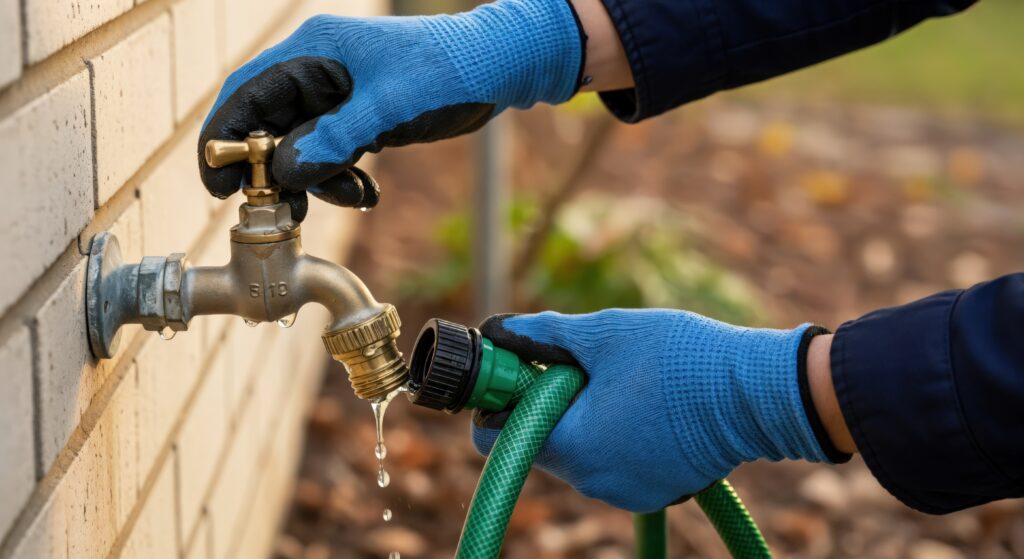
Slow drips at the faucet handle are the most common issue and the easiest to fix: tightening the packing nut slightly (the nut immediately behind the handle) or replacing the packing washer resolves most handle drips without replacing the entire faucet. A faucet that drips continuously when closed has a worn seat washer at the end of the stem — a repair that requires shutting off the supply and replacing the internal components, typically a 20-minute DIY task with basic plumbing tools.
Check all hose connections for leaks at the coupling. Rubber washers inside hose couplings compress and crack over time, producing drips at the connection point between hose and faucet or between hose sections. A set of replacement hose washers costs under two dollars and eliminating connection drips can save surprising amounts of water over a summer of regular use.
Inspect hoses themselves for cracks, bulges, and kinks. A hose stored outdoors through winter is subjected to freeze-thaw cycling that degrades the rubber or vinyl, often producing bulges at stress points that are vulnerable to sudden failure under pressure. A hose that bursts while running unattended in the garden can waste hundreds of gallons and damage plants with unexpected flooding. Replace any hose with visible bulging, cracking at the connection fittings, or significant kinking that doesn’t release when the hose is straightened.
Rain Barrels: Setup and Maintenance
Rain barrels — containers that capture roof runoff from downspouts for later use in the garden — are one of the most water-efficient additions to a home landscape and are particularly valuable during the dry stretches of summer that interrupt spring rains. Late May is an excellent time to set up or reconnect rain barrels that were removed for winter, before the first significant dry period of summer creates the demand that makes them most useful.
Positioning matters for both water collection efficiency and usability. A rain barrel under a downspout that drains a large section of roof will fill faster than one under a small roof section. The barrel needs to be elevated enough that a watering can or hose can be placed under the spigot — a few inches of elevation on cinder blocks or a purpose-built stand is usually sufficient. If you use a soaker hose connected directly to the rain barrel spigot, the barrel needs to be elevated at least 12 to 18 inches above the garden level for sufficient gravity-fed pressure.
Install an overflow diverter if you haven’t already. When a rain barrel fills to capacity — which can happen quickly during a significant rainfall — the overflow needs to be directed away from the foundation. An overflow diverter installed in the downspout automatically directs water to the barrel until it’s full and then routes overflow back down the downspout and away from the house.
Clean rain barrels that have been stored through winter before using them. Sediment, algae, and organic material can accumulate in stored barrels, and the first water collected after reconnection should be allowed to flush through the spigot and discarded before using barrel water on vegetables or herbs.
Check local regulations before installing rain barrels. Most states actively encourage rainwater collection, but a handful have restrictions on the amount of water that can be collected — a legacy of Western water law that treats even rainfall as a regulated resource. Regulations have liberalized substantially in most states in recent years, but verifying current local rules takes only a few minutes.
Watering Practices: Efficiency Before Heat Arrives
The watering habits established in late May tend to persist through summer — making this the right time to establish practices that use water efficiently before heat and potential drought create pressure on both water supplies and plants.
Deep, infrequent watering produces stronger plants than frequent shallow watering. When the top inch of soil is consistently kept moist by daily light watering, plant roots remain near the surface where the water is. Deep watering — saturating the soil to a depth of six to eight inches — encourages roots to grow downward toward the moisture, producing a root system that is more drought-resilient and more stable in wind. Established lawns and garden beds typically need one inch of water per week from rain and irrigation combined, applied in one or two deep sessions rather than daily light applications.
Check actual water delivery with a simple tuna can test: place several empty cans around a sprinkler zone and run the zone for a set time, then measure the depth of water in each can. This tells you both how much water the zone delivers per hour and whether coverage is even across the zone. Most people significantly overestimate or underestimate how much water their irrigation delivers without this simple measurement.
Apply mulch to garden beds if you haven’t already. A two to three inch layer of wood chip or shredded bark mulch reduces soil moisture evaporation dramatically — studies consistently show 25 to 50 percent reduction in soil water loss under mulch compared to bare soil. In summer heat, this difference determines whether garden beds need watering twice a week or once a week, with corresponding reductions in water use and time spent watering.
Water in the morning rather than evening. Evening watering leaves foliage wet through the night, promoting fungal diseases including powdery mildew and leaf spot that thrive in prolonged moisture. Morning watering allows foliage to dry during the day, reducing fungal pressure, and delivers water to the root zone before the heat of the day can evaporate it from the soil surface.
The Investment That Pays All Summer
A few hours spent on outdoor water system maintenance in late May prevents the combination of dead plants, inflated water bills, and emergency plumbing calls that a poorly prepared system delivers in August. The irrigation head that sprays the driveway all summer, the hose connection that drips continuously, the drip emitter that clogged in April and has been leaving one tomato plant dry for six weeks — these are the small failures that compound into significant costs and frustrations.
Check the systems now. Adjust what needs adjusting. The plants you’ve been nurturing since March deserve the reliable water delivery that a few minutes of attention in late May can guarantee.