A Holiday Weekend Interrupted
In late November 1950, just after Thanksgiving, an enormous storm swept across the eastern United States and became one of the most powerful and widespread winter storms of the twentieth century. Known as the Great Appalachian Storm, it struck over the holiday weekend of November 24 and 25, when many families were traveling, and it disrupted life across a vast area, from the Ohio Valley to New England. Roughly 350 people lost their lives, making it among the deadliest storms of its kind in the nation’s history.
A Storm With Two Faces
The storm brought two very different kinds of severe weather at once. West of the Appalachian Mountains, it was a blizzard, with heavy snow, strong winds, and bitterly cold temperatures. East of the mountains, it was a powerhouse of wind and rain, with hurricane-force gusts and, in some areas, heavy flooding and coastal damage.
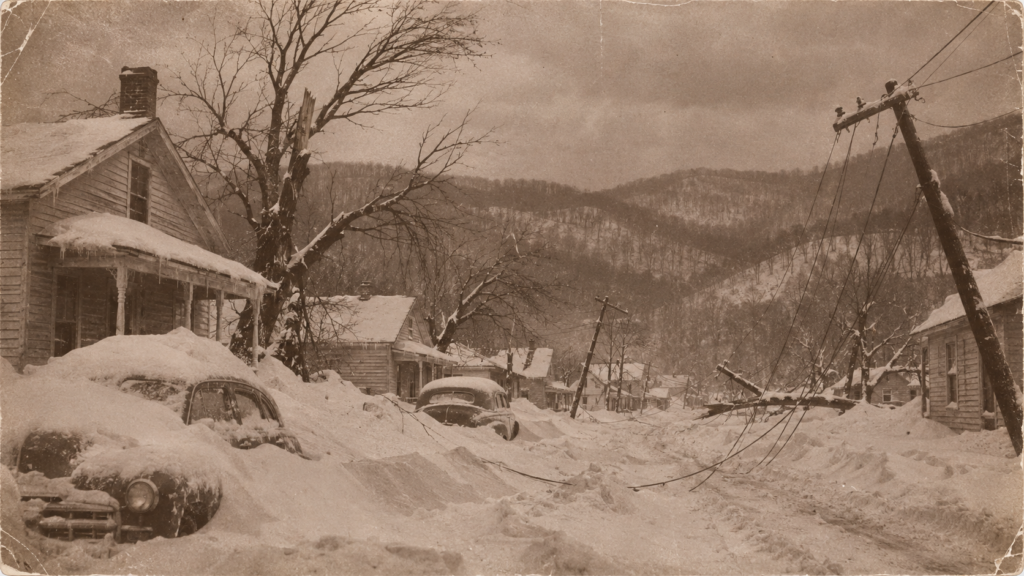
The Ohio Valley and the Appalachians received enormous snowfall, with some areas getting two feet or more, and drifts that buried cars, closed roads, and trapped travelers. Cities like Pittsburgh were brought to a standstill. Meanwhile, from the mid-Atlantic to New England, winds that reached hurricane force toppled trees, knocked out power lines, and damaged buildings.
How a Single System Became So Powerful
The storm developed from a strong low-pressure system that intensified as a very cold air mass from the north collided with warm, moist air from the south. Meteorologists later described it as an unusually deep and intense storm, with a sharp drop in pressure and a very strong gradient between the high pressure to the north and the low pressure at its center. That gradient created the extraordinary winds.
The Appalachian Mountains played an important role in shaping the storm’s effects. Cold air was trapped along the western side of the range, while warmer air moved up along the coast, and the contrast between them helped drive the storm’s intensity.
Cold, Snow, and Isolation
In the west, the combination of snow, wind, and cold temperatures created blizzard conditions across a wide region. Deep snow blocked roads and rail lines, and in some places, communities were isolated for days. Temperatures dropped sharply behind the storm, adding to the challenges of clearing roads and restoring services.
Power outages were widespread, leaving many without heat during bitter cold, and communication was disrupted in some places. Rescue and recovery efforts were slowed by the weather, and many people had to wait for help.
Winds That Damaged the East
East of the mountains, the storm’s winds were a major hazard. Hurricane-force gusts affected parts of the mid-Atlantic and the Northeast, causing extensive damage and widespread power failures. High winds, combined with high tides in some areas, caused coastal flooding and damage to ships and docks. Many people were killed by falling trees, collapsing structures, and storm-related accidents.
A Forecasting Challenge
In 1950, forecasters had far fewer tools than they do today. There were no weather satellites, no Doppler radar, and no sophisticated computer models, and forecasts depended heavily on surface observations, upper-air balloons, and the experience of forecasters. The severity of the storm and the breadth of its effects were difficult to anticipate precisely, and the event was a reminder of the limits of forecasting at the time.
Lessons and Legacy
The storm contributed to a growing recognition of the need for improved forecasting and communication of severe weather. In the decades that followed, advances in technology, including satellites, radar, and numerical weather prediction, greatly improved the ability to detect and forecast large winter storms and to give people advance notice.
It also became a reference point for large storms in the Appalachian region, and meteorologists continued to study it as an example of how a single system can produce widely varied weather across a large area.
A Holiday Lesson That Still Applies
The Great Appalachian Storm struck at a time when many people were on the road for the holiday, and its story remains relevant every Thanksgiving. Checking the forecast along a full travel route, building in flexibility, and being prepared for delays are lessons that continue to matter, especially when a strong storm system arrives at one of the busiest travel times of the year.