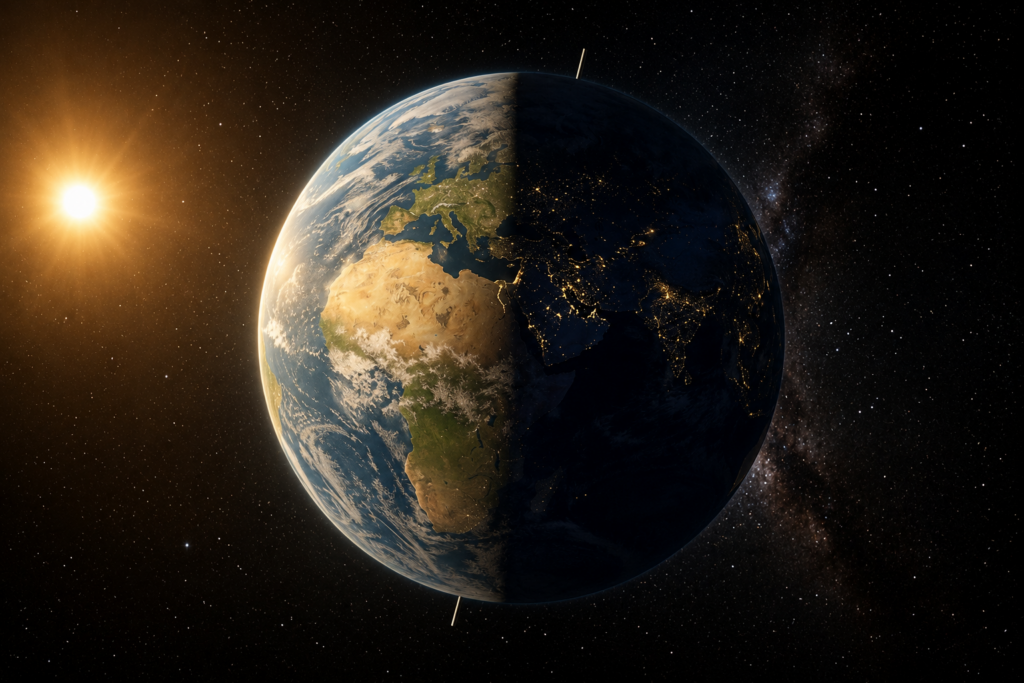
A Precise Astronomical Moment, Not Just a Calendar Date
The autumnal equinox arrives around September 22 or 23 each year, marking the point when the sun crosses directly over Earth’s equator and day and night are, for a brief moment, nearly equal in length across the entire planet. Unlike the solstices, which mark extremes—the longest and shortest days of the year—the equinox represents a genuine balance point, and the astronomical mechanics behind it explain why this particular moment occurs with such precise, predictable timing every year.
Earth’s Tilt Is the Reason Seasons Exist at All
Earth’s axis is tilted approximately 23.5 degrees relative to its orbital plane around the sun, and this tilt, rather than Earth’s distance from the sun, is the fundamental reason seasons exist. As Earth orbits the sun over the course of a year, this consistent tilt means different hemispheres receive more or less direct sunlight depending on the time of year, producing the summer and winter extremes that define each hemisphere’s experience of the seasonal cycle.
At the solstices, one hemisphere is tilted as far as possible toward the sun while the other tilts as far away, producing the year’s most extreme day-length disparities. The equinoxes occur at the two points in Earth’s orbit where neither hemisphere is tilted toward or away from the sun—the tilt is oriented sideways relative to the sun’s position, meaning sunlight is distributed essentially evenly across both hemispheres.
Why “Equal Night” Isn’t Perfectly Exact
The word equinox derives from Latin roots meaning “equal night,” reflecting the traditional understanding that day and night are precisely equal in length on this date. In practice, most locations experience a small discrepancy—typically just a few minutes—between what’s technically labeled the equinox and the day when daylight and darkness are truly split exactly in half.
This discrepancy exists primarily because of how sunrise and sunset are officially defined: they’re measured from the moment the top edge of the sun’s disk appears or disappears, not from the sun’s actual center crossing the horizon. Additionally, atmospheric refraction bends sunlight slightly, making the sun visible for a few extra minutes both before actual sunrise and after actual sunset, from an observer’s perspective on the ground. These small effects mean the day of truly equal daylight and darkness typically falls a few days before the equinox in fall, a detail that surprises many people who assume the equinox itself is the precise midpoint.
What Changes for the Northern Hemisphere After This Point
The fall equinox marks the specific point after which the Northern Hemisphere begins experiencing shorter days than nights, a pattern that will continue intensifying until the winter solstice in December, when the darkness reaches its yearly maximum. This is distinct from the gradual daylight shortening that’s already been underway since the summer solstice in June—the equinox specifically marks the moment when that ongoing trend crosses from days-still-longer-than-nights into days-now-shorter-than-nights.
The rate of daylight change is actually at its steepest right around the equinox itself, meaning the next few weeks will bring some of the year’s most noticeable day-to-day changes in sunrise and sunset times, a sharper transition than either the height of summer or the depths of winter, when daylight duration changes much more gradually from one day to the next.
A Global, Simultaneous Event
Unlike many weather phenomena that vary significantly by location, the equinox is a genuinely simultaneous global event—it occurs at the exact same moment worldwide, even though local clock time for that moment varies by time zone. Every location on Earth experiences this crossing point at the same instant, a reflection of the equinox being defined by Earth’s orbital position relative to the sun rather than by any location-specific atmospheric or geographic condition.
The Marker Between Two Seasons
The fall equinox serves as the traditional astronomical marker for the start of autumn, even though meteorological fall—the definition meteorologists use for record-keeping and seasonal statistics—actually began on September 1st, based on the calendar month grouping rather than the sun’s precise position. This is why you may hear fall referred to as having “started” on two different dates depending on which definition is being used, and understanding the distinction explains why neither reference is incorrect—they’re simply measuring the season’s start using two genuinely different, equally valid systems.
A Precise Moment Worth Marking
As the equinox approaches in the coming days, it represents more than a simple seasonal marker—it’s a specific, measurable astronomical event resulting directly from the consistent tilt that drives every seasonal transition throughout the year. Understanding the mechanics behind it makes the increasingly noticeable shift toward shorter days feel less like an arbitrary calendar change and more like the predictable consequence of Earth’s orbital geometry playing out exactly as it does every single year.