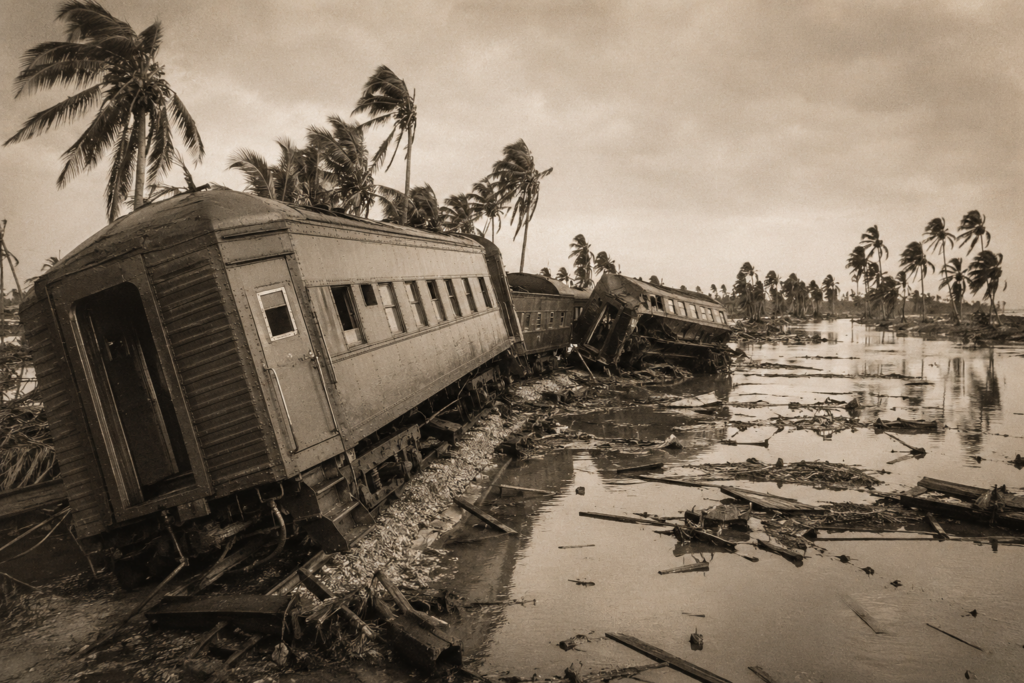
A Storm That Still Holds a Record Nearly a Century Later
On September 2, 1935, a compact, extraordinarily intense hurricane made landfall in the Florida Keys with a central pressure of 892 millibars, the lowest barometric pressure ever recorded at landfall for a hurricane in the continental United States—a record that still stands today. The storm, known simply as the Labor Day Hurricane before modern naming conventions existed, remains one of only a handful of Category 5 hurricanes ever confirmed to make landfall on U.S. soil, and its story is inseparable from a tragedy involving a government relief program and a rescue effort that arrived too late.
Extreme Intensity in a Small, Fast-Intensifying Package
The storm intensified with remarkable speed in the days before landfall, strengthening rapidly as it moved through the warm waters of the Bahamas before striking the Florida Keys. Its small size concentrated its most extreme winds and surge into a narrow, brutally intense corridor rather than spreading destructive force across a wide area—a characteristic that, as with other compact, intense hurricanes throughout history, meant the areas directly in its path experienced conditions at the absolute upper limit of what a hurricane can produce.
Wind speeds are estimated to have reached 185 mph, and the storm surge in the Keys reached as high as 18 to 20 feet in some locations, completely overwhelming the low-lying islands with almost no natural elevation to offer any refuge.
The Veterans Working on the Overseas Highway
The disaster’s most devastating and most controversial chapter involves several work camps of World War I veterans employed by the Federal Emergency Relief Administration, constructing a highway connecting the Florida Keys as part of a Depression-era public works project. These veterans, many of whom had struggled to find stable employment during the Depression and had participated in the Bonus Army protests demanding promised veteran compensation, were housed in temporary camps directly in the path of the approaching storm.
Warnings about the hurricane’s approach and intensification were delayed and inadequate by modern standards, in part due to the storm’s rapid intensification and in part due to communication and coordination failures between federal relief officials and the Weather Bureau. By the time the severity of the approaching storm became clear, evacuation efforts were organized far too late to move the veterans to safety.
The Rescue Train That Arrived Too Late
In a desperate late effort to evacuate the veterans and other Keys residents, the Florida East Coast Railway dispatched a rescue train from Miami, intended to reach the work camps and carry people to safety on the mainland. The train faced delays in its departure and encountered worsening conditions as it traveled south, and by the time it reached the Keys, the hurricane’s leading edge had already arrived.
The storm surge derailed much of the train, sweeping rail cars from the tracks with people still aboard. Many of the veterans and residents who had been counting on the train for evacuation died when it was overwhelmed, a tragedy that became one of the most searing images associated with the disaster and fueled intense public outrage over the government’s handling of the evacuation.
A Death Toll That Sparked National Outrage
The storm killed an estimated 400 to 600 people, including at least 259 World War I veterans in the work camps—though exact figures vary across historical accounts, in part due to the difficulty of accounting for transient camp populations. The scale of veteran deaths, combined with clear evidence of inadequate evacuation planning for a group the federal government had direct responsibility for, triggered a significant public and congressional backlash.
Author Ernest Hemingway, who lived in Key West at the time and traveled to the affected area shortly after the storm, wrote a scathing account criticizing the government’s failure to evacuate the veterans in time, helping draw national attention to what many viewed as a preventable tragedy resulting from bureaucratic delay and inadequate storm preparedness for a known vulnerable population.
What the Disaster Changed
The Labor Day Hurricane’s disproportionate impact on a government-managed relief camp population contributed to broader scrutiny of federal disaster preparedness and emergency communication protocols during the New Deal era. In the years following, the Weather Bureau worked to improve hurricane tracking and warning dissemination, though the broader systematic improvements in hurricane forecasting and evacuation planning that followed storms like this one would continue developing over subsequent decades rather than resulting from any single immediate policy overhaul.
The storm also permanently altered the Florida Keys’ landscape and infrastructure—the damaged railway was never fully rebuilt in its original form, and the corridor was instead redeveloped into the Overseas Highway, the very road the veteran work camps had originally been building, completed years later using a rebuilt version of the route.
A Record That Represents Genuine Human Cost
Nearly ninety years later, the 1935 Labor Day Hurricane remains the benchmark for landfalling hurricane intensity in the United States, but its historical significance extends well beyond the meteorological record it still holds. The storm stands as a stark early example of how vulnerable populations—in this case, veterans relying on a government relief program—can bear a disproportionate share of a disaster’s cost when preparedness and evacuation planning fail to account for exactly the people most in need of protection.