Old Sayings About the Sky Itself
Beyond animal behavior, some of the oldest weather folklore focuses directly on the sky—rings around the moon, red sunsets, and certain cloud formations have all been read as forecasting signals for centuries. Unlike a lot of animal folklore, several of these sky-based sayings hold up surprisingly well under actual meteorological scrutiny, because they’re often observing real atmospheric processes, even if the folklore explanation isn’t quite the scientific one.
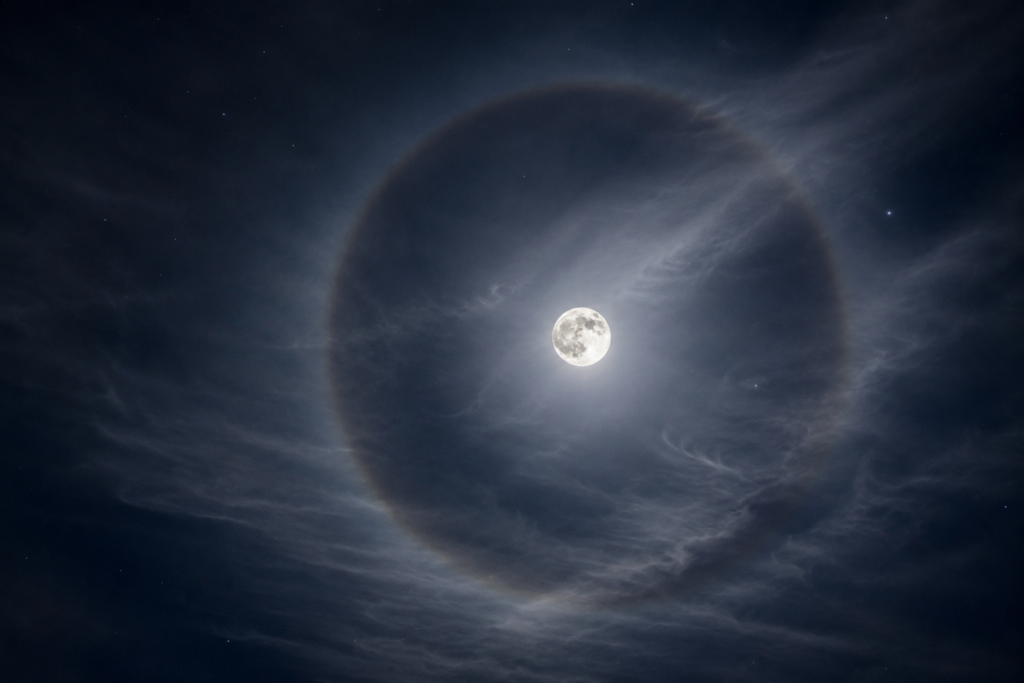
Mostly True: A Ring Around the Moon Means Rain Is Coming
This old saying has genuine meteorological grounding. The ring, technically called a lunar halo, forms when moonlight passes through ice crystals in high, thin cirrostratus clouds, bending and refracting the light into a visible circular halo around the moon. These specific high, thin clouds are frequently among the first visible signs of an approaching warm front or low-pressure system, since they often form at the leading edge of an advancing storm system well before lower, more obviously threatening clouds arrive.
Because cirrostratus clouds genuinely do tend to precede many storm systems by 12 to 24 hours, a lunar halo functions as a reasonably legitimate, if imprecise, short-term forecasting signal—not because of any mystical property of the ring itself, but because the specific cloud type responsible for creating it happens to correlate with approaching weather systems fairly often.
Mostly True: Red Sky at Night, Sailor’s Delight
This proverb, sometimes phrased as “red sky at night, sailor’s delight; red sky in morning, sailor’s warning,” has a legitimate atmospheric basis rooted in how weather systems typically move across the middle latitudes, generally from west to east. A red sky at sunset indicates that the setting sun’s light is passing through a relatively clear, dry atmosphere to the west—the direction from which weather typically arrives—suggesting that clear, dry conditions may be on the way.
A red sky at sunrise works in the opposite direction: since the rising sun is in the east, red coloring at sunrise suggests clear skies to the east, meaning any clouds or moisture responsible for producing that red coloring are actually located to the west, in the direction weather is arriving from—a signal that deteriorating conditions may be approaching. This proverb isn’t perfectly reliable, since it depends on typical wind patterns holding true on any given day, but it reflects a genuine, historically observed atmospheric pattern rather than pure superstition.
Partially True: Mackerel Sky Means Rain Within a Day or Two
Sailors and farmers have long described a sky filled with small, rippled, fish-scale-like clouds as a “mackerel sky,” and traditionally associated it with approaching rain, typically within a day or two. This pattern, technically produced by altocumulus clouds, does have some genuine forecasting value, since this cloud formation often develops in the atmospheric conditions that precede a frontal system, similar in principle to the cirrostratus halo mechanism.
However, the timing and reliability of this signal is considerably less precise than the lunar halo or red sky proverbs, since mackerel sky patterns can develop under a broader range of atmospheric conditions, some of which don’t lead to significant rainfall within the traditionally cited timeframe.
Myth: A Green-Tinted Sky Always Means a Tornado Is Coming
This one deserves a more careful treatment than a simple confirmation or denial. A greenish tint to storm clouds does correlate with severe thunderstorms, since the color is produced by sunlight interacting with the extremely tall, dense clouds and large water droplets or hail particles common in intense storm systems—these are indeed the kinds of storms most likely to produce tornadoes. But the green color itself doesn’t directly indicate that a tornado specifically is forming; it more broadly signals an unusually severe thunderstorm, which may or may not produce a tornado depending on additional atmospheric conditions like wind shear and instability that the color alone can’t reveal.
Why Sky Folklore Tends to Be More Reliable Than Animal Folklore
Sky-based weather folklore often outperforms animal-based folklore because it’s frequently observing genuine atmospheric processes directly, rather than relying on an indirect biological response that may or may not actually correlate with weather in any meaningful way. Cloud types, halos, and sky coloration are direct visual signatures of the actual atmospheric conditions responsible for producing weather, which is a fundamentally different, more reliable category of observation than watching how a cow or a caterpillar happens to be behaving on a given afternoon.
Old Observations, Real Physics
These sayings persisted for centuries not simply because they were memorable, but because generations of careful observers were noticing genuine, repeatable atmospheric patterns, even without understanding the underlying physics of ice crystal refraction or frontal cloud sequences. Modern meteorology has since explained precisely why several of these old sayings work as well as they do—a rare case where folklore and forecasting science arrive at a similar practical conclusion, even if they got there by very different paths.