Planning Starts Earlier Than You Think
With Thanksgiving a little over two weeks away, many cooks are starting to plan the main event, and a handful of long-standing turkey myths are about to resurface in kitchens everywhere. Several of them affect food safety, and one in particular, using the cold outdoors as a free refrigerator, depends on the weather in a way that often catches people out.
Myth: You Should Rinse the Turkey Before Cooking It
Many people were taught to rinse a raw turkey under running water before putting it in the oven. Food safety agencies advise against it. Rinsing doesn’t remove bacteria, and the splashing water can spread raw poultry juices onto the sink, the counters, and nearby food, increasing the risk of cross-contamination. Proper cooking is what kills harmful bacteria, so the better approach is to pat the bird dry with paper towels and take it straight to the pan.
Myth: It’s Fine to Thaw a Turkey on the Counter
Thawing at room temperature allows the outer layers of the bird to warm into the temperature danger zone, roughly between 40 and 140 degrees Fahrenheit, while the center is still frozen. Bacteria multiply rapidly in that range. Safe options are thawing in the refrigerator, which takes about 24 hours for every four to five pounds of turkey, or in cold water, which takes roughly 30 minutes per pound with the water changed every 30 minutes. A turkey can also be cooked from frozen, though the cooking time is considerably longer.
For a large bird, refrigerator thawing means starting several days ahead, which is a good reason to plan now.
Myth: A Cold Garage or Porch Is a Perfectly Good Refrigerator
This is the weather-related myth of the bunch. On a cold November day, it’s tempting to store a turkey, a pot of stock, or a cooler of leftovers outside, but outdoor temperatures swing widely from day to night and with the sun’s warmth. A garage or porch that dips below freezing overnight can climb well above 40 degrees on a sunny afternoon, which puts food right back into the danger zone. Outdoor storage also leaves food exposed to animals.
If you need extra cold storage, a cooler with ice or a dedicated refrigerator that you can monitor with a thermometer is far more reliable than relying on the weather. A refrigerator should stay at 40 degrees or below.
Myth: The Pop-Up Timer Tells You When It’s Done
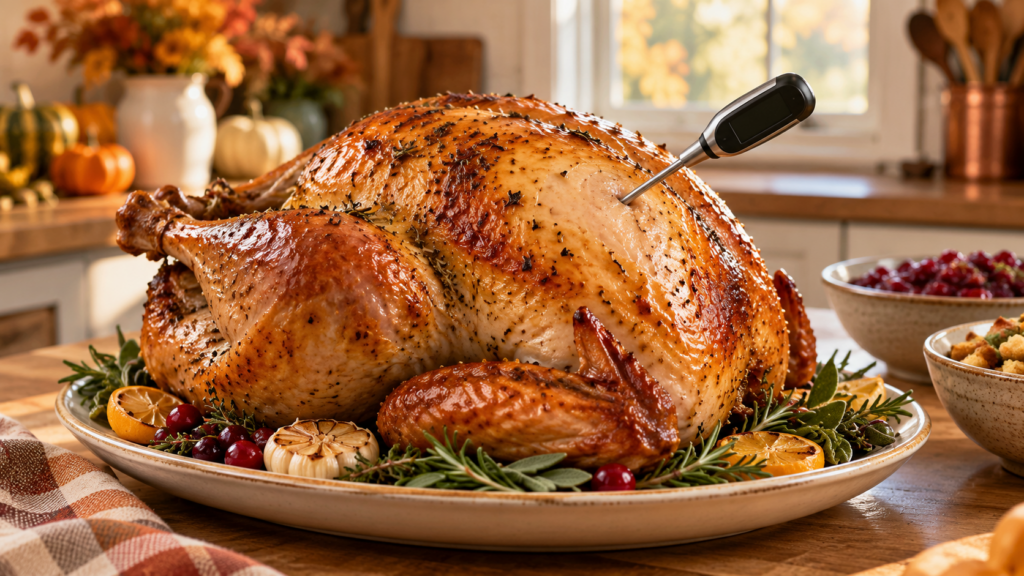
Pop-up timers are convenient, but they are not always accurate. Some trigger late, leaving the meat overcooked and dry, while others fail to pop until the bird is past safe temperatures or may not pop at all. A food thermometer is the dependable way to tell. The turkey is safe when the thickest part of the breast, the innermost part of the thigh, and the innermost part of the wing all reach 165 degrees Fahrenheit.
Myth: The Juices Running Clear Means It’s Done
Clear juices and a golden skin are appealing signs, but they don’t guarantee that the meat has reached a safe temperature. Color can be misleading, since meat can look done before it is, or remain slightly pink even when properly cooked. Temperature is the only reliable measure.
Myth: Turkey Makes You Sleepy Because of Tryptophan
Turkey does contain tryptophan, an amino acid the body uses to make serotonin and melatonin, but it doesn’t contain unusually high amounts compared with other common meats. The post-dinner drowsiness is more likely explained by a big meal heavy in carbohydrates, a long day of cooking and socializing, and possibly alcohol. In other words, the sleepy feeling comes from the whole feast, not the turkey alone.
Myth: Leftovers Can Sit Out Until Everyone’s Done Eating
Cooked food shouldn’t sit at room temperature for more than two hours, or one hour if the room is hot. It’s easy to lose track of time during a long holiday meal, so set a timer. Divide leftovers into shallow containers, which cool faster, and refrigerate promptly. Reheat leftovers until they’re steaming hot, at 165 degrees.
A Few Habits That Matter
The most reliable steps are also the simplest: skip the rinse, thaw in the refrigerator or cold water, use a thermometer, and keep cold foods cold with a refrigerator or ice-filled cooler rather than the weather. These habits protect everyone at the table and let the focus stay on the meal itself.