Why Wasp Activity Spikes in Late August
Wasp and hornet colonies follow a predictable seasonal arc, and late summer represents their peak—both in population size and in aggression. A colony that started with a single queen in spring has spent months growing, and by August, nests can house hundreds or even thousands of workers. At the same time, colonies shift their behavior late in the season, becoming noticeably more defensive and more likely to sting with minimal provocation, which is part of why late-summer wasp encounters tend to feel more dangerous than earlier-season ones.
Why Colonies Get More Aggressive Right Now
Earlier in the season, worker wasps are focused primarily on foraging and feeding developing larvae, which keeps them relatively occupied and less inclined toward defensive behavior around the nest. By late summer, most colonies have stopped producing new larvae and have shifted toward producing next year’s queens, a transition that coincides with a broader change in colony priorities—defense of the nest and its remaining resources becomes a higher priority, and worker wasps become measurably more willing to sting in response to disturbances that would have been ignored a few months earlier.
This shift is also why late summer brings more wasps foraging directly for sugar and protein from human food sources—picnics, outdoor meals, and trash cans—rather than relying primarily on insects and nectar, since natural food sources become somewhat less central to the colony’s priorities as the season progresses.
Where Nests Commonly Hide
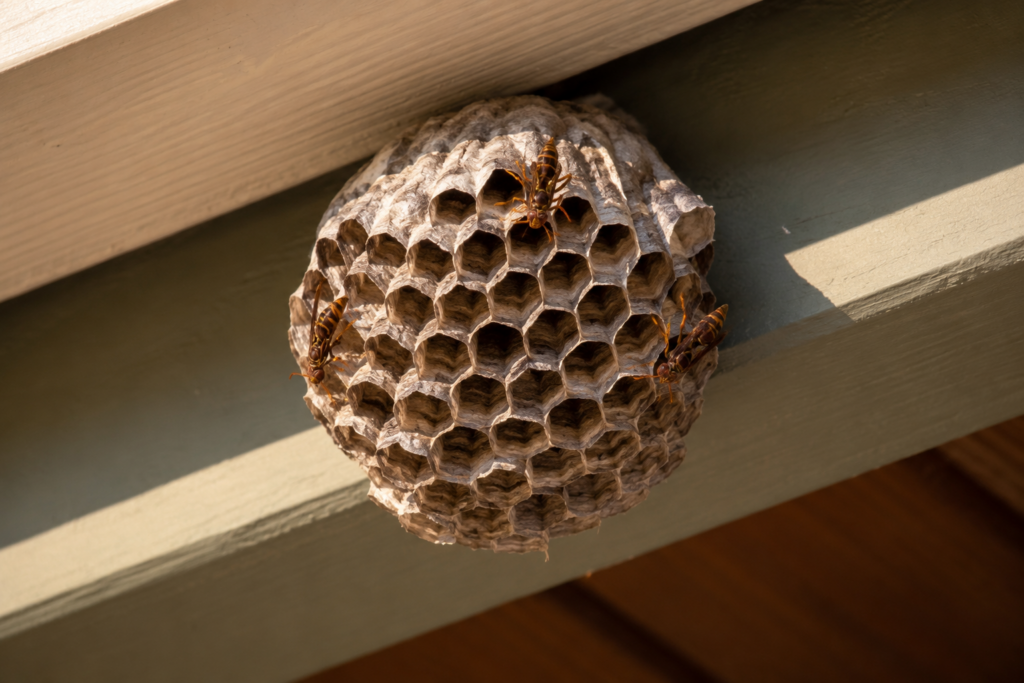
Late-summer nest inspection is worth doing specifically because colonies that started small and inconspicuous in spring have often grown into substantial, easily disturbed nests by now, frequently in locations that go unnoticed during routine outdoor activity. Common hiding spots include eaves and roof overhangs, where paper wasps often build open, umbrella-shaped nests; wall voids and attic spaces, accessible through small gaps or vents, where yellow jackets and some hornet species build enclosed nests; underground, particularly in abandoned rodent burrows or loose soil, favored by yellow jackets; and dense shrubs, wood piles, or unused sheds, where nests can grow undetected for an entire season.
Check these areas from a safe distance rather than up close, since a nest disturbed during inspection poses real risk—looking for wasp traffic patterns (repeated flight paths in and out of a specific spot) is usually a safer way to identify an active nest than approaching directly.
Signs You Have an Active Nest Nearby
Beyond visibly spotting a nest, several behavioral signs indicate an active colony in the vicinity: a consistent, repeated flight path of wasps entering and exiting the same specific location, increased wasp presence around outdoor trash or food areas, and audible buzzing coming from wall voids, attic spaces, or ground-level areas that wouldn’t normally produce that sound. Noticing these patterns over a few days, rather than reacting to a single wasp sighting, is a more reliable way to confirm an active nest before deciding how to address it.
When to Handle It Yourself and When to Call a Professional
Small, accessible paper wasp nests—typically visible, open, and containing a limited number of wasps—can sometimes be treated with over-the-counter wasp spray applied from a safe distance, ideally at dusk or dawn when wasps are least active. However, larger nests, nests in wall voids or other enclosed spaces, underground yellow jacket nests, or any nest near frequently used entryways generally warrant professional pest control, both because larger colonies pose meaningfully greater sting risk during treatment and because enclosed or underground nests are harder to fully eliminate without proper equipment and expertise.
Anyone with a known wasp sting allergy should avoid direct nest treatment entirely, regardless of nest size, given the elevated risk a defensive colony response poses to someone with a serious allergic reaction history.
A Seasonal Check Worth Doing Now
Late summer’s combination of peak colony size and peak defensive behavior makes this the point in the year when an unnoticed nest is most likely to result in a painful, potentially dangerous encounter. A deliberate walk around your property’s eaves, sheds, wood piles, and other common nesting spots—done from a comfortable distance—can identify problem areas before they turn a routine outdoor task into an emergency.