A Home Maintenance Task Most People Never Consider
By early August, weeks of heat and reduced rainfall in many regions have left soil around homes noticeably drier than it was in spring—and that dry soil can pose a real, if underappreciated, risk to your home’s foundation. Watering the ground around your house sounds like an unusual instruction, but in a genuine summer drought, it’s one of the more practical steps homeowners can take to prevent a serious and expensive structural problem.
Soil Moves More Than People Realize
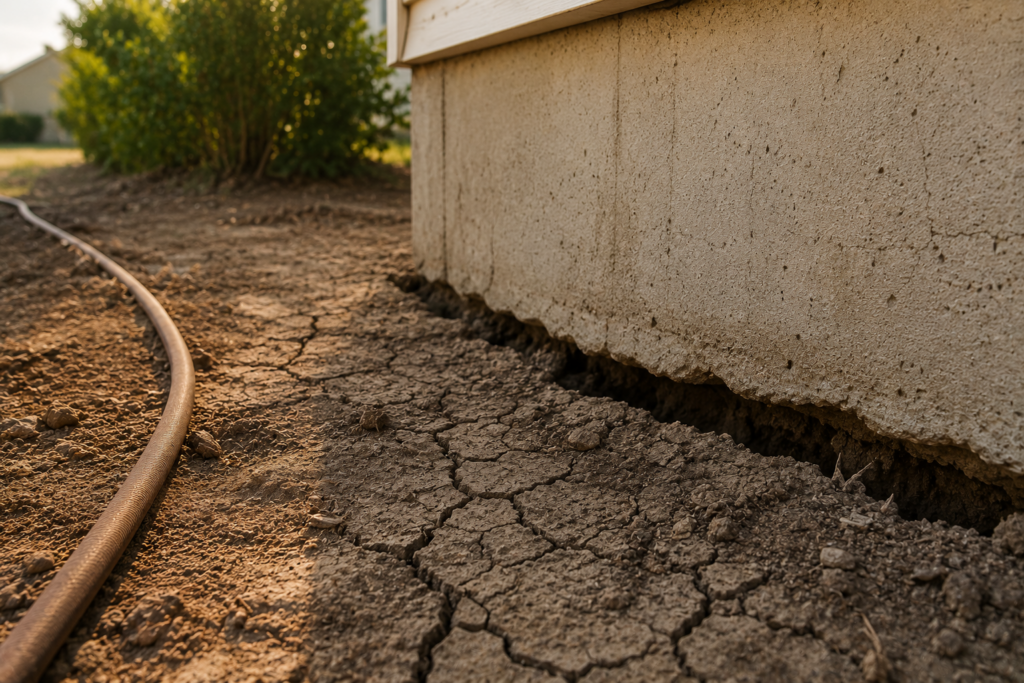
Most residential foundations sit on soil that expands when wet and contracts when dry, a property that’s especially pronounced in clay-heavy soils common across large parts of the country. During a wet spring, that soil holds moisture and stays relatively swollen. As a hot, dry summer progresses, the same soil loses moisture and shrinks—sometimes dramatically, pulling away from the foundation itself and leaving gaps beneath and around it.
This isn’t a subtle effect. Clay soils can shrink enough during a severe drought to create visible cracks in the ground several inches deep and wide, and that same shrinkage doesn’t stop at soil—the foundation resting on it can settle unevenly as the ground beneath different sections dries and contracts at different rates.
Why Uneven Drying Is the Real Danger
The problem isn’t dry soil itself so much as uneven dry soil. A foundation that sits on ground drying uniformly tends to settle evenly, which causes far less damage than a foundation experiencing differential settlement—where one section of the ground beneath it dries and shrinks more than another section just a few feet away.
This commonly happens because of uneven exposure: a side of the house shaded by large trees retains moisture longer than a side exposed to direct sun most of the day, or an area near a downspout stays wetter than a spot on the opposite corner of the house. As these zones dry at different rates, the foundation above them can shift unevenly, leading to the diagonal cracks in drywall, sticking doors and windows, and uneven floors that are the classic warning signs of foundation movement.
Large Trees Make the Problem Worse
Trees planted close to a home compound this risk significantly, because their root systems actively pull moisture out of the soil, competing directly with the ground beneath your foundation for whatever water is present. During a drought, large trees—particularly water-hungry species growing within 20 to 30 feet of a foundation—can dramatically accelerate soil drying and shrinkage in their immediate vicinity, creating exactly the kind of localized, uneven soil movement that leads to foundation cracking.
This is why foundation problems often become more apparent, or worsen noticeably, during drought years, even in homes that showed no signs of trouble in wetter years—it’s frequently the combination of extended dry weather and nearby tree roots that finally tips marginal soil conditions into visible structural movement.
How Watering Actually Helps
The goal of watering a foundation during drought isn’t to soak the soil—it’s to maintain a consistent, moderate moisture level that prevents the extreme shrink-swell cycling that causes structural movement. A soaker hose positioned roughly 12 to 18 inches from the foundation, run for a short period several times a week during extended dry spells, can help maintain steadier soil moisture without oversaturating the ground, which carries its own separate risks.
The aim is consistency rather than saturation: soil that stays evenly moist doesn’t experience the dramatic shrinking that soil cycling between soaked and bone-dry conditions does. This is particularly worth doing on the side of a house that gets the most direct sun exposure, since that side dries fastest and is often where the most significant differential settlement originates.
Watch for the Warning Signs
Even with careful watering, it’s worth periodically checking for early indicators of foundation movement: new cracks in interior walls (particularly diagonal cracks near door and window corners), doors or windows that have started sticking or no longer close properly, visible gaps between the foundation and the soil around it, or noticeably uneven or sloping floors. Catching these signs early and addressing soil conditions promptly is far less costly than addressing significant foundation repair after a drought has already caused substantial movement.
A Small, Odd-Sounding Task With Real Payoff
Watering your own foundation during a drought isn’t intuitive, but it directly addresses one of the more overlooked structural risks that late-summer dry spells create. A modest, consistent watering routine during the driest stretches of summer is a far cheaper investment than the foundation repairs that uneven soil shrinkage can eventually require.