Peak Season Brings Peak Misinformation
As hurricane season moves toward its most active weeks, a familiar set of misconceptions circulates alongside every storm forecast. Some are simply outdated advice that once made partial sense; others are dangerous misunderstandings that lead people to make choices that put them at real risk. With the season’s most intense stretch still ahead, it’s worth separating what actually protects you from what only feels like protection.
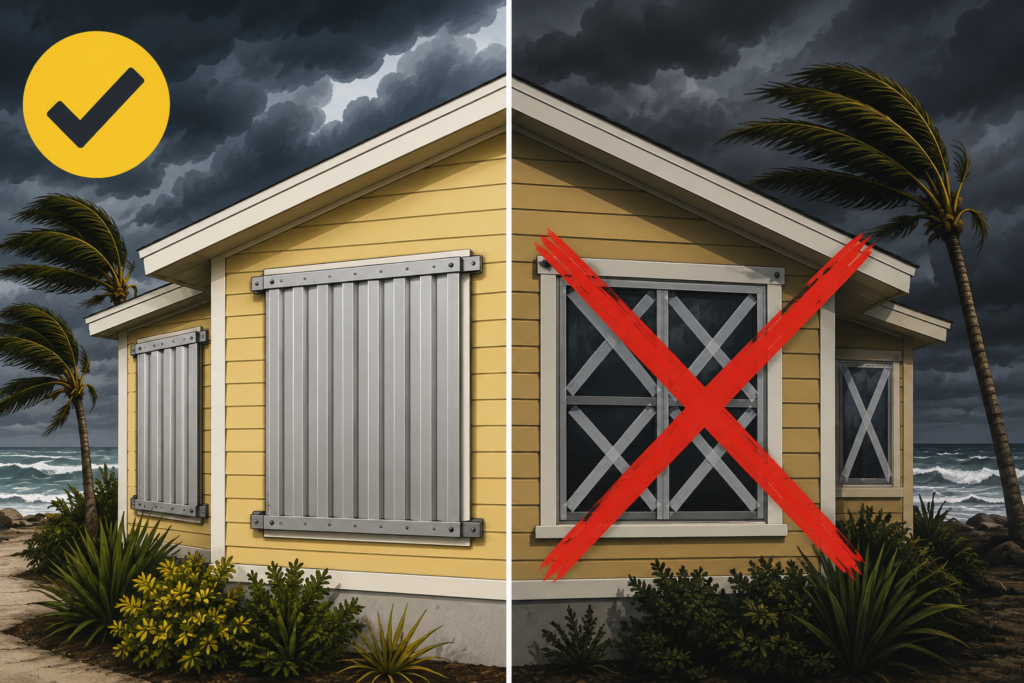
Myth: Taping Windows in an “X” Pattern Prevents Them From Shattering
This is one of the most persistent and most useless pieces of hurricane advice in circulation. Tape does nothing to strengthen glass against the wind pressure or debris impact that breaks windows during a hurricane. If anything, taped glass tends to break into larger, more dangerous shards than untaped glass, since the tape holds fragments together in bigger pieces rather than letting the glass shatter into smaller, less hazardous pieces.
The only things that meaningfully protect windows are permanent storm shutters, properly installed removable panels, or impact-rated glass rated for the wind speeds expected in your area. If none of those are available, plywood cut to fit and securely fastened is a reasonable substitute—tape is not.
Myth: Cracking a Window Equalizes Pressure and Protects Your Home
This myth draws on a real phenomenon—rapid pressure changes—but misapplies it dangerously. Modern homes are not at meaningful risk of “exploding” from internal pressure buildup during a hurricane, and cracking windows doesn’t provide any protective pressure equalization. What it does do is let wind-driven rain into your home and create an opening that can allow wind to get beneath your roof structure, which is one of the primary mechanisms by which roofs fail during high-wind events.
Keep windows and doors closed and sealed. The pressure differential myth has no basis in how houses actually fail in hurricanes.
Myth: The Calm of the Eye Means the Storm Is Over
The eye of a hurricane can bring a dramatic, sometimes eerie lull—calm winds, and occasionally even clear skies overhead. This calm has led to real tragedies over the decades, as people step outside believing the storm has passed, only to be caught when the opposite eyewall arrives.
A hurricane’s eye is often only 20 to 40 miles wide, meaning the calm period can last anywhere from a few minutes to over an hour depending on the storm’s forward speed and size—but it is always temporary. The wind on the far side of the eye typically returns just as suddenly and just as powerfully as it departed, often from a different direction than before. The only safe response to an apparent lull during an active hurricane is to stay sheltered until local officials or meteorologists confirm the storm has actually passed.
Myth: A Category Rating Tells You Everything About a Storm’s Danger
The Saffir-Simpson scale, which produces the familiar Category 1 through 5 ratings, measures only sustained wind speed. It says nothing about a storm’s size, forward speed, rainfall totals, or storm surge potential—all of which have historically caused more deaths and damage than wind alone in many hurricanes.
A slow-moving Category 1 storm parked over an area for days can produce catastrophic, life-threatening flooding, while a fast-moving Category 3 might pass through with comparatively modest rainfall. Storm surge, driven by a storm’s size and the shape of the coastline it approaches rather than its category alone, has been the deadliest single hazard in numerous historical hurricanes regardless of category rating. Category number is a useful shorthand for wind risk, but it is not a complete measure of danger, and treating it as one leads people to underestimate storms that don’t sound impressive on the scale.
Myth: You’ll Have Plenty of Warning to Evacuate
Hurricane forecasting has improved substantially, but forecast tracks still carry real uncertainty, particularly regarding a storm’s exact intensity and landfall location in the final 24 to 48 hours. Storms can also intensify rapidly in the day or two before landfall, sometimes strengthening by an entire category in less than 24 hours as they move over warm water—a phenomenon that has caught coastal communities off guard in several recent hurricane seasons.
Waiting until a storm’s exact path is certain before deciding whether to evacuate often means waiting until it’s too late to do so safely. Evacuation decisions are best made based on your zone’s official guidance and a storm’s potential, not on certainty that may never fully materialize before the window to leave safely has closed.
Preparedness Beats Prediction
Every one of these myths shares a common thread: they offer false reassurance that lets people underprepare or take unnecessary risks. Real hurricane safety doesn’t depend on outguessing the storm—it depends on solid preparation made well before the forecast cone even includes your location, and a willingness to follow official guidance over intuition once a storm actually arrives.