A Small, Fast-Moving Storm With Outsized Power
Hurricane Andrew made landfall in South Florida in the early morning hours of August 24, 1992, as a compact but extraordinarily intense Category 5 hurricane. Andrew was physically small compared to many major hurricanes—its most destructive winds were concentrated in a relatively narrow band—but that compactness didn’t reduce its power. If anything, the tightly wound structure concentrated Andrew’s destructive force into an intensely focused corridor, and the areas caught in that corridor experienced some of the most extreme wind damage ever documented in a U.S. hurricane.
Sustained winds at landfall were estimated near 165 mph, with gusts likely exceeding 175 mph, though the exact peak will never be known with certainty: nearly every wind instrument in Andrew’s path was destroyed or knocked offline before it could record the storm’s true maximum intensity.
A Storm That Outran Its Own Instruments
Part of what made Andrew so destructive was speed—not just wind speed, but forward speed. The storm moved across South Florida in roughly four hours, which sounds brief but meant sustained hurricane-force winds pounded structures continuously for that entire window, without the periodic lulls that slower-moving storms sometimes provide.
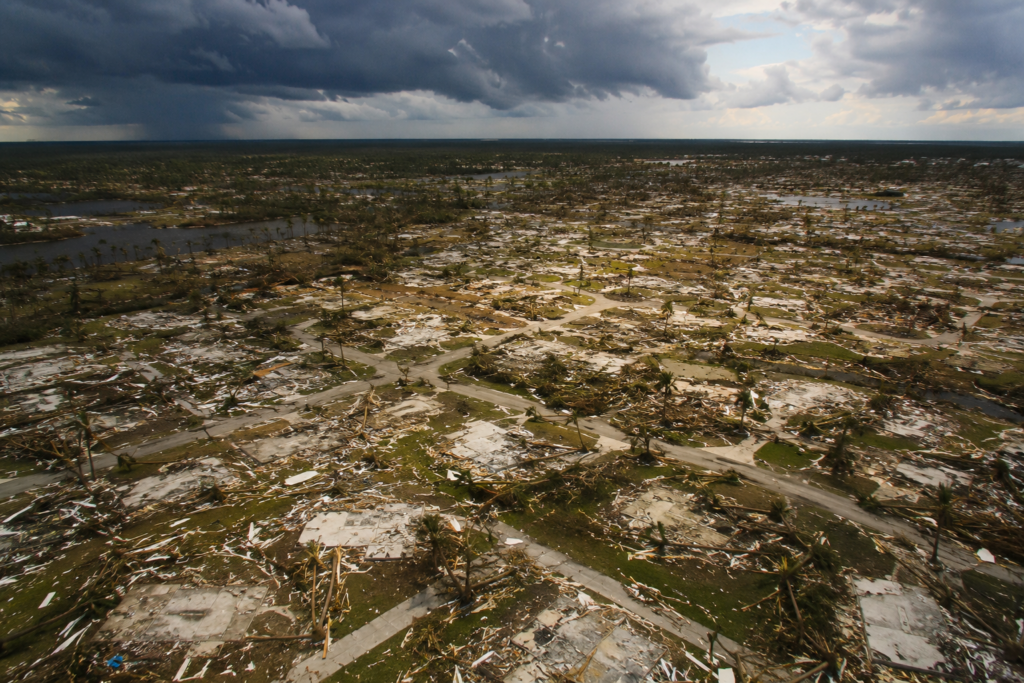
Homestead and Florida City, both south of Miami, bore the brunt of the eyewall. In some neighborhoods, wind speeds were high enough to strip homes down to their concrete slabs, leaving little more than a foundation and scattered debris where houses had stood the day before. An Air Force base near Homestead was almost entirely leveled.
The Building Code Failure Andrew Exposed
In the aftermath, investigators discovered that Andrew’s destruction wasn’t purely a story of extreme wind—it was also a story of inadequate construction standards and lax enforcement. Many homes failed not because the wind exceeded what a well-built structure could withstand, but because roof-to-wall connections, gable-end bracing, and window and door protection were built to standards that hadn’t kept pace with what engineers already understood about hurricane wind loads.
Roofs frequently failed first—torn off by wind that got underneath them through broken windows or garage doors, then found no adequate connection holding them to the walls below. Once a roof failed, the rest of a structure often failed catastrophically, since roofs provide critical structural bracing for walls.
This finding transformed hurricane construction standards nationally. Florida overhauled its building code in the years following Andrew, introducing far stricter requirements for roof-to-wall connections (hurricane straps and clips), impact-resistant windows or approved shutters, and garage door wind ratings—since a failed garage door was one of the most common initial failure points that allowed wind to enter and pressurize a structure from the inside. The Florida Building Code that emerged, implemented in 2002, became one of the most stringent in the country and has since influenced hurricane construction standards in coastal states well beyond Florida.
The Insurance Industry’s Reckoning
Andrew’s damage total—roughly $27 billion at the time, one of the costliest natural disasters in U.S. history to that point—was so far beyond what insurers had modeled that it triggered a fundamental restructuring of the property insurance industry. Several insurance companies became insolvent in the aftermath, unable to cover the claims Andrew generated. Others withdrew from the Florida market entirely, unwilling to accept the risk exposure a storm of Andrew’s magnitude represented.
This forced the creation of new catastrophe modeling approaches, state-backed insurance mechanisms designed to keep coverage available in high-risk regions, and a broader industry recognition that historical loss data alone had significantly underestimated what a worst-case hurricane could produce in a densely developed coastal area.
What Andrew Still Teaches
More than three decades later, Andrew remains a reference point in hurricane engineering and emergency planning—not because it was the largest hurricane on record, but because it demonstrated with brutal clarity what happens when rapid coastal development outpaces the construction standards needed to withstand the storms that development will eventually face. The stricter codes built in Andrew’s aftermath have measurably reduced damage in subsequent Florida hurricanes, a rare case where a catastrophe directly and durably reshaped the standards meant to prevent its recurrence.