The Second-Deadliest Natural Disaster in American History
On the night of September 16-17, 1928, a powerful hurricane crossed Florida’s Lake Okeechobee and pushed its waters over a low earthen dike onto the flat agricultural land to the south. The flood that resulted killed an estimated 2,500 to 3,000 people — a death toll that makes the Okeechobee Hurricane the second-deadliest natural disaster in American history, behind only the 1900 Galveston Hurricane. Yet the storm is largely unknown outside of Florida, its victims largely uncommemorated for decades, and its story largely absent from the national historical consciousness.
The reasons for this obscurity are not meteorological. They are social: the people who died were overwhelmingly poor Black agricultural workers, migrant laborers, and tenant farmers who had come to the Everglades agricultural region to work the winter vegetable and sugar crops. Their deaths occurred in a segregated America that did not count Black lives with the same urgency as white lives, bury them in the same cemeteries, or memorialize them in the same monuments. The Okeechobee Hurricane’s obscurity is inseparable from the racial history of who died and how those deaths were — and were not — recognized.
The Storm
The hurricane that struck Florida in September 1928 was one of the most powerful Atlantic storms of the early 20th century. It had crossed Puerto Rico on September 13 as a Category 4 storm, killing approximately 300 people and causing catastrophic damage before entering the Gulf Stream and moving toward Florida.
The storm made landfall near West Palm Beach on the evening of September 16 as a Category 4 hurricane with sustained winds estimated at 140 mph. The Palm Beach area, already hit hard by the 1926 Miami Hurricane, sustained significant damage again — but it was what happened inland, as the storm tracked northwest across the state, that produced the catastrophic death toll.
Lake Okeechobee, the large shallow lake at the center of the Florida peninsula, was surrounded by a low earthen dike — the Okeechobee Levee — that had been constructed to protect the agricultural lands to its south from flooding. The dike was modest by modern engineering standards: approximately 6 to 8 feet tall at most, constructed of muck and sand rather than engineered fill, and not designed to withstand a direct hit from a major hurricane.
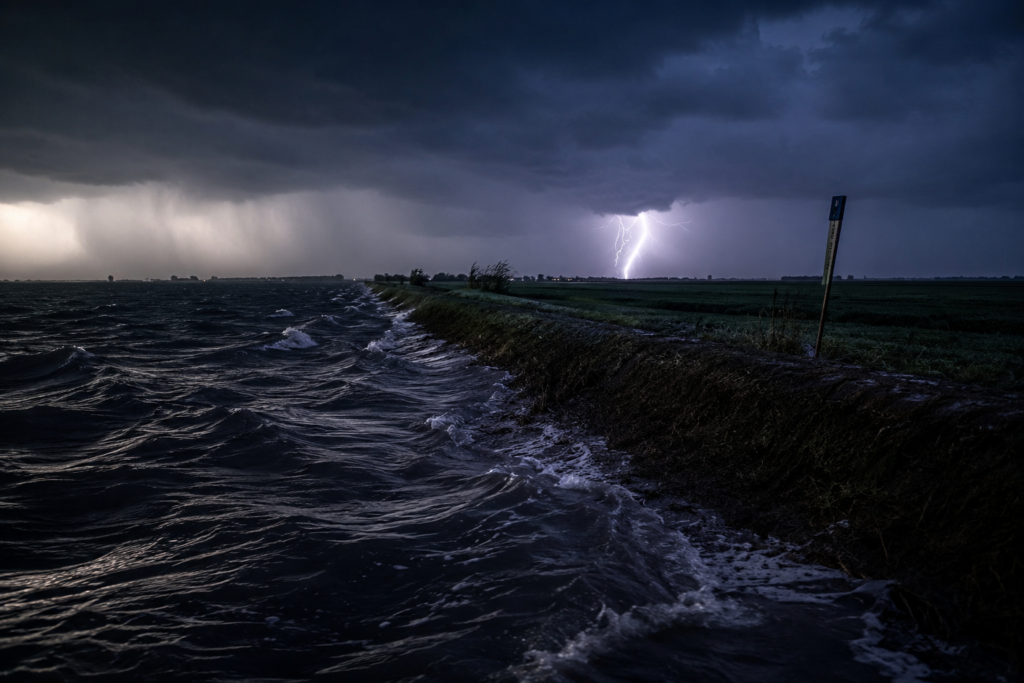
As the hurricane crossed the lake from south to north, its winds pushed the lake’s waters — which rose 6 to 9 feet above normal levels — southward against the dike. The dike failed in multiple locations, releasing a wall of water onto the flat agricultural land south of the lake where tens of thousands of people lived and worked. The flood reached 20 feet in some areas. The terrain offered no high ground — the agricultural land south of Okeechobee is among the flattest in North America, an engineered landscape that exists entirely because water has been managed away from it.
Who Died and Why
The death toll of 2,500 to 3,000 people — the uncertainty itself reflecting how incompletely the victims were counted — was concentrated with brutal specificity in the Black communities of the lake’s southern shore.
The agricultural labor system of South Florida in 1928 was organized around migrant and seasonal workers, overwhelmingly Black, who came from Georgia, the Carolinas, and other Southern states to work the winter crops. They lived in labor camps and small communities in the low-lying land directly south of the lake — exactly the land that the dike failure flooded most severely. These communities had no advance warning equivalent to what urban Palm Beach residents received, limited access to transportation for evacuation, and no elevated ground to retreat to.
White residents of the same region were not unaffected — the storm killed white residents as well — but the death toll was disproportionately concentrated among Black agricultural workers in ways that reflected both their geographic location in the most flood-prone areas and the systemic inequalities that had placed them there.
The aftermath of the storm intensified the inequities of the event itself. Bodies were recovered for weeks as floodwaters receded, and burial arrangements revealed the racial hierarchy of 1928 Florida explicitly: white victims were buried in individual graves in Palm Beach County cemeteries with markers and records. Black victims — nearly 700 of them — were buried in a mass grave in West Palm Beach with no individual markers. The mass grave’s location was largely forgotten within a generation.
Zora Neale Hurston, the Harlem Renaissance author who had grown up in Florida and was deeply connected to its Black communities, chronicled the storm and its aftermath in her 1937 novel Their Eyes Were Watching God — one of the few significant artistic responses to the disaster that centered the experience of Black victims. The novel’s hurricane sequence, set at Lake Okeechobee, drew on Hurston’s direct knowledge of what had happened there nine years earlier.
The Engineering Failure and Its Consequences
The failure of the Okeechobee Levee in 1928 was not a surprise to everyone. Engineers who had examined the dike before the storm had expressed concerns about its adequacy — it was built to manage agricultural water levels, not to withstand hurricane storm surge. The financial interests of the agricultural industry that depended on the dike for flood control had driven its construction on the most economical terms rather than the most robust engineering.
The scale of the catastrophe produced political pressure for a response that previous concerns had not. Congress authorized the Army Corps of Engineers to construct a new, substantially more robust flood control system for the Lake Okeechobee region. The Herbert Hoover Dike — named for the president who authorized the project — was constructed through the 1930s and 1940s and eventually surrounded the entire lake at heights and structural specifications that the original levee had never approached.
The Herbert Hoover Dike itself became a significant engineering concern by the early 21st century: a 2006 inspection identified structural deficiencies in portions of the dike that prompted the Army Corps to undertake a major rehabilitation program — an ongoing project that continues today — replacing and reinforcing sections of the dike that had deteriorated or been identified as inadequate for modern flood control standards. The dike that was built in response to 1928’s catastrophe required its own substantial remediation nearly a century later.
The Long Overdue Recognition
The mass grave in West Palm Beach where nearly 700 Black victims of the 1928 hurricane were buried in unmarked burial received no formal recognition for more than 75 years. Local historians and community members knew of its existence, but no memorial marked the site and no official recognition acknowledged the scale of what had happened there.
In 2003, the Port Mayaca Cemetery — where some of the white victims of the storm had been buried — was listed on the National Register of Historic Places. The mass grave site in West Palm Beach remained unmarked.
After sustained advocacy by community members, historians, and descendants of victims, a memorial was finally dedicated at the mass grave site in West Palm Beach in 2003 — 75 years after the storm. The Hurricane of 1928 Memorial was installed at the site in Woodlawn Cemetery, providing the first formal recognition of the Black victims buried there. Additional commemorations followed in subsequent years, including a Florida Historical Marker at the site.
The belated recognition — and the contrast between the 75-year wait for acknowledgment of the mass grave and the immediate recognition given to white victims — reflects the same historical pattern that has shaped memory of the storm more broadly. The Okeechobee Hurricane killed more people than almost any weather disaster in American history, and it killed them with a specificity that reflected the racial geography of the agricultural South. That specificity shaped not just who died but how their deaths were counted, buried, commemorated, and remembered.
A Storm Worth Remembering
The Okeechobee Hurricane of 1928 is a weather event, an engineering failure, a social history, and a story of belated recognition that is still unfolding. It deserves a place in the American weather historical memory alongside the Galveston Hurricane, the Tri-State Tornado, and the other disasters that shaped the country’s relationship with extreme weather — not despite the social dimensions of its story but because of them.
The storms that reveal the most about a society are the ones that reveal who is most exposed to danger, whose deaths are counted carefully and whose are estimated broadly, and whose suffering generates the institutional response that prevents recurrence and whose does not. The Okeechobee Hurricane of 1928 answers all of these questions in ways that remain relevant long after the waters receded.