The Sound That Traveled Farther Than It Should Have
You’ve heard it on a summer evening: a train whistle from miles away, the bass from a concert across town, the rumble of a distant thunderstorm that the radar shows is 50 miles distant. Sound that seems to travel impossibly far, with a clarity and presence that the same sound wouldn’t have on a winter afternoon. The phenomenon is real, consistent, and explained by the same atmospheric physics that governs weather — the relationship between air temperature, air density, and the behavior of sound waves as they travel through a layered atmosphere.
Understanding atmospheric acoustics connects to several threads running through this series — the temperature inversions that trap air pollutants, the radiative cooling that produces clear summer nights, the thunderstorm physics that produces lightning and its acoustic signature. And it explains something every outdoor person has experienced without having a framework for: why sound behaves so differently on summer nights than summer days.
How Sound Travels Through Air
Sound is a pressure wave — a series of compressions and rarefactions that propagate through a medium by transferring energy from molecule to molecule. The speed at which these waves travel depends primarily on the temperature of the medium: warmer air has more energetic molecules that transfer the pressure wave faster, while cooler air has less energetic molecules that transfer it more slowly.
At sea level, sound travels approximately 1,125 feet per second at 70°F — the basis of the five-seconds-per-mile rule for estimating lightning distance by counting seconds between flash and thunder. At 90°F, sound travels roughly 1,155 feet per second. At 40°F, approximately 1,090 feet per second. The variation is modest — about 1 foot per second per degree Fahrenheit — but its consequences for how sound travels through a layered atmosphere are significant.
The critical phenomenon is refraction: the bending of sound waves as they pass through air of different temperatures. When sound travels from warmer air into cooler air, it slows and bends toward the cooler air. When it travels from cooler into warmer air, it speeds up and bends away from the warmer air. This refraction is what determines whether sound stays near the ground — where it can be heard — or bends upward into the atmosphere where it becomes inaudible.
Why Sound Carries Farther on Summer Nights
During the day, the sun heats the ground, which heats the air immediately above it. The typical daytime temperature profile — warm at the surface, cooler aloft — means that sound waves traveling outward from a source encounter cooler air as they rise and are refracted upward, away from the ground. This upward refraction effectively lifts sound energy away from the surface where human ears are located, limiting how far the sound carries.
At night — particularly on the calm, clear summer nights described in the spring cold nights science piece — the pattern reverses. Radiative cooling causes the ground surface to lose heat to space, chilling the air immediately above it while the air aloft remains relatively warm from the day’s heating. This temperature inversion — cool air near the surface, warmer air above — reverses the refraction direction: sound waves traveling outward encounter warmer air as they rise, which refracts them back downward toward the ground rather than upward away from it.
This downward refraction creates what atmospheric acousticians call a sound duct: a layer of atmosphere near the ground in which sound waves are trapped, bouncing between the ground surface and the inversion layer above, traveling much farther than they would in a neutral or upward-refracting atmosphere. The same sound source produces a much larger audible range on a calm, clear summer night with a temperature inversion than on a sunny afternoon with normal temperature profiles.
This is why distant train whistles, highway noise, and the bass from outdoor concerts carry so far on summer nights — they are being ducted along the surface rather than refracted upward into inaudible altitudes. It is also why thunderstorm rumble can be heard from extraordinary distances on calm evenings: the sound energy that would be lost upward during the day is retained near the surface at night.
Wind’s Effect on Sound: Asymmetric Carrying
Wind adds another layer to atmospheric acoustics that explains a common experience: sound carries much farther downwind than upwind from the same source.
Wind speed typically increases with altitude — the surface friction that slows wind near the ground is absent at higher altitudes. This wind speed gradient produces a refraction effect: sound traveling downwind is moving into progressively faster-moving air as it rises, which refracts the waves downward toward the ground, increasing the distance it travels at the surface. Sound traveling upwind moves into slower air as it rises, which refracts waves upward, reducing the distance it carries.
The asymmetry can be dramatic. A sound source that is clearly audible a mile downwind may be essentially inaudible a quarter mile upwind. This is why you can hear a band playing at an outdoor festival from a parking lot a mile away when you approach from the downwind direction but barely hear them standing across the road upwind.
For thunderstorm detection, this means that storm sound travels farther in the downwind direction — the direction the storm is moving. A storm approaching from the west will typically be heard at greater distance than the same storm retreating to the east from the same location, because the downwind direction (east) carries sound farther than the upwind direction (west) from the storm’s perspective.
Thunder: The Sound of Lightning Decoded
Thunder is one of the most acoustically interesting sounds in nature, and its character at different distances reflects the physics of sound propagation through the atmosphere.
A lightning bolt is not a point source of sound — it is a linear source, a channel potentially several miles long that produces sound simultaneously along its entire length. The thunder you hear is the integration of sound arriving from different parts of this channel at different times. Sound from the nearest point of the channel arrives first; sound from progressively more distant parts of the channel arrives later. This is why distant thunder has a rolling, extended character rather than the sharp crack of a nearby strike: you are hearing the sequential arrival of sound from different parts of a long channel.
The specific sound character of thunder also changes with distance due to atmospheric absorption. High-frequency components of sound — the sharp crack of a nearby strike — are absorbed by the atmosphere more rapidly than low-frequency components. The bass rumble of distant thunder is the residual low-frequency energy that has survived the atmospheric absorption that removed the higher frequencies. A lightning strike that sounds like a sharp crack at 1,000 feet sounds like a deep, rolling rumble at 10 miles — not because it is a different phenomenon but because the atmosphere has filtered it.
This frequency-dependent absorption is why distant thunderstorms sound different from nearby ones in a way that goes beyond simply being quieter. The nearby storm’s thunder has the full frequency spectrum of the lightning discharge. The distant storm’s thunder has had its high-frequency content progressively removed by atmospheric absorption, leaving only the low-frequency rumble that carries farthest.
The Whispering Gallery Effect and Outdoor Acoustics
The same refraction principles that govern how thunder travels also affect the acoustics of outdoor spaces in summer in ways that create occasionally striking experiences.
Sound that travels along a curved surface — the inside of a dome, the surface of a still body of water — can follow the surface for extraordinary distances through a phenomenon called the whispering gallery effect. The curved surface continuously refracts sound waves back toward the surface, preventing them from spreading into the surrounding space and allowing them to travel much farther than free-space propagation would allow.
Over still water on calm summer nights, this effect can produce the experience of hearing a conversation clearly at distances that seem impossible — the water surface and the inversion layer above it create a near-ideal acoustic duct. Boaters on lakes at night sometimes report hearing conversations from other vessels hundreds of meters away with startling clarity, while the same voices would be inaudible during the day in normal atmospheric conditions.
Listening to Summer Differently
The atmospheric acoustics of summer nights — the temperature inversions, the wind gradients, the frequency-dependent absorption that transforms nearby thunder’s crack into distant thunder’s roll — are all expressions of the same physical principles that govern weather itself. The atmosphere that refracts light to produce mirages and halos also refracts sound to produce acoustic ducts and asymmetric sound propagation.
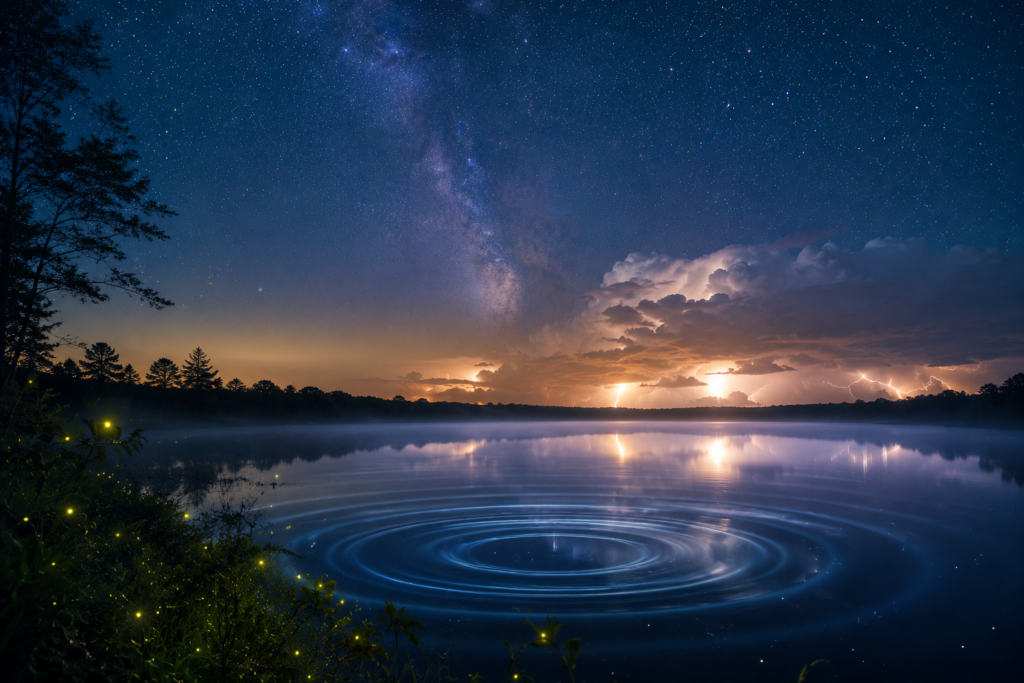
The distant rumble of a summer thunderstorm, rolling in from the horizon on a calm night, is traveling to your ears through a specific atmospheric structure — a duct between the ground and the inversion layer that was created by the same radiative cooling that made the stars unusually bright. The train whistle three towns over is following the same path, guided to your ears by the same physics.
The summer night sounds different from the summer afternoon, and now you know why.