The Phenomenon Has a Name. The Name Is Wrong.
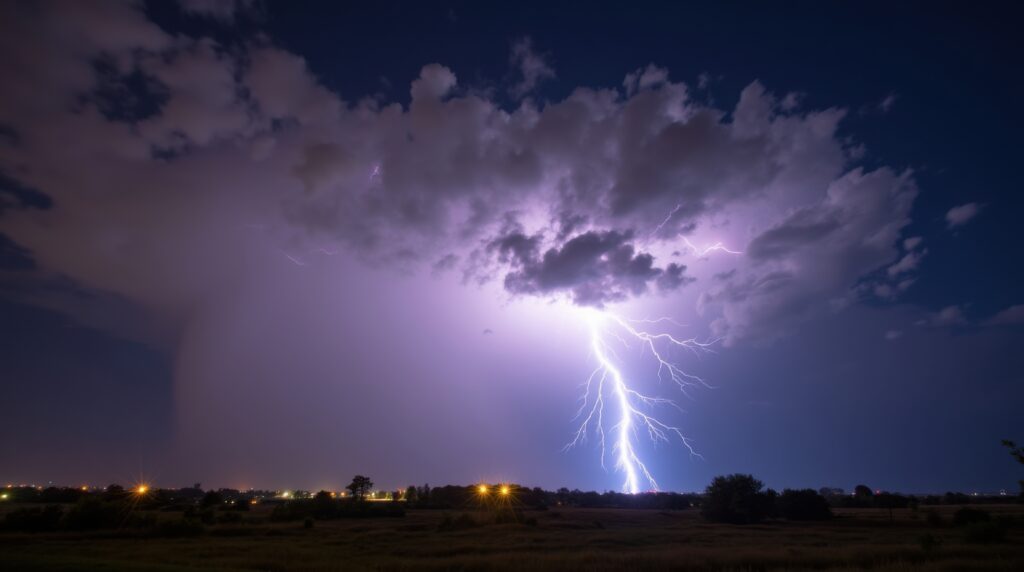
Sit on a porch on a warm May or June evening and you’ll often see it: flashes of light on the horizon, illuminating distant clouds from within or silhouetting them against a briefly brightened sky. No thunder follows. The air is calm. The sky overhead is clear. Whatever is producing those flashes seems to be doing it in a different world — too far away to hear, too consistent to be coincidence.
This phenomenon has been called heat lightning for centuries, and the name implies a specific mechanism: lightning generated by heat alone, without the thunderstorm machinery of updrafts, ice crystals, and charge separation that produces ordinary lightning. It is a satisfying explanation, intuitively plausible on a muggy summer evening, and entirely wrong.
Heat lightning is ordinary lightning. It is produced by ordinary thunderstorms through ordinary mechanisms. What makes it appear different — silent, diffuse, far away — is distance and atmospheric optics, not any difference in how it forms. Understanding what you’re actually seeing when you watch heat lightning turns a pleasant but vague observation into a genuinely interesting window into storm geography, atmospheric light transmission, and why warm-season nights produce so many visible distant storms.
Why You Can See It But Not Hear It
The defining characteristic of heat lightning — the absence of thunder — is the key to understanding it. Thunder is the acoustic shockwave produced by the rapid heating and expansion of air along a lightning channel. It is loud at close range but attenuates rapidly with distance, both because sound spreads outward in three dimensions and because atmospheric absorption and turbulence scatter sound energy.
Under typical atmospheric conditions, thunder is audible to a maximum range of about 10 miles from the lightning strike. Beyond that distance, the sound has attenuated below the threshold of human hearing. Lightning, however, is visible at distances far exceeding 10 miles — under the right atmospheric conditions, the light from a single large lightning bolt or the illumination of a cloud by multiple strokes can be seen from 100 miles or more away.
This asymmetry — light traveling much farther than sound under the same atmospheric conditions — is the entire explanation for heat lightning. When you see flashes on the horizon with no accompanying thunder, you are watching a thunderstorm that is more than 10 miles away, often 50 to 100 miles distant. The lightning is real, the storm is real, and the thunder is real — it simply cannot reach you across that distance.
Why Warm Evenings Produce So Much of It
Heat lightning is most commonly observed on warm, humid evenings in late spring and summer, and this seasonal pattern has reinforced the incorrect belief that heat is somehow generating the lightning. The real reason warm evenings produce so much visible distant lightning is a combination of storm geography, atmospheric transparency, and the geometry of how far you can see at night.
Warm, unstable afternoons produce thunderstorms across a wide geographic area. By evening, storms that developed 50 to 150 miles away are still producing lightning as they mature or dissipate, and the distance that seemed unreachable in afternoon haze becomes visually accessible at night when the horizon extends farther and the sky is darker.
Warm, humid air is also more transparent to visible light in certain wavelength ranges than the dry, hazy air of summer afternoons. The low-angle light transmission that applies to sunsets also affects how far lightning illumination can propagate — under the right atmospheric conditions, the light from a large lightning flash can illuminate cloud tops visible from extraordinary distances.
The thunderstorm activity itself is geographically distributed across a large area in warm seasons. On a calm May evening in Kansas City, there may simultaneously be active thunderstorms in Nebraska, Iowa, Missouri, and Oklahoma — all within visual range but none close enough for thunder. The flicker of lightning from multiple simultaneous distant storms produces a nearly continuous light show that looks nothing like the sharp, nearby strikes of a storm overhead.
The Geometry of Distant Lightning Visibility
The specific appearance of heat lightning — diffuse glows and cloud illumination rather than distinct bolt shapes — is a product of both distance and the geometry of what part of the storm is visible from far away.
At close range, a lightning bolt is a discrete, sharp channel of light visible from the ground to the cloud. At 50 to 100 miles distance, the geometry changes: the ground-level portions of the storm are below the horizon, hidden by Earth’s curvature. Only the upper portions of the storm — towering cumulonimbus tops that may reach 50,000 feet or higher — are visible above the horizon. Lightning within these upper cloud regions doesn’t appear as discrete bolts but as diffuse illumination — the cloud lighting up from within as lightning discharges between charge centers inside it.
This is why heat lightning looks so different from nearby lightning. You’re not seeing the lightning bolt itself — you’re seeing the cloud it illuminates, from a distance and angle that shows only the storm’s uppermost structure. The same storm producing terrifying bolt-to-ground strikes in Omaha appears as a gentle, diffuse glow from Kansas City 200 miles away.
Cloud-to-cloud lightning — discharges between charge centers within the same storm or between adjacent storms — is also more visible at distance than ground strikes because it illuminates the cloud from within rather than producing a discrete bolt that travels to the ground. On nights with multiple active storm systems in the region, the interplay of cloud-to-cloud discharges between distant storm systems can produce nearly continuous flickering across large sections of the sky.
Why Some Evenings Produce More Heat Lightning Than Others
The visibility of distant lightning varies significantly from night to night, and the factors that determine it are the same atmospheric variables that affect all long-range visibility.
Atmospheric clarity is the primary determinant. After a cold frontal passage that has cleared the lower atmosphere of haze, dust, and aerosols, visibility extends dramatically farther than on hazy evenings when particulates scatter and absorb light. The most spectacular heat lightning displays often occur on clear post-frontal evenings when distant storm systems are producing active lightning in an atmosphere unusually transparent to light.
Humidity in the lower atmosphere can cut both ways. Moderate humidity increases atmospheric density in ways that can enhance the propagation of certain light wavelengths, but high surface humidity combined with aerosols produces haze that limits visibility. The clearest heat lightning views typically occur at moderate humidity levels — comfortable rather than oppressive — with high upper-level moisture that supports the distant storms producing the lightning.
The phase of the moon matters for the visibility of subtle distant flashes. A bright full moon washes out the faint illumination of distant clouds in the same way it washes out stars; the darkest nights, near new moon, produce the most dramatic heat lightning displays because the contrast between the dark sky and the briefly illuminated clouds is greatest.
What the Distant Storms Are Telling You
Heat lightning is not just a beautiful atmospheric light show — it’s information about the weather geography surrounding you. The direction and persistence of distant lightning tells you where active storm systems are located and, combined with knowledge of the general wind flow pattern, something about whether those storms are moving toward or away from your location.
A heat lightning display that is intensifying — flashes becoming more frequent and the illuminated area growing — indicates storms moving closer. Combined with a wind shift or falling barometric pressure, it can be early notice of an approaching storm system hours before standard forecast tools would prompt awareness.
Meteorologists and storm chasers use distant lightning as one of several tools for tracking storm activity across a broad area, particularly at night when visual storm observation is otherwise impossible. The direction, frequency, and character of lightning illumination on the horizon provides information about where active convection is occurring that supplements radar data and satellite imagery.
An Old Name for an Old Observation
The term heat lightning is old — it appears in written records from the 18th century and almost certainly predates those. For most of human history, the inability to hear thunder from distant storms, combined with the observation that the phenomenon was most common on hot evenings, made the heat explanation seem reasonable. Without the ability to detect distant storms by any means other than direct observation, the connection between the silent flashes and a thunderstorm 100 miles away was impossible to make.
The explanation has been known to science for well over a century. The name has simply persisted because it is vivid, familiar, and attached to a genuine and beautiful phenomenon that deserves a name. Heat lightning may not be caused by heat, but it is reliably seen on warm evenings, reliably beautiful, and reliably worth watching from a porch when the sky overhead is clear and the distant horizon flickers with the electricity of storms you’ll never hear.