A Region That Didn’t Expect Tornadoes
When people think of tornado country, Pennsylvania and Ohio rarely come to mind. The Great Plains, Oklahoma, Kansas, Texas — those are the places where tornadoes happen. The forested hills and river valleys of the mid-Appalachians feel like a different world from the flat, open terrain of Tornado Alley. This perception, widespread in the mid-1980s as it is today, contributed directly to the death toll of the most catastrophic tornado outbreak in northeastern American history.
On the evening of May 31, 1985, a family of tornadoes swept across northwestern Pennsylvania, northeastern Ohio, and southern Ontario, killing 88 people and injuring more than 1,000. It remains the deadliest tornado event in Pennsylvania history and one of the deadliest in the entire northeastern United States. The outbreak’s devastation was magnified by the near-total unpreparedness of communities that had never considered themselves at serious tornado risk.
The Atmospheric Setup
The conditions on May 31, 1985 were the product of a classic late-spring severe weather pattern that would be immediately recognizable to any modern meteorologist — but which the forecasting technology of 1985 could characterize only in general terms.
A powerful low-pressure system was tracking northeast across the Great Lakes region, drawing warm, unstable air northward from the Gulf region along its eastern flank. The jet stream was positioned directly over the Ohio Valley, providing extreme wind shear at all levels of the atmosphere. Surface temperatures across western Pennsylvania had climbed into the low 80s during the afternoon, and dew points were in the mid-60s — air mass characteristics more typical of Oklahoma in May than of western Pennsylvania.
The Storm Prediction Center’s predecessor had issued a tornado watch for the region by mid-afternoon. But tornado watches in the northeastern United States in 1985 were relatively rare events that many residents, emergency managers, and even local meteorologists had limited experience responding to. The cultural framework for tornado preparedness — the drills, the designated shelters, the instinctive response of seeking cover at a warning — that had been developed through decades of experience in the Plains states was largely absent in Pennsylvania and northeastern Ohio.
The Tornadoes
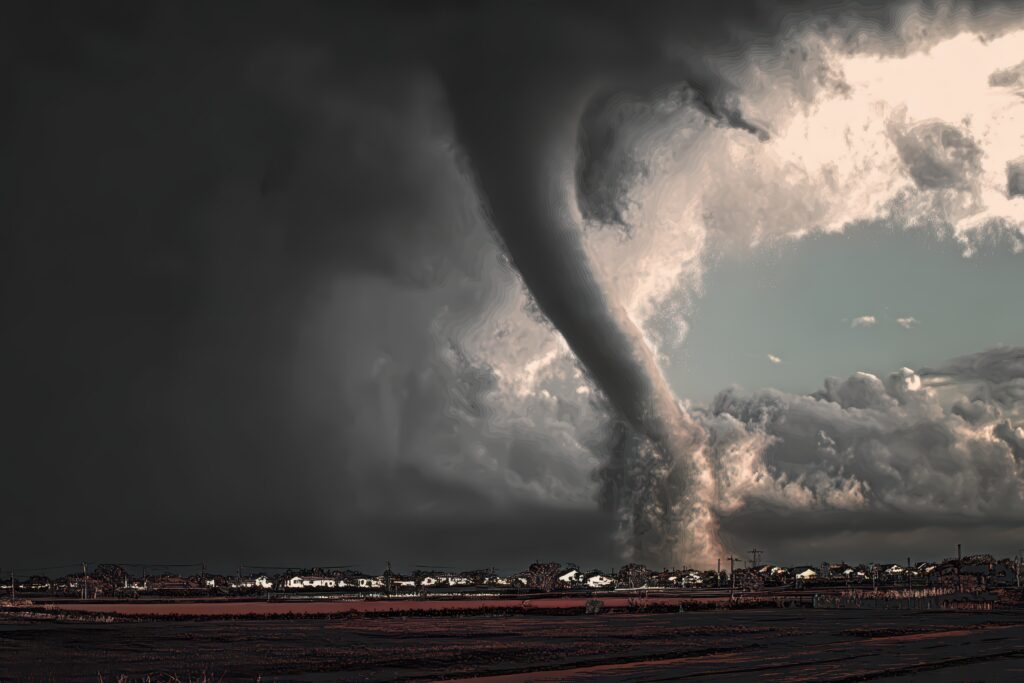
The outbreak produced a family of tornadoes that developed rapidly along a squall line as it moved northeast through the early evening hours. Unlike the discrete supercell tornadoes of the Plains, some of the May 31 tornadoes formed from a quasi-linear convective system — a line of intense thunderstorms that produced brief, violent tornadoes with very little warning time.
The most destructive tornado of the outbreak struck Wheatland and Hermitage in Mercer County, Pennsylvania, killing 12 people and destroying hundreds of homes. A second violent tornado tracked through Albion, Cranesville, and into New York state, killing 9 people and producing damage consistent with F4 intensity.
The Newton Falls, Ohio tornado killed 12 people, including several who were caught outdoors or in vehicles when the storm struck with little warning. Communities along the Lake Erie shoreline in both Ohio and Pennsylvania, and extending into southern Ontario where the outbreak crossed the international border, experienced tornado damage on a scale that residents had no historical reference for.
In total, the outbreak produced approximately 40 tornadoes across the three jurisdictions in a period of roughly four hours. The concentration of casualties in the northeastern United States rather than the traditional tornado belt created particular shock — these were communities without storm shelters, without a culture of tornado awareness, and without the reflexive response to warnings that decades of Plains tornado experience had built into communities like those in Oklahoma and Kansas.
Why the Death Toll Was So High
Several factors combined to produce a death toll that seems high even for an outbreak of this intensity.
Radar technology in 1985 was in a transitional period. The modern NEXRAD Doppler radar network, which can detect rotation within thunderstorms and provide warnings with 10 to 15 minutes of lead time, was still years from deployment. The conventional radar of 1985 showed precipitation but could not reliably identify rotating storm structures or differentiate tornado-producing supercells from ordinary severe thunderstorms. Warning lead times were measured in minutes rather than the 13-minute average that post-NEXRAD studies document.
Warning dissemination was limited. The Emergency Alert System as it exists today — capable of pushing alerts directly to radio, television, and eventually mobile phones — was not operational in its modern form. Warnings were broadcast on radio and television and through outdoor siren networks that had highly variable coverage and reliability across the region. Many residents in rural areas of western Pennsylvania received no warning at all before tornadoes struck.
The regional inexperience with tornado response compounded both of these factors. In Oklahoma or Kansas, a tornado watch prompts immediate behavioral changes — people monitor weather radio, identify shelter locations, and maintain heightened awareness. In western Pennsylvania in 1985, many residents had never experienced a significant tornado and had no practiced response to a watch. The watch that had been issued hours earlier had not produced the behavioral changes that might have saved lives when warnings followed.
What Changed Because of It
The May 1985 outbreak was a significant driver of several improvements in tornado preparedness infrastructure across the northeastern United States.
The National Weather Service accelerated public education campaigns in traditionally low-tornado-risk regions, emphasizing that no part of the country was immune from tornado danger and that the perceived safety of hilly, forested terrain was a myth. The outbreak became a standard case study in meteorological and emergency management training for how complacency about regional tornado risk contributes to casualties.
The drive toward Doppler radar deployment gained additional urgency. The NEXRAD network, which had been in development and planning for years, was partly justified by the need to provide better warning lead times for tornadoes in all regions — not just the Plains states. The first operational NEXRAD units came online in the early 1990s, and the full network was in place by 1997.
Community tornado preparedness programs expanded into the northeastern United States, bringing the shelter identification, drill practices, and cultural awareness that had long been standard in tornado-prone regions to areas that had previously considered them unnecessary.
Tornadoes Don’t Respect Geography
The fundamental lesson of the May 31, 1985 outbreak — that tornadoes occur in the northeastern United States, in hilly terrain, in forested regions, in places that don’t consider themselves tornado country — remains only partially absorbed forty years later.
Tornado risk in the Northeast and mid-Atlantic is genuine, though lower than in the Plains states. New England, New York, Pennsylvania, Ohio, and Michigan all experience significant tornadoes in most years. The geography does influence tornado behavior — terrain can disrupt some storm structures — but it does not prevent tornadoes from forming or tracking through populated areas.
The spring atmospheric conditions that produced the May 31, 1985 outbreak are not historically anomalous. They occur in some form across the northeastern United States every May, when Gulf moisture occasionally pushes far enough north and east to fuel severe thunderstorms in regions that don’t experience it routinely. Most years, those conditions produce strong thunderstorms without tornadoes. In 1985, they produced forty tornadoes and 88 deaths.
The difference between that outcome and what a similar atmospheric event would produce today is the Doppler radar network, the improved warning systems, and — most importantly — a slightly better cultural awareness that tornado warnings in Pennsylvania and Ohio deserve the same response as tornado warnings in Oklahoma. The 1985 outbreak helped build that awareness. It is a lesson worth remembering every May.