The Most Dangerous Tornado Month Has Arrived
April tornadoes get significant attention because they arrive early in the season and catch people psychologically unprepared for severe weather. But statistically, May is the most active and most dangerous tornado month in the United States. More tornadoes touch down in May than any other month. More significant tornadoes — those rated EF2 or stronger — occur in May than any other month. The deadliest tornado outbreaks in modern American history have disproportionately clustered in May.
This isn’t coincidence. The atmospheric conditions that produce tornadoes reach their annual peak in May, and understanding why explains both the heightened risk and what you can do to navigate the month’s weather more safely.
Why May Peaks Above April and June
Tornado season runs roughly from March through June across the central United States, with a secondary peak in the fall across the Southeast. Within that window, May occupies a specific sweet spot that produces the most extreme atmospheric conditions of the year for tornado development.
The three ingredients required for tornado-producing supercells — moisture, instability, and wind shear — all reach their seasonal maximum in May, and they reach it simultaneously.
Moisture peaks in May because the Gulf of Mexico has had all spring to warm from its winter minimum. By May, sea surface temperatures in the Gulf are high enough to support vigorous evaporation, and the southerly flow that pulls this moisture northward is well-established. Surface dew points across the southern Plains and Midwest regularly reach the mid-60s to low 70s in May — values that represent enormous potential energy available to thunderstorms. April’s moisture, while significant, is typically lower because the Gulf is still warming.
Instability is maximized by the contrast between this warm, moist surface air and the upper atmosphere that, while warming, is still cold enough to create extreme temperature gradients with height. The steeper this gradient — warm and moist at the bottom, cold aloft — the more explosive the vertical development when surface air is lifted. May’s surface temperatures are higher than April’s, making the contrast with cold air aloft greater and the instability more extreme.
Wind shear — the change in wind speed and direction with altitude — remains powerful in May because the jet stream, while beginning its summer retreat northward, is still strong and still positioned over the country’s midsection. By July, the jet stream has retreated into Canada and weakened substantially, reducing the wind shear that organizes supercells and enables tornado formation. May sits at the peak of the jet stream’s influence over the prime tornado geography.
The convergence of all three ingredients at their annual maximum in the same region — the southern Plains and Midwest — in the same month is what makes May exceptional.
The Geography of May Tornadoes
May tornado activity is concentrated in a specific geographic corridor that has shifted somewhat over the decades but remains centered on Oklahoma, Kansas, northern Texas, and Nebraska — the heart of traditional Tornado Alley — with significant activity extending into Missouri, Iowa, Illinois, and Indiana.
This geography reflects the convergence zone where Gulf moisture meets drier air from the west and cold air from the north, along the dryline and cold frontal boundaries that serve as the primary lifting mechanisms for storm initiation. When all three air masses — moist Gulf air, dry desert air from the Southwest, and cold Canadian air from the north — meet in a tight geographic area with a strong jet stream overhead, the resulting atmospheric instability is extraordinary.
The movement of this convergence zone northward through spring tracks the advancing warm season: in March, the most favorable tornado geography is over Texas and Louisiana. By April, it has shifted north to Oklahoma and Kansas. In May, it reaches its maximum extent, covering an area from Texas to Nebraska and pushing significant activity into the upper Midwest. By June, the zone has moved into the northern Plains and the risk for the central United States begins to diminish.
The Outbreaks That Define the Month
Several of the most destructive tornado outbreaks in American history have occurred in May, and their stories illuminate both what May conditions produce and why warnings, while vastly better than they were decades ago, cannot eliminate all casualties.
The May 3, 1999 Oklahoma tornado outbreak produced 74 tornadoes across Oklahoma and Kansas in a single day, including the Bridge Creek-Moore tornado — an F5 that was at the time measured with the highest wind speed ever recorded near Earth’s surface, estimated at over 300 miles per hour. The storm struck the Oklahoma City metropolitan area directly, killing 36 people despite tornado warnings that had been issued 38 minutes before impact.
The April 25 through May 28, 2011 tornado season — one of the most active on record — culminated in the May 22, 2011 Joplin, Missouri tornado, which killed 161 people and remains the deadliest single tornado in the United States since 1947. The Joplin tornado was an EF5 that struck with a warning lead time of approximately 17 to 24 minutes. The death toll, while devastating, would almost certainly have been far higher without modern warning infrastructure.
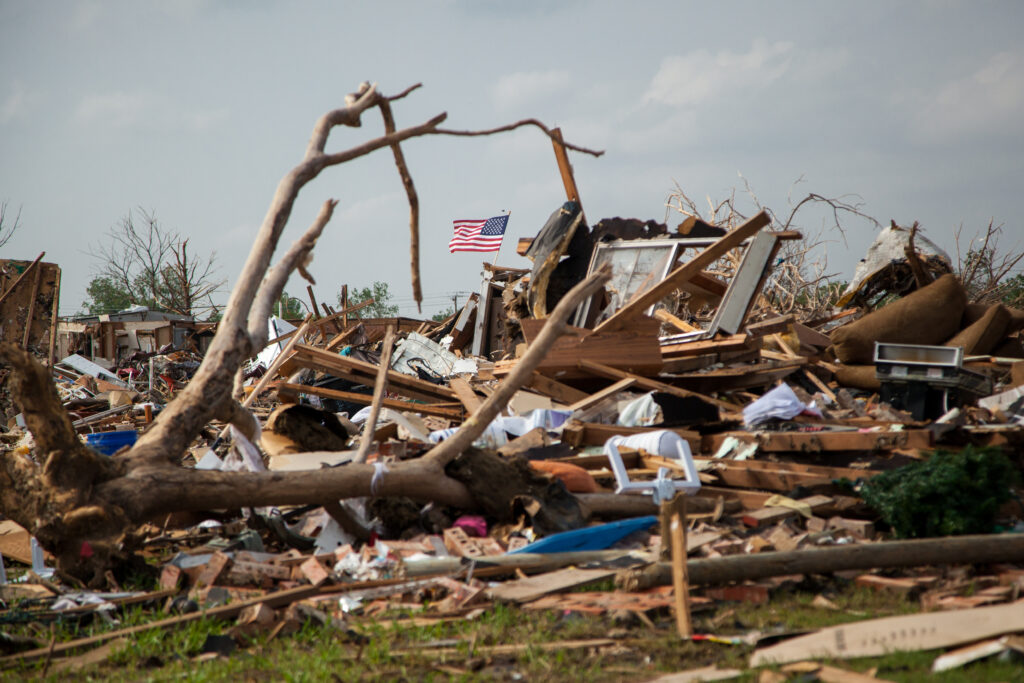
The May 20, 2013 Moore, Oklahoma tornado — also an EF5, also striking the Oklahoma City area — killed 24 people including seven children at Plaza Towers Elementary School. The storm was forecast and warned; the deaths occurred primarily because the affected area had inadequate shelter options, particularly in schools that lacked underground shelters.
These events are not failures of meteorology — warnings were issued with meaningful lead times in all cases. They are reminders that warning time is only valuable when it is acted upon and when adequate shelter exists.
What Changes in May for Safety Purposes
Understanding that May is peak tornado month has practical implications for how you approach the month’s weather.
Maintain awareness throughout the month, not just during obvious severe weather days. Some of May’s most significant tornado events have developed on days that seemed marginal in the morning forecast and then rapidly intensified as instability built through the afternoon. Checking the Storm Prediction Center’s convective outlook — available free at spc.noaa.gov — each morning in May gives you a reliable baseline for how concerning the day’s atmosphere is.
Know the difference between a watch and a warning — and act on both. A tornado watch means conditions are favorable for tornado development in the watch area. A tornado warning means a tornado has been detected by radar or confirmed by a spotter and is imminent or occurring. A watch is the time to prepare and identify your shelter. A warning is the time to be in that shelter immediately.
Have a shelter plan that doesn’t depend on good decisions made under pressure. The research on tornado deaths consistently shows that casualties are higher when people are making shelter decisions for the first time during the warning — deciding where to go, whether to leave work or school, whether to drive away from a storm. Having made those decisions in advance, rehearsed them, and knowing exactly where you’re going when a warning sounds removes the decision-making burden from the worst possible moment.
Mobile homes remain the highest-risk shelter during tornadoes, regardless of tie-downs. This is worth repeating every tornado season: if you live in or are visiting a mobile home or manufactured structure when a tornado warning is issued, leave for a sturdier structure immediately. No mobile home is an adequate tornado shelter.
May’s Severity Is Also Its Warning
The same conditions that make May dangerous also make May’s severe weather more forecastable. High-end tornado days — the days with significant outbreak potential — are typically identifiable days in advance because the atmospheric ingredients that produce them are large-scale and detectable in numerical weather prediction models. The Storm Prediction Center issues outlooks at Day 1, Day 2, and Day 3 that reliably identify the most dangerous weather days before they arrive.
This predictability is May’s silver lining. The worst tornado days of the year are also the most warned-about days of the year, appearing in forecasts 24 to 72 hours before they materialize. The question is always whether those warnings reach the people in the path of the storms, and whether those people have the plans and shelter in place to act on them.
May rewards preparation. The atmospheric conditions it produces are among the most powerful the atmosphere can generate — and the forecasting tools that track those conditions have never been better.