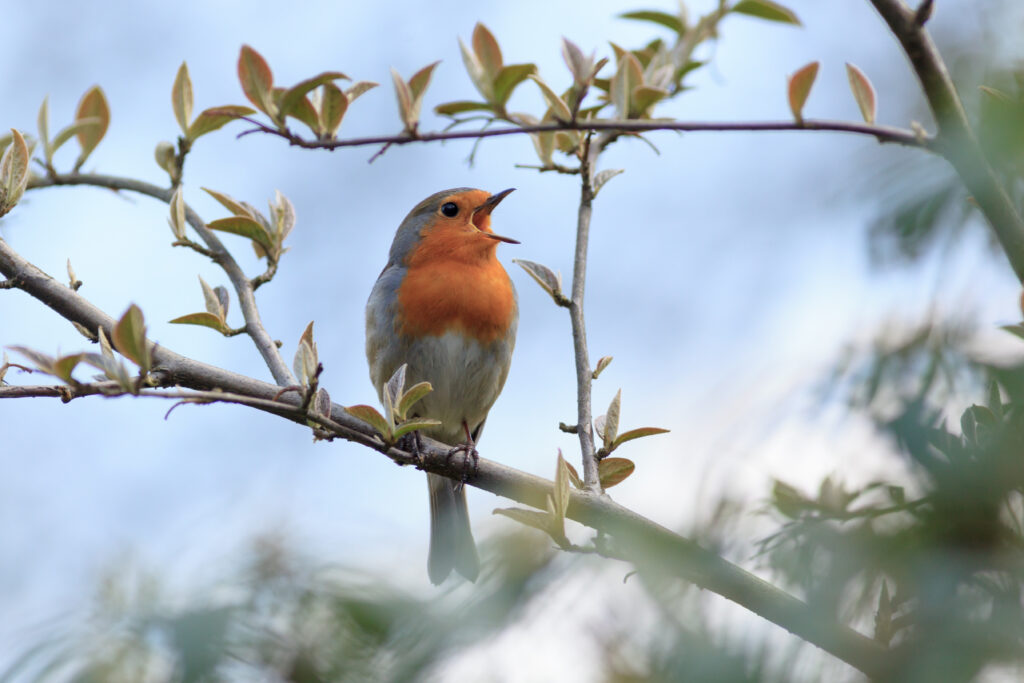
The Sudden Symphony That Signals Seasonal Change
Walk outside on a March morning and you’re greeted by something that was absent just weeks before: an explosion of birdsong. Robins, cardinals, sparrows, and dozens of other species fill the air with calls, whistles, and complex melodies that seem to come from every direction. The same neighborhood that was relatively quiet in January now hosts a daily dawn chorus that can wake you before your alarm.
This spring increase in birdsong isn’t random or simply birds being cheerful about warmer weather. It’s driven by powerful biological imperatives related to breeding, territoriality, and reproduction. Understanding why birds sing more in spring reveals the sophisticated communication systems birds use and how seasonal changes trigger hormonal shifts that transform quiet winter residents into vocal performers.
Birdsong Serves Specific Purposes
Not all bird vocalizations are “songs” in the technical sense. Birds produce two main types of sounds:
Calls are short, simple vocalizations used year-round for immediate communication—alarm calls warning of predators, contact calls keeping flocks together, flight calls announcing movement. These occur in all seasons.
Songs are longer, more complex, and often musical vocalizations typically produced only by males during breeding season. Songs serve two primary functions: attracting mates and defending territories.
The dramatic increase in bird activity you notice in spring is primarily an increase in singing rather than calling. Males that were relatively quiet through winter suddenly become persistent vocalists, singing from prominent perches for hours daily.
Lengthening Days Trigger Hormonal Changes
Birds respond to increasing day length (photoperiod) in late winter and early spring. As days grow longer, specialized cells in birds’ brains detect the change in light exposure. This triggers a cascade of hormonal changes that prepare birds for breeding.
The hypothalamus releases hormones that stimulate the pituitary gland, which in turn produces hormones that cause the gonads (testes in males) to grow dramatically. In many songbirds, the testes can increase in size by several hundred times within weeks as breeding season approaches.
This gonadal growth produces testosterone, which has profound effects on male birds. Testosterone drives aggressive territorial behavior, increases singing rate and duration, and enhances the complexity of songs. It also causes physical changes—some species develop brighter plumage, and the song-control regions in birds’ brains actually grow larger under testosterone’s influence.
These hormonal changes essentially reprogram male birds from winter survival mode to breeding mode. A male robin that spent winter quietly foraging suddenly becomes a territorial singer defending a breeding area and advertising for a mate.
Establishing Territory Is Critical
Most songbirds are territorial during breeding season, defending exclusive areas where they’ll nest and raise young. Territory serves multiple purposes: it provides food resources for the breeding pair and their nestlings, offers nesting sites, and spaces out the population to reduce competition and disease transmission.
Establishing and defending territory requires communication, and song is the primary tool. A singing male is essentially posting “No Trespassing” signs around his territory. The song tells other males of the same species: “This area is occupied. Find your own territory or be prepared to fight.”
Territorial singing is most intense in early spring when birds are establishing boundaries. Males sing from prominent perches throughout their territory—treetops, utility wires, rooftops—to broadcast their claim as widely as possible. Singing from multiple locations within the territory defines its boundaries and reinforces the owner’s presence.
Territory defense can escalate to physical fighting if songs don’t settle the matter, but most disputes are resolved through vocal displays. The bird with the stronger, more persistent song often wins without physical confrontation.
Attracting Mates Requires Advertising
While territory defense explains much spring singing, mate attraction is equally important. Females select mates based partly on song quality, complexity, and persistence. A male who sings frequently, from multiple locations, with complex songs is advertising his fitness and genetic quality.
Song serves as an honest signal of male quality because producing and maintaining complex songs requires good health, proper brain development, and sufficient energy reserves. A sick or undernourished bird can’t sing as well as a healthy one. Females using song quality to choose mates are essentially selecting for genetic fitness and good territory holders.
This is why male birds don’t just sing—they sing elaborately, adding trills, variations, and extended performances. Many species have repertoires of multiple song types, and males that master larger repertoires often have greater breeding success.
The persistence of singing also signals commitment and fitness. A male who can spend hours daily singing while also finding food, avoiding predators, and defending territory is demonstrating impressive competence.
The Dawn Chorus Phenomenon
Birdsong peaks at dawn—the hour just before and after sunrise when bird activity reaches its maximum. This “dawn chorus” is often the most impressive acoustic display of spring, with dozens of species singing simultaneously.
Several factors contribute to dawn singing intensity:
Acoustic conditions are optimal at dawn. Cooler, denser air carries sound farther, and there’s typically less wind and ambient noise. Songs broadcast at dawn reach farther than they would later in the day.
Light levels are sufficient to see but not bright enough for efficient foraging yet. Birds use this twilight period for territorial displays rather than feeding.
Hormones peak at dawn in many species. Testosterone levels follow daily cycles, often reaching maximum in early morning, driving increased singing motivation.
Social stimulation creates a feedback loop. As one bird begins singing, others join in, creating escalating vocal competition.
The dawn chorus typically lasts 30-90 minutes, then gradually subsides as birds transition to foraging and other activities. A smaller evening chorus may occur before sunset in some species, but it’s typically less intense than dawn singing.
Species Variation in Timing
Different bird species begin breeding activities at different times, creating a progression of song activity through spring. Early migrants and residents start first, while later arrivals join the chorus as they return from wintering grounds.
Robins are among the earliest singers, sometimes starting territorial singing in late February or early March even when snow remains on the ground. Cardinals, song sparrows, and tufted titmice also begin relatively early.
Warblers, vireos, and other late migrants don’t arrive until late April or May, adding new voices to the spring chorus as they establish territories in their breeding areas.
This staggered timing reduces competition—species arriving at different times compete less for territories and mates—and extends the period during which you notice increased bird activity.
Why Winter Is Quieter
The contrast between winter and spring birdsong is stark, but it’s not that birds are silent in winter. They’re just not singing.
Winter birds still produce calls for communication—flock contact calls, alarm calls, begging calls at feeders. What’s missing is territorial singing because most birds aren’t defending breeding territories in winter.
Many species form flocks in winter, and territorial behavior is suspended. Birds that would attack each other during breeding season tolerate close proximity at winter feeding sites. There’s no benefit to singing in winter, and it would waste energy and attract predators without providing reproductive benefits.
Some species are absent entirely in winter, having migrated to warmer regions. Their return in spring suddenly adds new voices that were missing for months.
Climate Change Affects Timing
Rising temperatures and earlier springs are shifting the timing of bird breeding activities, including the onset of singing. Studies document that many species now begin singing 1-2 weeks earlier than they did 50 years ago, tracking the earlier arrival of spring conditions.
This creates potential mismatches. If birds begin breeding earlier but their food sources (insects, primarily) don’t shift their timing equally, nestlings may hatch before adequate food is available. If migrant birds don’t adjust their arrival timing to match earlier springs, they may arrive after other species have already claimed the best territories.
These phenological shifts (changes in the timing of life cycle events) are being closely monitored as indicators of climate change impacts on ecosystems.
Enjoying the Spring Chorus
The increase in birdsong offers one of spring’s most accessible and enjoyable experiences. You don’t need any equipment—just step outside early in the morning and listen.
Learning to recognize different species by song adds depth to the experience. Phone apps like Merlin Bird ID can help identify songs you hear. Over time, you’ll learn the distinctive songs of common species and notice when new migrants arrive or when particular species begin singing.
The spring chorus peaks in late April through May in most temperate regions, then gradually subsides as breeding progresses. By July, territorial singing decreases significantly as pairs focus on raising young rather than defending territories or attracting additional mates.
A Biological Symphony
The next time you hear the morning chorus in spring, remember that you’re listening to one of nature’s most sophisticated communication systems. Those songs encode information about species identity, individual identity, territorial boundaries, mate quality, and willingness to fight. They represent the culmination of hormonal changes triggered by lengthening days, millions of years of evolutionary refinement, and the immediate urgency of breeding season.
The male robin singing from your roof isn’t celebrating spring—he’s working, advertising his territory and fitness, competing with rivals, and attempting to attract a mate who will evaluate his performance and decide whether his genes are worth passing to the next generation. The complexity, persistence, and beauty of his song are tools in that competition, shaped by natural and sexual selection to maximize reproductive success.
Spring’s increased birdsong is ultimately about sex and survival, territory and competition, hormones and ancient instincts—all packaged in melodies that happen to please human ears as much as they impress female birds. It’s biology operating in the open, audible to anyone who steps outside at dawn and listens to the season changing, one song at a time.