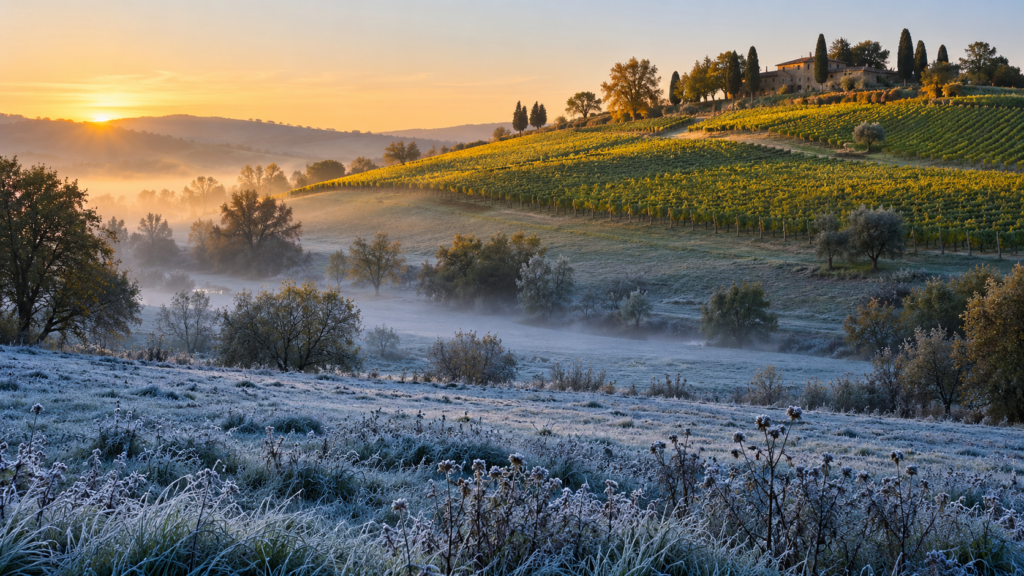
A Pattern Worth Noticing This Time of Year
As frost season sets in, attentive gardeners and anyone who’s noticed their car windshield frosted over while a neighbor’s wasn’t may have observed something genuinely consistent: certain specific locations reliably develop frost earlier and more severely than others nearby, even when both spots experience essentially the same broader weather conditions. This pattern, related to what meteorologists call frost pockets or cold air drainage, follows predictable physical principles rooted in how cold air actually behaves.
Cold Air Is Denser and Flows Like a Liquid
The fundamental principle behind frost pockets is that cold air is denser than warm air, and dense air, much like water, flows downhill under the influence of gravity. On clear, calm nights—precisely the conditions that favor frost formation through radiational cooling—air near the ground cools and becomes progressively denser as the night progresses. This cooling, denser air then flows downhill along the landscape’s natural contours, accumulating in low-lying areas: valleys, depressions, and any location situated at a lower elevation relative to the surrounding terrain.
This downhill flow of cold air is sometimes called katabatic drainage, and it explains why valley floors and low spots in a yard or garden consistently experience colder overnight temperatures and earlier, more severe frost than slightly elevated areas just a short distance away, even though both locations experience identical air temperatures at any given altitude above the ground.
Why Hilltops and Slopes Often Stay Warmer
Following the same physical principle in the opposite direction, elevated areas—hilltops, upper slopes, and locations positioned above the surrounding terrain—tend to avoid the most severe frost because the cold, dense air draining downhill doesn’t accumulate there. Instead, these elevated locations experience a continuous, gentle flow of the cooling air passing through and away, rather than the pooling and accumulation that occurs in low-lying areas where the cold air has nowhere further to drain.
This is why orchards and vineyards in frost-prone regions are frequently planted on gentle slopes rather than valley floors, a practice directly informed by understanding this cold air drainage pattern, since crops planted even slightly upslope from the coldest pooling areas can experience meaningfully reduced frost damage compared to identical crops planted in a nearby low spot.
Obstructions Can Trap Cold Air in Unexpected Places
Beyond natural topography, physical obstructions like fences, hedges, or buildings positioned across a slope can interrupt the natural downhill flow of cold air, causing it to pool on the uphill side of the obstruction rather than continuing to drain away. This means a yard with a solid fence running across even a gentle slope can develop a localized frost pocket immediately uphill of that fence line, even in an area that wouldn’t otherwise be considered particularly frost-prone based on the broader topography alone.
Recognizing this effect can help explain seemingly puzzling frost patterns—a garden bed that frosts considerably more severely than a seemingly similar bed just a few feet away may simply be positioned on the cold-air-trapping side of a fence, wall, or other obstruction interrupting what would otherwise be a continuous downhill drainage flow.
Surface Materials and Nearby Features Also Matter
Beyond topography and obstructions, specific surface characteristics influence frost development at a very local scale. Areas near large bodies of water, even relatively small ponds, often experience somewhat reduced frost severity due to the water’s heat-retaining properties providing a modest warming influence on the immediately surrounding air. Conversely, open areas with clear exposure to the night sky experience more efficient radiational cooling than areas partially shielded by overhead tree canopy, which can trap some outgoing heat similar to how cloud cover moderates overnight cooling more broadly.
Paved surfaces like driveways and patios retain daytime heat somewhat longer than bare soil or grass, meaning areas immediately adjacent to significant paved surfaces may experience a modest, localized warming influence compared to areas further from any heat-retaining hardscape.
Using This Knowledge Practically
Understanding your own property’s specific frost pocket pattern—likely developed through a season or two of simply observing where frost appears first and most severely—allows for more targeted protection efforts, concentrating covering and protective measures on the genuinely vulnerable low-lying or cold-air-trapping areas rather than uniformly covering an entire garden regardless of each section’s actual frost risk. For anyone planning future garden layout, this same understanding can inform where to place particularly frost-sensitive plants, favoring elevated areas with good air drainage over low spots or areas trapped behind solid obstructions.
A Microclimate Pattern Hiding in Plain Sight
Frost pockets demonstrate how dramatically local topography and small landscape features can influence a specific location’s weather experience, even within the scale of a single property. The same broader atmospheric conditions producing frost risk across an entire region play out in meaningfully different ways from one specific spot to another, driven by the simple physical reality that cold, dense air behaves predictably—flowing downhill, pooling in low spots, and accumulating against obstructions—exactly the way water would under the same terrain conditions.