The Storm That Wasn’t in the Forecast
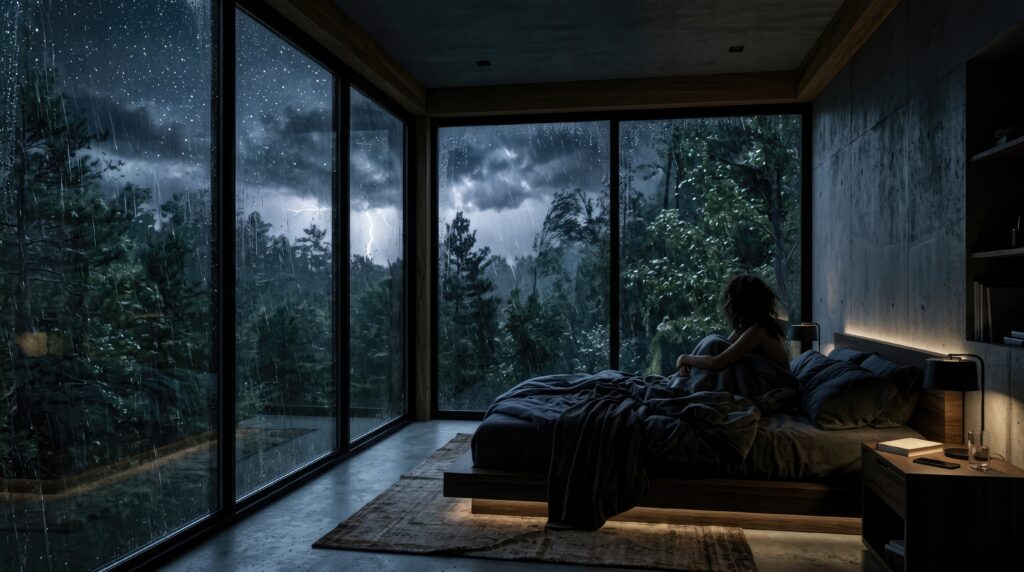
You go to bed on a clear June evening. The forecast mentioned a slight chance of overnight storms — nothing alarming. You wake at 3 a.m. to a full thunderstorm, an inch of rain already in the gauge, and lightning illuminating a sky that was clear eight hours ago. By morning, flash flood watches are posted and the creek down the road is running bank-full.
Nocturnal thunderstorms — storms that develop or intensify after sunset and through the overnight hours — are one of the most practically significant and scientifically interesting aspects of Great Plains and Midwest summer weather. They kill people, produce some of the most damaging hail and flash flooding of the summer season, and confound the intuition that thunderstorms are afternoon phenomena driven by daytime heating. Understanding what drives them reveals atmospheric mechanisms that operate invisibly — literally in the dark — and produce consequences that morning weather reports document but don’t always explain.
The Daytime vs. Nighttime Storm Paradigm
The summer afternoon thunderstorm covered in the 5/28 science piece is driven primarily by solar heating — the sun warms the surface, surface air becomes buoyant, thermals rise and build cumulus clouds, and by mid-afternoon the most unstable areas produce thunderstorms. This mechanism shuts down after sunset because its power source — solar heating — is no longer operating. Surface temperatures fall, thermals weaken and stop, and the convective engine that drove the afternoon storms loses its fuel.
Most of the country’s summer thunderstorm activity follows this daytime pattern. In Florida, the Southeast, and the Northeast, thunderstorm frequency peaks in the afternoon and falls off sharply after sunset. A clear evening in these regions usually stays quiet through the night.
The Great Plains and parts of the Midwest operate differently. Across a broad swath of the central United States — roughly from the Dakotas south through Kansas and Oklahoma and east into Iowa, Missouri, and Illinois — thunderstorm activity has a pronounced nocturnal peak. More thunderstorms occur between midnight and 6 a.m. than between noon and 6 p.m. in some parts of this region during summer. The mechanism that drives this overnight activity is entirely different from the solar heating that drives afternoon convection — and understanding it requires understanding a feature of the Great Plains atmosphere that has no equivalent in most other regions.
The Low-Level Jet: The Great Plains’ Nocturnal Engine
The primary driver of nocturnal thunderstorm activity on the Great Plains is a remarkable atmospheric feature called the Low-Level Jet — a narrow channel of fast-moving air in the lower troposphere, typically between 1,000 and 5,000 feet above the ground, that develops over the central Plains almost every summer night and dissipates by mid-morning.
The Low-Level Jet is a southerly wind surge — air flowing from the Gulf of Mexico northward across the Plains at speeds that can reach 50 to 70 mph, sometimes higher. It is a fast, focused ribbon of moist, warm air running through the lower atmosphere like a river, and it is one of the most important weather features in the world in terms of its moisture transport role and its contribution to precipitation.
The Low-Level Jet forms through a process called inertial oscillation — the same physics that produces ocean tides, but operating in the atmospheric boundary layer. During the day, turbulent mixing throughout the lower atmosphere creates friction that slows the southerly wind flow over the Plains. After sunset, the boundary layer stabilizes and this turbulent mixing largely ceases. Without the friction that was slowing the flow, the wind accelerates — the same air that was moving at 20 mph in the afternoon may be moving at 50 mph by midnight as friction decreases. The jet reaches its maximum intensity in the hours between midnight and dawn, then weakens again as daytime heating restores turbulent mixing.
The Ozark Plateau and the terrain transition from the southern Plains into the Midwest slightly deflect and focus the Low-Level Jet, concentrating its moisture transport toward specific regions. This focusing — combined with the jet’s timing — explains why Iowa, Missouri, Nebraska, and Kansas receive disproportionate amounts of their summer rainfall from overnight events rather than afternoon events.
How the Low-Level Jet Drives Thunderstorms
A fast-moving stream of warm, moist air flowing into a region is a lifting mechanism — wherever the jet encounters an obstacle, a boundary, or a region of convergence, it forces air upward. And upward-forced moist, unstable air is the basic recipe for thunderstorm development.
Several mechanisms translate the Low-Level Jet’s energy into overnight thunderstorm activity.
Convergence lifting. Where the Low-Level Jet encounters a region of slower-moving air — a front, an outflow boundary from previous thunderstorms, or a terrain feature — the faster air piles up and must rise. This forced ascent lifts the moist jet air above its lifting condensation level, initiating convection in the middle of the night when surface-based convection would be impossible.
Nocturnal boundary layer lifting. After sunset, the stable layer of cool air near the surface effectively decouples from the atmosphere above it. Thunderstorms that develop from the Low-Level Jet tap their energy not from the surface but from elevated layers of the atmosphere — a process called elevated convection. Elevated convective storms can produce heavy rainfall and significant lightning with no surface-based instability at all, which is why the standard afternoon thunderstorm forecast tools — based on surface temperature, surface dew point, and surface-based instability — often underforecast nocturnal convective events.
Mesoscale Convective Systems. The most significant nocturnal storm systems on the Great Plains are Mesoscale Convective Systems — large, organized clusters of thunderstorms that can cover areas larger than some states and persist for 6 to 12 hours or longer. MCSs frequently initiate in the afternoon over the High Plains or Rocky Mountain foothills when daytime heating provides initial lift, then evolve overnight as the Low-Level Jet provides the sustained moisture transport and lifting that keeps the system organized after solar heating has ceased. Some of the most prolific rainfall-producing weather systems in the central United States — responsible for significant fractions of the annual precipitation across Iowa, Illinois, and Missouri — are MCSs that peak in intensity between midnight and dawn.
Why Nocturnal Storms Are Particularly Dangerous
The combination of darkness, sleep, and storm timing creates specific safety challenges that afternoon storms don’t present.
People are asleep. This sounds obvious but has profound implications for warning response. A tornado warning issued at 2 a.m. for a storm approaching a sleeping community has dramatically fewer people actively monitoring weather than the same warning issued at 4 p.m. Wireless Emergency Alerts have addressed this significantly — the phone alarm that wakes sleeping residents is now the primary nighttime warning pathway — but the initial response time and shelter-reaching time after a nighttime warning is necessarily longer than daytime.
Tornado deaths in nighttime events are statistically higher per event than daytime tornado deaths, partly because of delayed warning response and partly because mobile home residents — who are at extreme tornado risk — are more likely to be asleep and inside the mobile home rather than driving somewhere with access to better shelter when a nighttime event occurs.
Flash flooding from overnight rainfall catches people in vulnerable locations. Campers along streams, motorists on rural roads in the early morning, and people in low-lying areas who went to bed without flood risk awareness are all more vulnerable to flash flooding from overnight MCS rainfall than people who are awake and monitoring conditions. The phenomenon of waking to a flooded yard or road — or in extreme cases, to water inside the house — is almost exclusively a nocturnal storm product.
Storm severity can be harder to perceive. The visual cues that help people assess afternoon storm severity — the green sky, the towering cumulonimbus, the rotation visible in the storm base — are invisible at night. Nighttime tornadoes are more deadly per occurrence partly because the visual warning that a severe storm is producing extraordinary conditions is absent. A storm that would be unmistakably alarming at 4 p.m. can arrive at 2 a.m. as nothing more than a sudden increase in rain intensity and wind before impact.
Forecasting Nocturnal Convection
Nocturnal convective forecasting is one of the more challenging problems in operational meteorology, precisely because the mechanisms that drive it are different from the surface-based instability that standard severe weather parameters measure.
The High-Resolution Rapid Refresh model — the HRRR, a convection-allowing model updated hourly — has improved nocturnal convective forecasting substantially by explicitly simulating individual thunderstorm cells and their interaction with the Low-Level Jet rather than parameterizing convection. When HRRR consistently shows an MCS developing overnight across a specific region, forecasters have increased confidence in that signal even when surface-based instability parameters don’t support it.
The Low-Level Jet forecast itself — its timing, speed, and position — is a primary input to nocturnal convective outlooks. A forecast of a particularly strong jet, moisture-laden and converging with a boundary during the overnight hours, is one of the more reliable signals that significant nocturnal convective activity will occur.
For residents of the Great Plains and Midwest, the practical takeaway is to check not just daytime severe weather outlooks but overnight outlooks and model guidance during active summer weather patterns. The Storm Prediction Center’s Day 1 outlook covers the full 24-hour period, and its overnight convective timing — shown in the accompanying discussion — is worth reading during summer months when nocturnal MCS activity is climatologically favored.
The Rain That Feeds the Breadbasket
There is a larger context for the Low-Level Jet and nocturnal convection that extends beyond the severe weather implications. A substantial fraction of the summer rainfall that sustains corn and soybean agriculture across Iowa, Illinois, Indiana, and neighboring states arrives via nocturnal MCS events fed by the Low-Level Jet. The jet transports Gulf moisture northward, deposits it as overnight rainfall on the agricultural Midwest, and retreats by morning — leaving clear skies and dry fields for the next day’s farming operations while having delivered the rain the crops needed.
This moisture transport mechanism is one of the reasons the central United States supports the most productive agricultural landscape in the world. The Gulf of Mexico functions as a moisture source, the Low-Level Jet as a delivery mechanism, and the instability of the warm-season atmosphere as the conversion process that turns transported moisture into rainfall. The storms that wake Kansas City at 3 a.m. are, in part, the same storms that produce the corn harvest in August.