The Warning Sign You’ve Seen Countless Times
Drive through cold regions in winter and you’ll inevitably see the warning: “Bridge Ices Before Road” or “Bridge May Be Icy.” For many drivers, this seems like a minor technical detail, barely worth noticing. But this simple warning reflects an important difference in how heat transfers through different structures—a difference that can mean the difference between safe driving and a dangerous accident on a winter morning.
The phenomenon seems counterintuitive at first. The bridge and the road are experiencing the same air temperature and the same weather conditions. They’re often made of similar or identical materials. Yet bridges consistently freeze before the roads leading to them, sometimes creating hazardous ice when surrounding roads remain merely wet or even completely dry. Understanding why requires looking at what’s beneath these surfaces and how heat moves through different structures.
Roads Have the Ground Beneath Them
A typical road sits on the ground, with layers of gravel, soil, and bedrock beneath the pavement surface. This connection to the earth provides something crucial: thermal mass and heat storage.
The ground stores enormous amounts of heat. During summer and early fall, soil absorbs heat from the sun and warm air. This heat penetrates deep into the ground—many feet down—and remains stored even as surface temperatures drop in winter. The ground acts as a giant heat reservoir, slowly releasing stored warmth upward through the road surface.
Even in winter, the temperature just a few feet below ground remains relatively stable and much warmer than the freezing air above. In most temperate regions, ground temperature a few feet deep stays in the 45-55°F range year-round. This warmth conducts upward through the layers of soil and road base, providing continuous heat to the road surface from below.
This means that when cold air chills the road surface from above, the ground beneath is simultaneously warming it from below. The road surface temperature becomes a balance between cooling from the air and warming from the ground. As long as heat is flowing upward from below, the road surface stays warmer than it would otherwise be, delaying or preventing freezing.
Bridges Have Air Beneath Them
A bridge, by contrast, has nothing but cold air beneath it. The bridge deck is exposed to air on both the top and bottom surfaces. When air temperature drops below freezing, the bridge is being chilled from both sides simultaneously with no heat source to counteract this cooling.
With cold air circulating freely above and below the bridge surface, heat escapes in both directions. The bridge deck loses heat more than twice as fast as a road surface that’s only exposed to cold air from above. This rapid heat loss means bridge surfaces reach freezing temperatures much faster than road surfaces.
The effect is especially pronounced on clear, calm nights when radiational cooling is most efficient. Without clouds to trap heat or wind to mix air layers, cold air settles around the bridge and temperatures can drop rapidly. The bridge surface, losing heat in all directions with no ground connection to provide warmth, quickly falls to the same temperature as the surrounding air—or even colder through radiational cooling.
Thermal Mass Makes a Difference
Beyond the ground connection, roads typically have more thermal mass than bridge decks. A road’s full structure includes thick layers of compacted soil, gravel base, and pavement—all of which store heat and take time to cool. This mass acts as a buffer, slowing temperature changes and keeping the surface warmer.
Bridge decks are relatively thin structures, often just several inches of concrete or asphalt supported by steel or concrete beams. This minimal mass stores little heat, so bridge temperature responds quickly to changes in air temperature. When air temperature drops, bridge temperature follows almost immediately.
Think of it like the difference between a thick cast-iron pan and a thin aluminum pan on a stove. The heavy pan heats slowly and stays hot long after you remove it from heat. The thin pan heats quickly but also cools quickly. Roads are like the heavy pan—slow to freeze. Bridges are like the thin pan—quick to reach air temperature.
Wind Accelerates Bridge Cooling
Bridges are often exposed to more wind than roads because they typically span valleys, waterways, or other open areas. Wind accelerates heat loss through convection, constantly replacing air near the bridge surface with fresh cold air.
The wind effect is amplified because air can circulate beneath the bridge as well as above it. This air movement beneath the deck is particularly effective at removing heat, creating a wind-chill effect that makes the bridge surface colder than a sheltered road surface experiencing the same air temperature.
Roads, especially those bordered by trees, buildings, or earth embankments, are more sheltered from wind. The still or slower-moving air near road surfaces insulates them slightly, reducing the rate of heat loss compared to wind-exposed bridge surfaces.
Elevation Sometimes Plays a Role
Bridges are often elevated above the surrounding landscape, and temperature can vary with altitude—even modest elevation differences can mean slightly colder air at bridge level compared to ground-level roads.
Additionally, cold air is denser than warm air and tends to sink and pool in valleys and low areas. A bridge spanning a valley might extend through a layer of slightly warmer air above the coldest air settled at the valley bottom, but this is a minor effect compared to the heat loss from exposure to air on both sides.
More significant is that elevated bridges often experience less temperature inversion effects. On clear, calm nights, the coldest air settles at ground level while slightly warmer air exists at higher elevations. Roads benefit from this ground-level cold air sitting still and acting as slight insulation. Elevated bridges don’t have this protection and experience more efficient cooling.
Black Ice Forms First on Bridges
The danger of icy bridges is compounded by the formation of black ice—a thin, transparent layer of ice that’s nearly invisible because you can see the dark pavement through it. Black ice is especially treacherous because drivers often don’t realize they’re on ice until they’ve lost traction.
Black ice forms readily on bridges because the rapid cooling creates perfect conditions: temperatures just below freezing, moisture from fog or light precipitation, and a smooth surface. The thin ice layer that forms is transparent rather than white and frosty, making it almost impossible to see.
A driver approaching a bridge may see wet pavement and not realize that the slight temperature difference between road and bridge means that wetness has frozen into ice. By the time the vehicle is on the bridge, it’s too late to slow down safely, and the reduced traction can lead to loss of control.
Material Differences Can Affect Freezing
Most modern bridges use either steel-reinforced concrete or steel grid decks with a thin concrete or asphalt overlay. The thermal properties of these materials differ from typical road construction.
Steel conducts heat rapidly, which means a steel bridge structure quickly loses any stored heat to the surrounding cold air. Steel has relatively low heat capacity for its mass, so it doesn’t store much heat to begin with and loses what little it has quickly.
Concrete has better heat capacity than steel but still doesn’t compare to the massive heat reservoir provided by the ground beneath a road. Bridge concrete is also typically less thick than road pavement layers, reducing its thermal mass advantage.
Some bridges use open steel grating, which provides even less protection from cold air circulation. These bridges can ice even more quickly than solid-surface bridges because cold air flows directly through the deck surface.
Why the Warning Signs Matter
The practical implication of bridges icing before roads is that conditions can change dramatically within seconds as you transition from road to bridge. You might be driving on wet but unfrozen pavement, then encounter ice on the bridge, then return to wet pavement on the other side—all within a few hundred feet.
This rapid change is dangerous because drivers don’t have time to adjust their speed or driving style. If you’re traveling at a speed appropriate for wet roads, that speed may be too fast for icy conditions. By the time you realize the bridge is icy, you’re already on it with reduced traction.
This is why bridge ice causes a disproportionate number of winter accidents relative to the small percentage of road distance that bridges represent. The unexpected nature of the hazard, combined with drivers’ tendency to maintain the same speed transitioning from road to bridge, creates dangerous situations.
How to Drive Safely When Bridges May Be Icy
When you see bridge ice warnings or when conditions suggest bridges might be icy (temperatures near or below freezing, especially at night or early morning), reduce speed before reaching the bridge, not on it. Slowing down on ice can cause loss of control, so make speed adjustments while still on the regular road surface.
Avoid sudden steering, acceleration, or braking while on bridges when ice is possible. Smooth, gentle inputs reduce the risk of breaking traction on the reduced-friction surface.
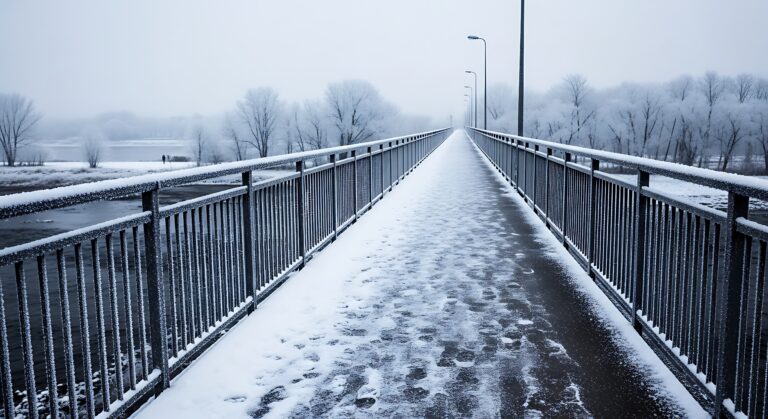
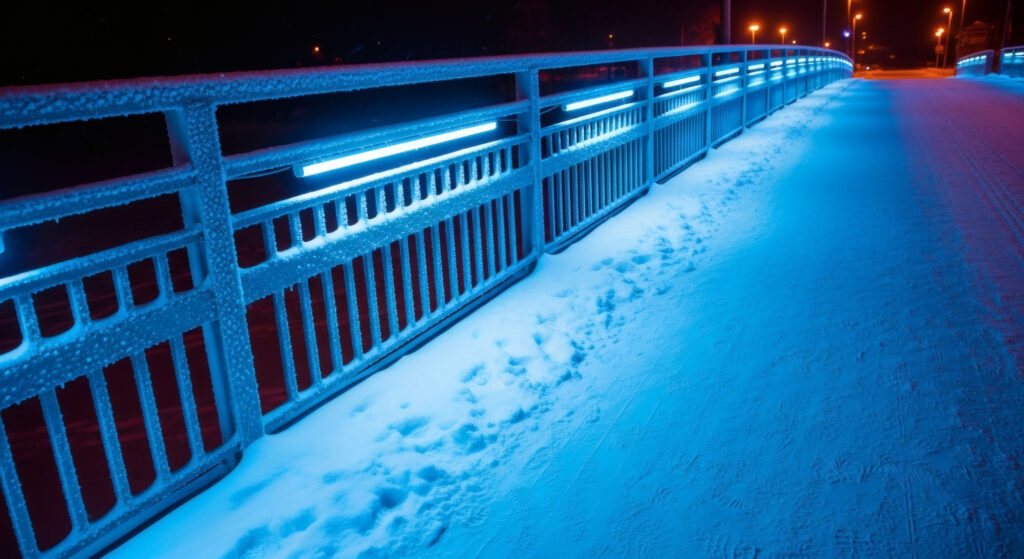
Watch for visual cues that a bridge might be icy: frost on bridge railings, ice on the road surface immediately before or after the bridge, or visible ice on the bridge surface itself. If you see cars ahead having traction problems on a bridge, that’s a clear warning to slow down even more.
Be especially cautious on overpasses and elevated roadways, which experience the same physics as bridges even though they may not span water. Any road surface suspended above the ground with air circulating beneath it will freeze before ground-level roads.
The Same Physics Affects Other Structures
The principle of ground-connected surfaces staying warmer than air-exposed surfaces applies beyond roads and bridges. Elevated parking garages freeze before ground-level lots. Second-floor balconies and decks ice before ground-level patios. Boat docks and piers over water freeze readily because water below may be near freezing temperature, providing no heat source.
Railroad tracks on elevated structures freeze before ground-level tracks, potentially affecting train operations. Airport runways on elevated sections or bridges freeze faster than runways at ground level, requiring extra attention from airport operations crews during winter weather.
Temperature Transitions in Spring and Fall
The road-versus-bridge temperature difference isn’t just a winter phenomenon. It also affects how surfaces warm in spring. Bridges warm more quickly than roads when air temperature rises because they respond directly to air temperature without the thermal inertia of the ground beneath roads.
This means bridges can be the first surfaces to dry after rain, or the first to warm above freezing during a spring thaw. The same physics that makes bridges problematic in winter makes them respond more quickly to warming conditions—they simply track air temperature more closely than ground-connected roads do.
A Reminder of How Heat Moves
The next time you see a “Bridge Ices Before Road” sign, remember that it’s not just a generic winter warning—it’s a description of real physics at work. The sign is telling you that you’re about to cross a structure that loses heat differently than the road you’ve been driving on, and that difference creates a genuine hazard that’s invisible to your eyes but very real to your tires.
It’s also a reminder that the ground beneath us stores and releases enormous amounts of heat, affecting everything built on top of it. Roads stay warmer than you might expect in winter not through any special treatment but simply because they’re connected to the deep heat reservoir of the earth itself—a luxury that bridges, suspended in the air, don’t enjoy.