A Predictable Winter Morning Pattern
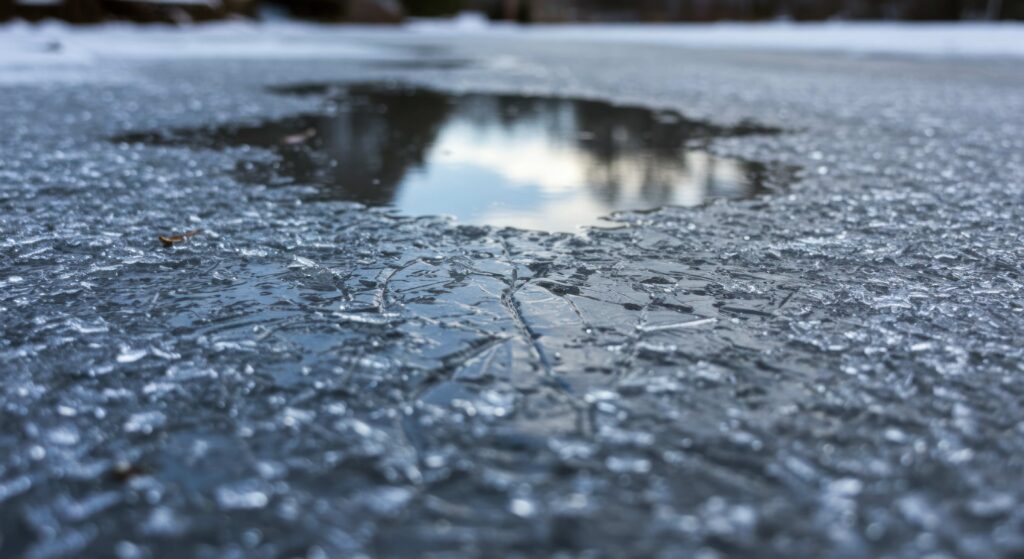
Walk past a puddle on a cold morning and you’ll often notice a distinct pattern: ice has formed around the edges while the center remains liquid. Sometimes just a thin ring of ice borders the puddle. Other times, ice extends partway across, leaving a smaller pool of water in the middle. Only when temperatures have been below freezing for extended periods does the entire puddle freeze solid.
This edge-first freezing pattern appears so consistently that it seems inevitable, yet it’s not immediately obvious why freezing should proceed this way. Both the edges and center of the puddle are exposed to the same cold air, receive the same amount of sunlight, and consist of the same water. What gives the edges an advantage in the race to freeze? The answer involves heat capacity, shallow water physics, and the insulating properties of water and ice.
Shallow Water Freezes Faster
The most important factor is that puddle edges are typically shallower than the center. Most puddles form in slight depressions or irregularities in the ground. The deepest water naturally collects in the lowest point—the center—while water spreads thinner toward the edges where the ground slopes upward to meet the surrounding surface.
This depth difference matters enormously for freezing rates. A thin layer of water at the edges might be only a few millimeters deep, while the center might be a centimeter or more. Heat capacity—the amount of heat that must be removed to lower temperature—scales with volume. The shallow edges contain less water volume per unit of surface area, meaning less total heat must be removed for freezing to occur.
Think of it this way: to freeze one cubic centimeter of water, you must remove the same amount of heat regardless of its shape. But if that water is spread into a thin sheet versus a deep pool, the thin sheet reaches air temperature and freezes more quickly because the cold air can access a larger proportion of the water volume.
The shallow edges also have a higher surface-area-to-volume ratio. More of the water is in direct contact with cold air and cold ground, allowing faster heat extraction from all sides rather than primarily from the top surface.
Ground Temperature Plays a Crucial Role
Puddles don’t just lose heat to the air above—they also lose heat to the ground below. The ground’s temperature and thermal properties significantly affect freezing patterns.
At the edges of a puddle, water may be in contact with pavement, soil, or other surfaces that have already cooled below freezing. These cold surfaces draw heat from the shallow water through conduction. The ground at the puddle’s edge is often drier and exposed to air, allowing it to cool more efficiently than the ground beneath the puddle’s center, which is insulated by deeper water above it.
The deepest part of the puddle—the center—has the most water between the surface and the ground. This water insulates the ground beneath from the cold air above, and insulates the surface water from the cold ground below. Heat transfer must occur through this larger volume of water, which slows the process.
Additionally, if the ground beneath the puddle retains any warmth from daytime sun exposure or from the earth’s deep heat reservoir, this warmth affects the deeper center water more than the shallow edges, further delaying central freezing.
Ice Formation Changes Heat Transfer
Once ice begins forming at the edges, it affects subsequent freezing patterns. Ice is actually a decent insulator—not as good as air, but significantly less conductive than water. A layer of ice at the puddle’s edge protects the water beneath it from direct contact with cold air, slowing further freezing below that ice layer.
However, the ice at the surface is still colder than the water below it, so freezing continues to advance downward through the shallow edge water. Meanwhile, ice also begins to spread horizontally across the puddle’s surface, advancing from the frozen edges toward the still-liquid center.
This creates a pattern where the puddle freezes both downward (through the thin edge water to the ground) and inward (across the surface toward the center). The edges may be frozen solid while the center still has liquid water both at the surface and through its depth.
As ice advances inward, it creates a progressively smaller pool of liquid water in the center. This remaining water is now partially insulated from cold air by the surrounding ice, which slows its freezing. The last portion to freeze is often the deepest part of the original puddle, where the most water volume exists and where ice insulation from surrounding areas is most effective.
Sunlight and Thermal Mass
During daytime freeze-thaw cycles, sunlight can affect freezing patterns. The center of a puddle, being deeper, contains more water volume and thus more thermal mass—the ability to store heat. When sun warms the puddle during the day, the deeper center absorbs and stores more total heat than the shallow edges.
As temperatures drop in the evening or overnight, this stored heat in the center delays freezing. The edges, with less thermal mass, lose their limited heat quickly and freeze first. The center’s larger heat reservoir takes longer to dissipate, keeping it liquid longer.
This effect is most pronounced in puddles that experience multiple freeze-thaw cycles—freezing at night, melting partially during sunny days, then refreezing. The pattern reinforces itself: edges freeze first each night, and the center (having more thermal mass and being partially protected by edge ice) is last to freeze.
Wind and Evaporation Effects
Wind accelerates heat loss from puddle surfaces through both convection (carrying away warm air) and evaporation (which removes heat as water molecules escape). These effects are strongest at the edges of puddles where wind has better access and where there are no barriers from surrounding ice.
However, evaporation also removes water volume, which can cause puddles to shrink and become shallower overall. In dry, windy conditions, puddles may lose significant volume to evaporation before freezing, which can actually speed overall freezing by reducing the water volume that must be frozen.
In calm conditions with minimal evaporation, the puddle’s original depth distribution—shallow edges, deep center—remains the dominant factor in determining freezing patterns.
Temperature Cycling Creates Visible Layers
Puddles that freeze, partially thaw, and refreeze can develop visible layering in the ice, particularly at the edges where freezing is most advanced. Each freeze cycle adds a new layer, sometimes trapping air bubbles, impurities, or different crystal structures that make the layers distinguishable.
The center, freezing last and often during a single prolonged cold period, may show more uniform ice structure. This difference in ice appearance between edge and center ice can persist even after the entire puddle is frozen solid, creating a visible record of the freezing progression.
Why Some Puddles Freeze Differently
Not all puddles show the classic edge-first pattern. In very shallow puddles of nearly uniform depth, freezing may occur relatively uniformly across the surface. In puddles on highly conductive surfaces like metal, heat extraction from below may dominate, creating different patterns.
Moving water—from rain, melting snow, or flowing runoff—disrupts ice formation and can prevent edge-freezing even when temperatures are below freezing. The water movement mixes warmer and cooler water, preventing the surface layer from becoming cold enough for ice formation.
Very deep puddles or small ponds may freeze primarily from the top surface downward rather than from edges inward, following the same pattern as lakes. Once a puddle reaches sufficient depth (roughly several inches or more), the depth factor begins to matter more than edge effects.
Ice Thickness Varies Across the Puddle
Even when an entire puddle appears frozen, ice thickness typically varies significantly from edge to center. Edge ice may be frozen through to the ground, creating a solid layer perhaps a half-inch or more thick. Center ice may be a thin sheet just barely frozen at the surface, with liquid water beneath.
This variation creates danger for anyone (or anything) stepping onto frozen puddles—what looks uniformly frozen may have weak spots in the center that break through easily. The consistent appearance of ice can be deceptive, hiding substantial differences in ice thickness and strength.
This same principle applies to larger bodies of water like ponds and lakes, where ice near shorelines is almost always thicker and stronger than ice farther out, making edge ice the safest place to test or access frozen water bodies.
Watching Physics Happen in Real Time
Puddles offer one of the most accessible ways to observe freezing and ice formation. Unlike lakes that freeze over long periods or ice cubes that freeze inside freezers, puddles freeze at a scale and timeframe that allows easy observation of the entire process.
On a cold morning, you can watch a puddle’s transformation—noticing which areas freeze first, how ice crystals form and spread, how the last pocket of liquid water shrinks and finally disappears. It’s physics happening at walking pace, visible to anyone who takes a moment to look closely.
The edge-to-center freezing pattern is predictable enough that it becomes a diagnostic: if a puddle is freezing from the center outward or showing unusual patterns, something interesting is probably happening—perhaps the ground is warmest at the edges, or wind patterns are unusual, or the puddle is being replenished with warmer water from somewhere.
A Small-Scale Demonstration of Universal Principles
The next time you notice ice forming around a puddle’s edges while the center remains liquid, remember that you’re seeing a demonstration of heat transfer principles that apply at all scales. The same physics governs how lakes freeze, how ice sheets form on oceans, and how ice develops on any water surface exposed to cold.
The pattern emerges not from any plan or design but from the simple fact that shallow water has less thermal mass and higher surface area relative to volume, allowing faster heat extraction. Add in the effects of cold ground beneath, wind above, and the insulating properties of ice once it forms, and edge-first freezing becomes nearly inevitable.
Puddles are easy to overlook—just temporary collections of water that will evaporate or drain away soon enough. But they’re also perfect little laboratories for observing phase changes, heat transfer, and crystal formation. The ice forming at their edges is following the same physical laws that shape glaciers and ice caps, just at a scale small enough to fit on a sidewalk and observable enough to watch during your morning walk. It’s nature doing physics right in front of you, patient and consistent, freezing the same way every time conditions align.