The Disappearing Act That Accelerates With Seasons
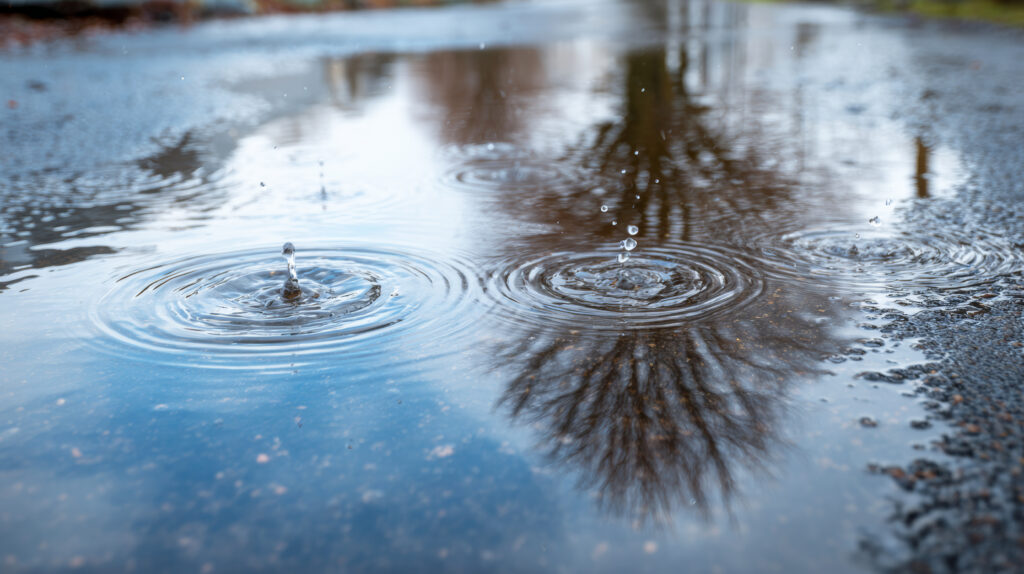
Notice a puddle after a March rain and it might be gone by the next afternoon. The same-sized puddle from a December rain could linger for days or even weeks. Both receive no additional rain, both sit in the same location, yet spring puddles vanish dramatically faster than winter ones. This difference isn’t subtle—spring evaporation can be five to ten times faster than winter evaporation for the same water volume.
Understanding why puddles dry so much faster in spring reveals fundamental principles about how water moves from liquid to vapor, what controls evaporation rates, and how multiple seasonal factors—temperature, sunlight, humidity, and wind—combine to create dramatic differences in how quickly water returns to the atmosphere.
Temperature Is the Primary Driver
Evaporation is the process by which liquid water molecules gain enough energy to escape into the air as water vapor. Temperature directly controls how much energy water molecules have and therefore how readily they can evaporate.
Water molecules in a puddle are constantly moving, vibrating, and colliding with each other. At higher temperatures, molecules move faster and have more kinetic energy. The fastest-moving molecules at the surface can break free of the attractive forces holding them in the liquid and escape as vapor.
A 50°F spring day provides water molecules with far more thermal energy than a 30°F winter day. The difference might seem small, but evaporation rate increases exponentially, not linearly, with temperature. Water at 50°F evaporates roughly three times faster than water at 30°F under otherwise identical conditions.
By the time temperatures reach typical spring levels—60°F and above—evaporation rates can be five to ten times higher than winter rates. A puddle that would take a week to evaporate at 30°F might disappear in a single day at 60°F.
Sunlight Intensity Makes a Huge Difference
Solar radiation provides energy that heats water directly, accelerating molecular motion and evaporation. Spring sunlight is dramatically more intense than winter sunlight due to the sun’s higher angle in the sky.
In winter, the sun takes a low arc across the southern sky (in the Northern Hemisphere), striking the ground at a shallow angle. This spreads the same amount of solar energy over a larger area, reducing the intensity of heating per square foot.
By spring, the sun climbs much higher at midday. Solar radiation strikes the ground more directly, concentrating energy in a smaller area. This means puddles receive more heating per unit area, warming the water and driving faster evaporation.
Additionally, spring days are longer—March has roughly three more hours of daylight than December in mid-latitudes. More hours of sunlight means more cumulative heating and more total time for evaporation to occur.
The combination of more intense sunlight and longer exposure time means spring puddles receive dramatically more solar energy than winter puddles, accelerating evaporation even beyond what air temperature alone would predict.
Humidity Controls Evaporation Potential
Evaporation rate depends not just on the water itself but on the air above it. Specifically, it depends on the humidity—how much water vapor the air already contains versus how much it could hold.
Air has a maximum capacity for water vapor that depends on temperature. Warm air can hold much more moisture than cold air. When air is “saturated” (100% relative humidity), it can’t accept any more water vapor, and evaporation essentially stops.
Winter air often has relatively high humidity even when absolute moisture content is low. Cold air near saturation (say, 80% relative humidity at 30°F) can’t accept much additional moisture, so evaporation proceeds slowly.
Spring air is typically warmer and often has lower relative humidity. Even if absolute moisture content is similar, the warmer air has much higher capacity for water vapor. Air at 60°F and 50% relative humidity has enormous capacity to accept more moisture, allowing rapid evaporation.
The gradient between the puddle (saturated at 100% humidity right at the water surface) and the drier air above drives evaporation. The larger this gradient, the faster evaporation occurs. Spring’s combination of warm, relatively dry air creates much larger humidity gradients than winter’s cold, often-humid air.
Wind Accelerates the Process
Wind removes water-vapor-saturated air from just above the puddle surface and replaces it with drier air, maintaining a strong humidity gradient and keeping evaporation rates high.
In still air, water evaporating from a puddle saturates the air immediately above the surface, creating a microenvironment of high humidity that slows further evaporation. The evaporated water has nowhere to go quickly, so it accumulates near the surface.
Wind disperses this saturated air layer, constantly bringing fresh, drier air into contact with the water surface. This maintains maximum evaporation rate because the humidity gradient never decreases.
March is notably windier than December in most regions due to stronger temperature contrasts and more active weather patterns during the winter-spring transition. These persistent spring winds enhance evaporation beyond what temperature and sunlight alone would create.
Even light breezes make significant differences. A 5 mph wind can double or triple evaporation rates compared to still conditions. The strong winds common in March can increase evaporation by factors of five or more.
Ground Temperature Matters Too
Puddles sit on ground that can either warm or cool the water. In winter, the ground is often frozen or very cold—at or below the water’s temperature. Cold ground provides no heat to the puddle and may actually cool it further, slowing evaporation.
By spring, the ground has warmed considerably. Soil heated by spring sunshine can be 10-20°F warmer than the overlying puddle water. This warmth conducts into the puddle from below, heating the water and accelerating evaporation.
Pavement and concrete show even more dramatic effects. Dark surfaces absorb solar radiation readily, and these materials conduct heat efficiently. A puddle on spring asphalt might be sitting on a surface that’s 70-80°F or hotter, receiving continuous heating from below that drives rapid evaporation.
This bottom-heating is particularly effective because it warms the entire puddle depth, not just the surface. Warmer water throughout the puddle means more molecules have sufficient energy to escape, increasing evaporation rate.
Puddle Depth and Surface Area
Deeper puddles take longer to evaporate than shallow ones because there’s more water to evaporate. However, evaporation occurs only at the surface—water below the surface must first make its way to the top before it can evaporate.
Spring puddles often form from rain rather than snowmelt, and they tend to spread out more rather than being confined by ice or frozen ground edges. This creates puddles with larger surface-area-to-volume ratios—more surface where evaporation can occur relative to total water volume.
Winter puddles (or meltwater pools) may be trapped in depressions or against ice edges, creating deeper pools with less surface area. Less surface means slower evaporation even if other conditions were equal.
Additionally, as spring puddles evaporate and shrink, they become shallower, which warms the remaining water faster (less thermal mass to heat) and further accelerates the final stages of drying.
The Combined Effect Is Dramatic
Each factor alone would increase spring evaporation rates over winter. But they don’t act alone—they multiply each other’s effects:
- Warmer temperatures (3x faster evaporation)
- More intense sunlight (2-3x more energy)
- Longer days (1.3x more exposure time)
- Lower relative humidity (2x larger gradient)
- Stronger winds (2-3x better mixing)
- Warmer ground (1.5-2x more heat input)
When you multiply these factors together, spring evaporation can easily be 10-50 times faster than winter evaporation for the same initial puddle. What takes two weeks to dry in December disappears in a few hours in April.
Why This Matters Beyond Puddles
Understanding evaporation rates has practical applications:
Water management: Reservoirs, ponds, and irrigation systems lose much more water to evaporation in spring and summer than winter. Water managers must account for seasonal variation in planning.
Agriculture: Soil moisture evaporates quickly in spring, requiring more frequent irrigation. Understanding evapotranspiration rates helps farmers schedule watering.
Weather forecasting: Evaporation from wet ground and water bodies feeds moisture back into the atmosphere, influencing humidity and precipitation forecasts.
Climate science: Changes in seasonal evaporation patterns affect regional water cycles and are important indicators of climate shifts.
Flood management: Rapid spring evaporation helps reduce standing water after snowmelt or heavy rain, but it also dries vegetation and creates fire risk if drought follows.
A Visible Sign of Seasonal Change
The next time you notice puddles disappearing rapidly on a spring day, remember you’re watching the combined effects of warmer temperatures, stronger sunlight, lower humidity, persistent winds, and heated ground all working together to return water to the atmosphere at rates that would be impossible in winter.
Those vanishing puddles are one of countless small signs that the seasons have truly changed—not just on the calendar, but in the fundamental physics of how water and energy interact in the environment. Spring’s accelerated evaporation is one reason everything feels more active and dynamic—moisture cycles more quickly, the atmosphere is more energized, and the transition toward summer is visible in phenomena as simple as puddles that won’t stay put from one day to the next.