A Frozen Surface, Liquid Below
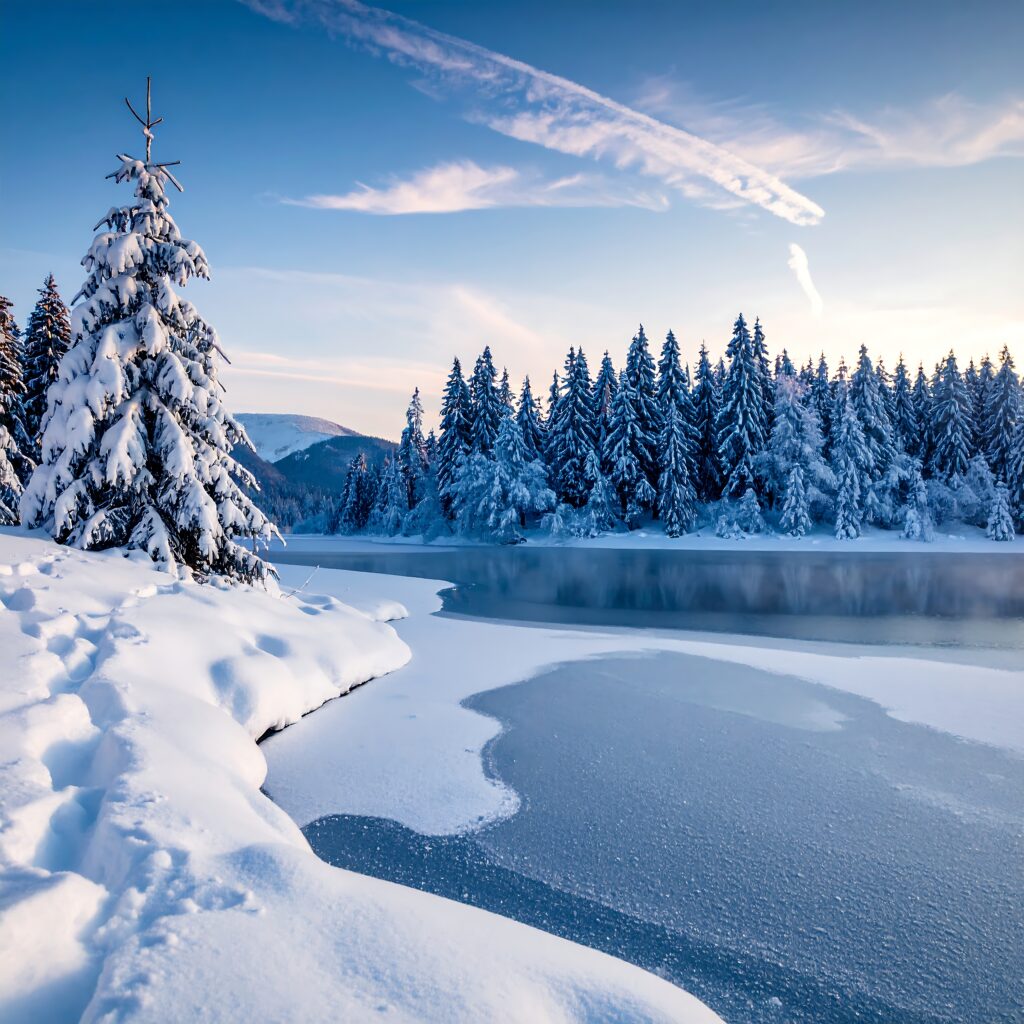
Walk across a frozen lake in winter and you’re standing on solid ice while fish swim in liquid water just feet beneath your boots. This top-down freezing pattern seems natural and unremarkable—until you consider that for nearly every other substance on Earth, the solid form sinks in the liquid form. Ice cubes float in your water glass, but frozen lead sinks in molten lead. Solid wax sinks in melted wax. For most materials, solids are denser than liquids and sink to the bottom.
If water followed this normal pattern, lakes would freeze from the bottom up. Ice would form on the lake bed and gradually build upward until the entire lake became a solid block of ice. Fish and aquatic plants would be crushed or frozen. Lake ecosystems as we know them couldn’t exist. The fact that water behaves differently—that ice floats and lakes freeze from the top—is one of the most important anomalies in nature, and it exists because water has truly bizarre properties at the molecular level.
Why Ice Floats: Water’s Density Anomaly
Most substances become denser when they freeze because their molecules pack together more tightly in the solid state than they do in the liquid state. As molecules slow down and lock into a solid crystal structure, they typically arrange themselves more efficiently, occupying less space.
Water does the opposite. When water freezes into ice, it becomes less dense—ice is about 9% less dense than liquid water. This happens because of water’s molecular structure and the unique way water molecules bond to each other.
A water molecule (H₂O) has a bent shape with the oxygen atom at the center and two hydrogen atoms positioned at about a 104-degree angle. This creates a molecule with a slightly negative charge on the oxygen side and slightly positive charges where the hydrogen atoms are located—what chemists call a polar molecule.
In liquid water, these polar molecules are constantly moving, forming temporary hydrogen bonds with neighboring molecules and then breaking them as the molecules shift position. The molecules are close together but disorganized, able to slide past one another.
When water freezes, the molecules slow down enough that hydrogen bonds become stable and hold molecules in fixed positions. But here’s the key: the geometry of hydrogen bonding forces water molecules to arrange themselves in a hexagonal crystal lattice with lots of empty space between molecules. This open, cage-like structure is actually less compact than the arrangement of molecules in liquid water.
The result is that ice occupies more volume than the same mass of liquid water—which means ice is less dense and floats. This is why ice cubes float in your drink, icebergs float in the ocean, and lakes freeze from the top down rather than the bottom up.
Water’s Temperature-Density Relationship Is Unusual
Water has another strange property that contributes to top-down lake freezing: it reaches its maximum density at 39°F (4°C), not at its freezing point. As water cools from room temperature toward freezing, it gets denser and sinks—but only until it reaches 39°F. Below that temperature, water becomes less dense as it continues to cool toward freezing at 32°F (0°C).
This means that as a lake cools in autumn and winter, the coldest water isn’t necessarily the densest water. Water at 39°F is denser than water at 34°F, even though 34°F is colder. This unusual density-temperature relationship is crucial for understanding how lakes freeze.
How a Lake Freezes: The Process Step by Step
When winter arrives and air temperatures drop, the surface of a lake begins losing heat to the cold air above. The water at the surface cools first, becomes denser, and sinks. Warmer water from below rises to replace it, creating circulation that mixes the lake.
This process continues as long as the surface water is cooling but still above 39°F. The sinking of cool, dense water distributes the cooling effect throughout the lake’s depth, which is why the entire lake must cool to approximately 39°F before freezing begins at the surface.
Once the whole lake reaches 39°F, further cooling at the surface has a different effect. Now when surface water cools below 39°F, it becomes less dense rather than more dense. This cooler, lighter water stays at the surface instead of sinking. It continues to cool, eventually reaching 32°F and freezing.
Because the coldest, lightest water remains at the top, ice forms at the surface first. The ice layer then acts as insulation, protecting the water below from further heat loss and slowing the rate of additional freezing. The water directly beneath the ice remains liquid, usually at temperatures between 32°F and 39°F depending on depth and conditions.
Deeper water in the lake can remain at 39°F throughout the winter—the temperature of maximum density—creating a stable, stratified system with ice at the surface, very cold water just below it, and slightly warmer (but still cold) water at depth.
Why This Matters for Aquatic Life
If lakes froze from the bottom up like most substances, aquatic ecosystems would be devastated. Fish, turtles, frogs, and countless invertebrates would be trapped in shrinking pockets of liquid water as ice advanced from below. In harsh winters, entire lakes could freeze solid, killing everything inside.
Instead, the insulating ice layer at the surface protects the liquid water below. Aquatic life can survive in this cold but unfrozen water throughout winter. Fish slow their metabolism and move to deeper water where temperatures are most stable. Turtles and frogs burrow into mud at the lake bottom and enter a dormant state. Aquatic plants die back but leave seeds and roots that will regenerate in spring.
The ice cover also provides habitat. Snow on top of the ice creates an insulating layer that further stabilizes temperatures below. Some light penetrates the ice, allowing photosynthesis to continue at reduced levels. Dissolved oxygen in the water—put there by summer photosynthesis and autumn mixing—sustains animal life through winter, though oxygen levels can become critically low in heavily frozen lakes by late winter.
Even in the coldest climates where ice grows thick—several feet in extreme cases—there’s almost always liquid water below. Only very shallow ponds in extreme cold may freeze completely to the bottom.
Lake Turnover: The Mixing Cycle
The density anomaly of water creates another important phenomenon called lake turnover. This happens twice a year in temperate regions and is crucial for lake health.
In spring, as ice melts and surface water warms from 32°F toward 39°F, it becomes denser and sinks, mixing with deeper water. This continues until the entire lake reaches 39°F and becomes uniformly mixed. Wind can then circulate water throughout the depth, carrying oxygen to deep water and nutrients from the bottom to the surface. This spring turnover revitalizes the lake ecosystem after winter.
In fall, the reverse happens. As surface water cools from warm summer temperatures toward 39°F, it becomes denser and sinks, again creating circulation that mixes the lake before winter stratification sets in.
These turnover periods are when lakes are most thoroughly mixed, distributing oxygen and nutrients that accumulated in different layers during summer and winter. Without water’s unusual density properties, this beneficial mixing wouldn’t occur.
Not All Ice Is the Same
While all freshwater ice is less dense than liquid water, the exact density and structure of ice can vary. Ice formed slowly in calm conditions creates clear, strong ice with a well-organized crystal structure. Ice formed rapidly or in turbulent conditions can trap air bubbles and have a more irregular structure, creating cloudy, weaker ice.
Snow ice—formed when snow on the ice surface gets saturated with water and freezes—is less dense and weaker than clear ice. This is why ice fishermen and ice safety experts warn that ice thickness alone doesn’t determine safety; ice quality matters enormously.
The salinity of water also affects freezing patterns. Salt water freezes at lower temperatures than fresh water, and sea ice formation is more complex, involving the exclusion of salt from the ice crystal structure. This is why ocean ice is less salty than the seawater it formed from, and why Arctic and Antarctic ecosystems have very different freezing dynamics than freshwater lakes.
Climate Change and Lake Ice
Lake ice is one of the clearest indicators of climate change. Across the Northern Hemisphere, lakes are freezing later in autumn, thawing earlier in spring, and maintaining thinner ice throughout winter compared to historical patterns.
Long-term records from some lakes extend back over a century, showing clear trends toward shorter ice seasons. This affects aquatic ecosystems in numerous ways: shorter winter periods mean longer growing seasons for some organisms but also allow invasive species to extend their ranges northward. Thinner ice provides less insulation, potentially allowing colder temperatures to penetrate deeper into the water column.
Changes in ice cover also affect the timing of spring turnover, which can disrupt the seasonal cycles that aquatic life has adapted to over thousands of years. Earlier ice-out allows lakes to warm earlier, potentially leading to harmful algae blooms or mismatches between when prey species and predators are most active.
Other Substances With Unusual Density Properties
Water isn’t the only substance that becomes less dense when it freezes, though it’s the most important for life on Earth. Silicon, germanium, and a few other elements also expand when freezing, though for different chemical reasons than water.
Bismuth also expands when freezing, which made it historically useful for creating detailed metal castings—the expanding metal would fill every detail of a mold. But these are exceptions. The vast majority of substances become denser when they freeze, making water’s behavior genuinely anomalous and critical for the existence of aquatic life in cold climates.
A Happy Accident of Chemistry
The fact that ice floats is often called a “happy accident” of water’s molecular structure, but from an evolutionary perspective, it’s not an accident at all—life evolved in the context of water’s properties and depends on them. We consider water’s behavior unusual because most other substances behave differently, but from life’s perspective, water’s properties are exactly what they need to be.
If water behaved “normally” and ice sank, life on Earth would be dramatically different or might not have developed at all. The liquid oceans that covered much of early Earth could have frozen solid from the bottom up. Aquatic life would have been restricted to tropical regions or would never have diversified beyond primitive forms that could survive complete freezing.
Instead, water’s bizarre density anomaly allows lakes, rivers, and polar oceans to maintain liquid water beneath surface ice, creating year-round aquatic habitats even in the coldest climates. Fish swim beneath frozen lakes, marine mammals thrive in Arctic waters, and ecosystems persist through winter—all because of the unusual angle of a bent molecule and the geometry of hydrogen bonding.
The next time you see a frozen lake or pond, remember that the solid surface you’re looking at exists specifically because ice is lighter than water—a violation of how almost everything else in the universe behaves, but a property absolutely essential for life as we know it.