The Paradox Above Your Head
Look up at a cloudy sky and you’re seeing millions of gallons of water suspended in the air above you. A single cumulus cloud—one of those puffy white clouds you see on pleasant days—can contain as much water as an Olympic swimming pool. Some large thunderstorm clouds hold the equivalent of hundreds of thousands of tons of water. Yet somehow, all that water floats effortlessly overhead instead of immediately crashing down as rain.
This seems to violate common sense. Water is much denser than air, so shouldn’t it fall immediately? The answer reveals fascinating physics about the size of cloud droplets, air currents within clouds, and the delicate balance that keeps water suspended until conditions change and precipitation finally forms.
Clouds Are Made of Incredibly Tiny Droplets
The key to understanding why clouds float lies in the size of the water droplets that compose them. Cloud droplets are extraordinarily small—typically between 10 and 20 micrometers in diameter. That’s about one-fifth the width of a human hair, or roughly the size of a red blood cell.
At this microscopic size, water droplets have very little mass. While water is indeed denser than air, the tiny droplets have such a small volume that gravity’s pull on each individual droplet is incredibly weak. The force pulling each droplet downward is measured in fractions of a millinewth of a pound—essentially nothing.
Meanwhile, air molecules are constantly bombarding these tiny droplets from all directions through normal molecular motion. This bombardment, combined with the droplet’s tiny mass, means the droplets drift and float rather than falling in a straight line. They do technically fall, but incredibly slowly—often less than a centimeter per second.
Air Resistance Matters More at Small Scales
When you drop a baseball, it falls quickly because its weight easily overcomes air resistance. But at microscopic scales, the physics change dramatically. Air resistance increases relative to weight as objects get smaller.
For a cloud droplet, air resistance is proportionally enormous compared to the droplet’s weight. The droplet is so small and light that pushing through air molecules creates enough resistance to nearly cancel out gravity’s pull. It’s similar to how dust particles or pollen can hang suspended in the air inside your home for hours—they’re so small and light that air resistance prevents them from falling quickly.
The terminal velocity (maximum falling speed) of a typical cloud droplet is only about 1 centimeter per second. At that speed, a droplet would take nearly an hour to fall from a cloud at 2,000 feet. In reality, even that slow descent rarely happens because of another crucial factor: rising air.
Updrafts Keep Clouds Aloft
Clouds don’t form in still air—they form in rising air currents. When the sun heats the ground, warm air rises in columns called thermals. As this air rises and cools, water vapor condenses into the tiny droplets that form clouds. The same upward air motion that created the cloud continues to push upward through it.
These updrafts typically rise at speeds of several feet per second—much faster than cloud droplets can fall. So even though droplets are technically falling through the air, the air itself is rising faster than they descend. The net result is that droplets rise with the air, remaining suspended in the cloud.
This is why clouds often have flat bottoms and puffy tops. The flat bottom marks the altitude where rising air cools enough for water vapor to condense. The puffy top shows where rising air continues to push the cloud higher. In powerful thunderstorms, updrafts can exceed 100 miles per hour, carrying water droplets and even ice particles miles into the atmosphere.
When Clouds Do Fall: How Rain Forms
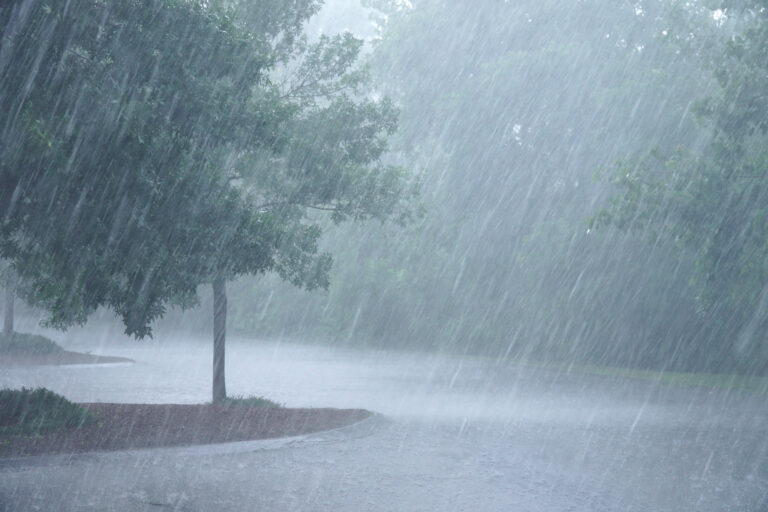
If cloud droplets are so small and slow-falling, how does rain ever reach the ground? Precipitation occurs when cloud droplets grow large enough that gravity overcomes both air resistance and updrafts. This requires droplets to become thousands of times larger than the typical cloud droplet.
In warm clouds (above freezing throughout), droplets grow through collision and coalescence. As droplets drift through the cloud, some collide and merge into larger drops. Larger drops fall slightly faster, allowing them to collect even more droplets as they descend. Once a droplet reaches about 1 to 2 millimeters in diameter—roughly the size of a small ladybug—it’s heavy enough to fall as rain despite updrafts.
In cold clouds, ice crystals play a crucial role. Water vapor preferentially deposits onto ice crystals rather than liquid droplets, allowing ice particles to grow larger more quickly. These crystals can grow into snowflakes, or if they fall through warmer air below the cloud, they melt and become raindrops.
The process of growing droplets from cloud-sized (20 micrometers) to rain-sized (2 millimeters) typically takes 20 to 30 minutes in favorable conditions. During that time, a droplet might collide with a million smaller droplets to achieve raindrop size.
Different Clouds, Different Behaviors
The ability of clouds to remain suspended varies with cloud type and atmospheric conditions. Thin, wispy cirrus clouds form at high altitudes where temperatures are well below freezing. These clouds consist of ice crystals rather than water droplets, and the crystals are so small and light that they can remain suspended for hours or days, slowly falling while being blown hundreds of miles by high-altitude winds.
Thick, dark stratus clouds produce drizzle rather than rain because their weak updrafts can’t support the development of large raindrops. Droplets grow large enough to fall slowly, but remain small enough that they take a long time to reach the ground—creating the steady, light precipitation characteristic of these cloud types.
Towering cumulonimbus thunderstorm clouds have such powerful updrafts that they can suspend large raindrops and even hailstones. Hail forms when ice particles are repeatedly carried upward by updrafts, accumulating more ice with each cycle until they finally become heavy enough to overcome even the strongest rising air and fall to the ground.
The Fog Is Just a Cloud at Ground Level
Fog demonstrates the same physics as clouds but at an elevation you can walk through. Fog consists of the same tiny water droplets suspended in air, formed when moist air cools to its dew point near the ground. The droplets are small enough that they remain suspended despite being at ground level.
When you walk through fog, you’re essentially walking through a cloud. The droplets are so small they don’t feel wet initially—only after thousands of them collect on your skin or clothing does moisture become noticeable. This is the same reason clouds don’t immediately soak you if you’re in an airplane passing through one.
Clouds Are Heavier Than They Look
Despite floating effortlessly, clouds contain enormous amounts of water. A single cumulus cloud might hold 500,000 pounds of water. A large thunderstorm can contain tens of millions of pounds. The water is there—it just exists as countless billions of tiny droplets, each one individually light enough to remain suspended.
When you see a cloud dissolve and disappear on a sunny day, the water hasn’t fallen—it’s evaporated back into invisible water vapor as warming air reduces the relative humidity below the point where condensation can occur. The water is still in the air, you just can’t see it anymore.
A Delicate Balance
Clouds represent a precise balance between gravity, air resistance, updrafts, and droplet size. Change any of these factors and the cloud’s behavior changes. Stronger updrafts create taller clouds. Weaker updrafts allow precipitation to form more easily. Larger droplets fall faster. Smaller droplets remain suspended longer.
The next time you see clouds drifting overhead, you’re watching billions of tiny droplets, each one light enough to float on air currents, collectively holding thousands or millions of gallons of water in suspended animation—until the delicate balance shifts and rain finally falls. It’s one of the atmosphere’s most elegant demonstrations of how size, scale, and physical forces interact to create the weather we experience every day.