People Have Been Reading the Sky for Thousands of Years
Before weather satellites, Doppler radar, and numerical prediction models, humans read the sky, the animals, and the landscape for clues about what was coming. The weather proverbs and folk sayings that accumulated over millennia of observation represent a genuine attempt to systematize those clues — to distill patterns into memorable rules that could be passed on without instruments or equations.
Some of these sayings encode real atmospheric science. The observations that generated them were real, the patterns were genuinely predictive in the regions where they originated, and the underlying physics is sound. Others are pure folklore — memorable, satisfying, and wrong. And some are partly right in ways that require qualification to be useful rather than misleading.
Mid-June is a good moment for this exercise — the summer sky is producing the full range of phenomena these sayings describe, and understanding which ones to trust makes reading it more rewarding.
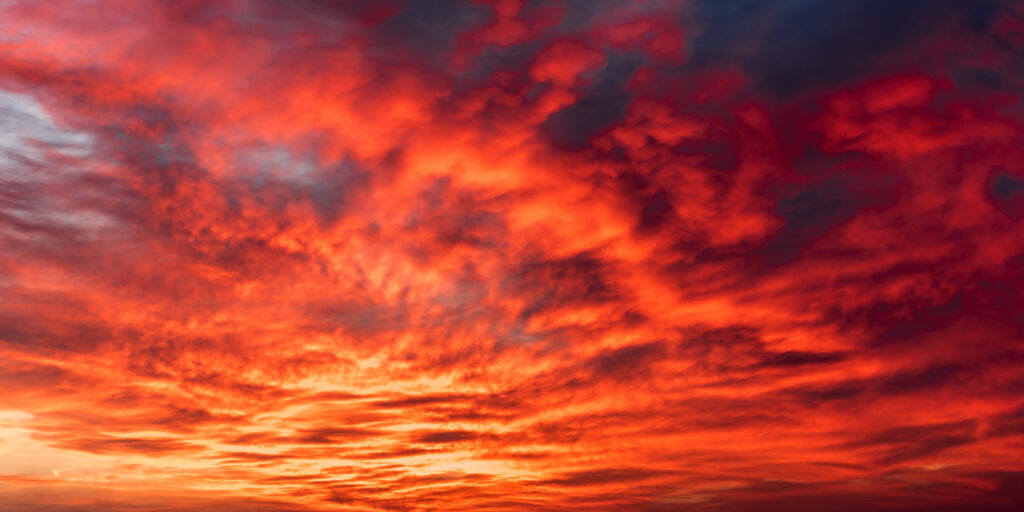
“Red Sky at Morning, Sailor Take Warning; Red Sky at Night, Sailor’s Delight”
This is one of the oldest and most widely repeated weather proverbs, appearing in the Bible (Matthew 16:2-3) and in maritime traditions across multiple cultures. It is also one of the most scientifically defensible.
The science behind it is the same atmospheric optics that produces colorful sunrises and sunsets, covered in the 3/30 sunset piece. Red morning and evening skies occur when the sun’s light travels through a long path of atmosphere and the blue wavelengths scatter away, leaving the warm reds and oranges. But the color also indicates something about what that atmosphere contains: a red sky typically indicates dust, moisture, and particles — the kinds of conditions associated with specific weather patterns.
In the mid-latitudes of North America and Europe — where weather systems predominantly move from west to east — a red sky at sunset (western sky) indicates that the air to the west, where weather is coming from, is relatively clear and dry. This is genuinely associated with fair weather arriving from the west overnight and into the next day. A red sky at sunrise (eastern sky) indicates that the same clear, moisture-rich conditions are to the east — already past — while clouds and weather are approaching from the west. The sailor’s warning is real.
The saying works reasonably well in the mid-latitudes where the westerly weather pattern holds. It is less reliable in regions with different dominant weather patterns — tropical areas, monsoon climates, or locations where weather frequently arrives from directions other than the west.
Verdict: Mostly true, with geographic caveats.
“When Cows Lie Down, Rain Is Coming”
This one has been tested more rigorously than it deserves, partly because it’s charming and partly because the underlying mechanism — that animals detect barometric pressure changes before humans notice — is plausible. The actual evidence is considerably less satisfying.
Cows lie down for many reasons: they lie down to rest, to ruminate, to cool their udders on hot days, to rest after feeding, and for reasons that have nothing to do with weather. Studies that have tracked cow posture relative to weather events have not found a reliable predictive relationship between lying-down behavior and subsequent rainfall. Cows lie down before rain events at roughly the rate you’d expect if they were lying down randomly relative to weather.
The appeal of the saying is its narrative logic — animals sensing something we can’t — but the mechanism doesn’t hold up. Cows are not sensitive barometers. If they were, we would expect them to systematically stand up and lie down in response to the pressure swings of passing weather systems, and this behavior hasn’t been documented.
Verdict: Not reliable. Entertaining, but not a weather indicator.
“A Ring Around the Moon Means Rain Within Three Days”
This one is more scientifically grounded than it might appear. The ring around the moon — the 22-degree halo covered in the atmospheric optics piece — forms when moonlight refracts through hexagonal ice crystals in high cirrus clouds. Cirrus clouds often precede warm fronts and their associated precipitation by 12 to 48 hours, which gives the saying its empirical basis.
The “three days” timeframe is too broad to be a precise forecast — the relationship between cirrus and precipitation arrival is real but variable. The clouds that produce the halo may be associated with a front that arrives in 12 hours or 36 hours or may miss the area entirely. The saying captures a genuine correlation but overstates its precision and reliability.
A moon halo does increase the probability of precipitation within the next day or two, compared to a clear night with no cirrus. It is not a guarantee, and the three-day window is too generous to be useful as a specific forecast. What it actually tells you is: cirrus clouds are present, which means a weather system may be approaching. Check the actual forecast.
Verdict: Partially true — the correlation is real, the precision is not.
“Cricket Thermometer: Count the Chirps”
The Dolbear’s Law cricket thermometer — counting cricket chirps to estimate temperature — is one of the most specifically verifiable pieces of weather folklore, and it is genuinely accurate within its limits.
Snowy tree crickets (Oecanthus fultoni) chirp at a rate that varies directly with temperature, and the relationship is consistent enough that Amos Dolbear described it mathematically in 1897. The most commonly cited version: count the number of chirps in 14 seconds and add 40 to get the temperature in Fahrenheit. This formula is accurate to within a few degrees for snowy tree crickets under normal conditions.
The caveats are significant. The formula applies specifically to snowy tree crickets, not to all cricket species, which chirp at different rates and with different temperature relationships. It applies at temperatures between roughly 55°F and 100°F — outside this range, crickets either don’t chirp or the relationship breaks down. And it requires accurately identifying the species producing the chirps, which is not straightforward.
As a party trick on a summer evening with a cooperative snowy tree cricket nearby, it works. As a general-purpose thermometer replacement, it has too many species-specific and temperature-range limitations to be consistently reliable.
Verdict: True for the right species in the right temperature range — genuinely interesting science.
“If Woolly Bear Caterpillars Have Wide Brown Bands, It Will Be a Mild Winter”
The woolly bear caterpillar — the larva of the Isabella tiger moth — is the mascot of American weather folklore, celebrated at dedicated festivals and consulted earnestly about winter outlooks every fall. The belief: a wider brown middle band relative to the black ends predicts a milder winter; more black predicts a harsher one.
The science is straightforward: there is none. Studies of woolly bear coloration patterns have found no correlation with subsequent winter severity. The width of the brown band reflects the caterpillar’s age, its specific population, local moisture conditions during its larval development, and individual variation — none of which have any relationship to the large-scale atmospheric patterns that determine winter temperature. The band has no predictive value for winter weather.
This doesn’t stop woolly bear festivals from being charming or people from looking for the caterpillars every fall. But the prediction is folklore in the pure sense — an observed pattern with an appealing narrative that turns out to have no empirical basis.
Verdict: No scientific basis. Watch the caterpillars for the joy of it, not the forecast.
“Groundhog Day: Six More Weeks of Winter”
Punxsutawney Phil’s shadow-based winter forecast has been studied with the same statistical rigor applied to woolly bears, and the result is the same: no predictive skill beyond chance. Phil’s forecasts are correct roughly 40 percent of the time — slightly less than a coin flip — which is consistent with random variation rather than any genuine meteorological sensitivity.
The specific mechanism proposed — a groundhog being disturbed from hibernation by his own shadow on February 2 — has no plausible connection to atmospheric science. Groundhogs don’t have meteorological sensing abilities that would allow them to forecast six weeks of atmospheric conditions, and the shadow mechanism makes no physical sense as a predictor of anything.
Groundhog Day persists as a beloved midwinter celebration, and Punxsutawney Phil is a genuinely charming cultural institution. His forecasts should be enjoyed accordingly.
Verdict: No predictive skill. Delightful tradition, terrible forecast.
“When Leaves Show Their Undersides, Rain Is Coming”
This one has a mechanism worth examining. Leaves on many tree species curl or turn to expose their undersides before rain events, and the observation behind this saying is genuine. The question is whether the leaf behavior actually predicts rain or is simply correlated with it.
The mechanism proposed is that rising humidity before a storm causes leaves to absorb moisture and curl or droop, exposing the lighter undersides. There is some evidence that certain species do show increased leaf curl and petiole bending in high-humidity conditions, which would indeed correlate with pre-frontal conditions when rain is likely.
The problem is that humidity rises for many reasons unrelated to approaching rain — it rises every morning as temperatures drop, rises on foggy days, and varies with microclimatic conditions. Leaf curl behavior driven by humidity is correlated with rain probability only in specific contexts, not universally.
For specific tree species in specific conditions, this saying may have real observational basis. As a general rule, it is too variable and too dependent on species and context to be reliably predictive.
Verdict: Partially grounded in real biology, but too variable to be reliably predictive.
The Sayings Worth Keeping
Of the sayings above, only the red sky proverb and the moon halo observation have enough scientific grounding to be worth treating as genuine signals rather than charming noise. Both encode real atmospheric optics connected to real weather pattern associations. Both were derived from genuine observation in the right geographic context.
The others — the cows, the woolly bears, the groundhog — are best appreciated as what they are: the accumulated attempts of careful observers to find patterns in a complex system, expressed in memorable language that survived because it was satisfying rather than because it was reliably correct.
The summer sky produces all of the phenomena these sayings describe — red sunrises and sunsets, moon halos on cirrus nights, morning dew and evening humidity. Knowing which observations to trust and which to enjoy without trusting makes the sky more interesting to read rather than less.