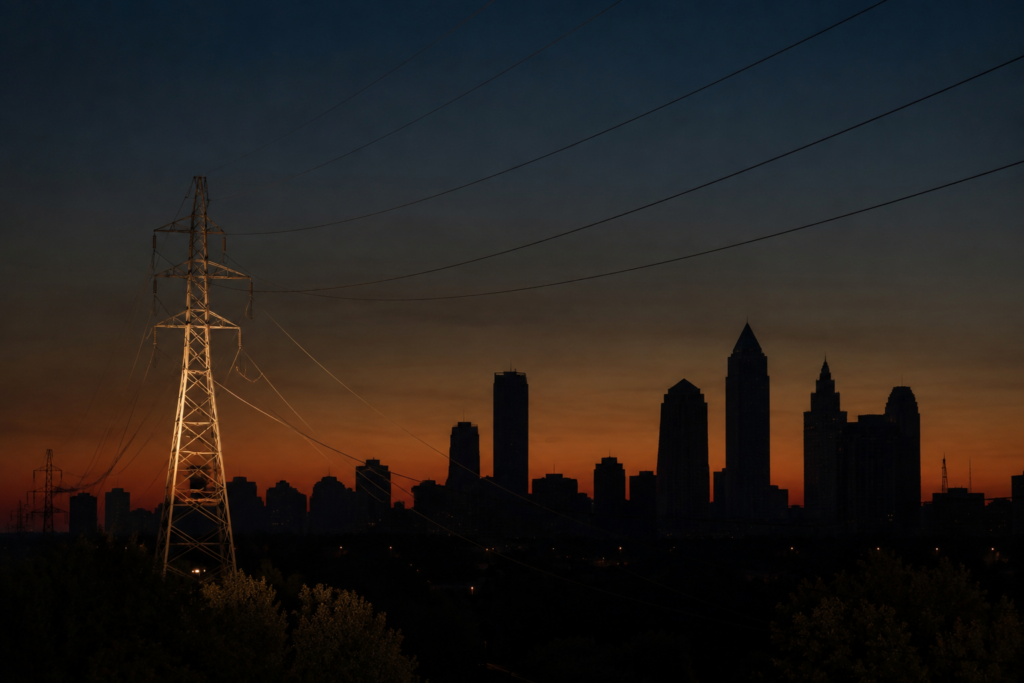
A Failure That Started Small and Cascaded Fast
On the afternoon of August 14, 2003, a series of relatively minor issues on the electrical grid in Ohio set off a cascading failure that, within hours, left roughly 50 million people across the northeastern United States and parts of Canada without power. What made the event notable wasn’t just its scale—it remains one of the largest blackouts in North American history—but how directly it was connected to a specific weather condition: a sustained heat wave that had pushed electricity demand to levels the aging grid infrastructure struggled to handle even before anything went wrong.
Heat Demand Set the Stage
In the days leading up to the blackout, much of the northeastern and midwestern United States was experiencing a significant summer heat wave, driving air conditioning use and electricity demand to seasonal highs. High electricity demand causes power lines to carry more current, and current flow generates heat within the lines themselves—a straightforward physical relationship that becomes significant during sustained high-demand periods. As transmission lines heat up, they also physically expand and sag lower toward the ground and surrounding vegetation, a well-understood engineering phenomenon called thermal sag.
This combination—high demand pushing lines toward their thermal limits, combined with sag bringing already-stressed lines closer to trees and other obstructions—created exactly the vulnerable conditions in which a cascading grid failure becomes far more likely than it would be under cooler, lower-demand conditions.
The Trigger: A Line, a Tree, and a Missed Warning
The blackout’s initiating event occurred when a heat-sagged transmission line in Ohio came into contact with overgrown trees that hadn’t been adequately trimmed, causing the line to trip offline. Under normal circumstances, this kind of localized failure would be manageable, with the grid rerouting power through alternative paths. But subsequent investigation revealed that a monitoring system failure at the utility responsible for that section of grid meant operators didn’t receive timely alerts about the developing problem, delaying the kind of intervention that might have contained the failure before it spread.
As additional lines, already operating near their thermal limits due to the ongoing heat wave, absorbed the rerouted load from the failed line, they too became overloaded and failed in succession. This cascading pattern—each failure increasing the load on remaining lines, which then failed in turn—spread rapidly across interconnected grid systems spanning multiple states and into Canada, ultimately cutting power to an area encompassing parts of eight U.S. states and the Canadian province of Ontario.
A Grid Built for a Different Era
Investigations following the blackout identified systemic vulnerabilities well beyond the specific chain of events that triggered it. The North American power grid had grown organically over decades, with increasing interconnection between regional systems designed to improve reliability, but that interconnection also meant that failures could propagate across much larger areas than the more isolated regional grids of earlier decades. Vegetation management—the ongoing maintenance required to keep trees and brush clear of transmission lines—had been inconsistently maintained by different utilities, creating exactly the kind of vulnerability that turned a heat-related line sag into a continent-spanning failure.
The event highlighted a growing mismatch between electricity demand, which had climbed steadily for decades, and grid infrastructure investment, which had not kept pace, leaving less operational margin during exactly the high-demand conditions—heat waves—when that margin mattered most.
What Changed Because of the Blackout
In the years following 2003, Congress passed legislation establishing mandatory, enforceable reliability standards for the bulk power grid, replacing a previous system of voluntary compliance that the blackout investigation identified as inadequate. Utilities significantly increased investment in vegetation management programs specifically targeting transmission line clearance, and grid operators implemented improved monitoring and communication systems designed to prevent the kind of delayed situational awareness that allowed the initial Ohio failure to cascade rather than being contained locally.
The event also became an important reference point in ongoing discussions about grid modernization, particularly as climate patterns have driven increasingly frequent and intense heat waves in the decades since, placing sustained pressure on exactly the kind of infrastructure vulnerabilities the 2003 blackout exposed.
A Blackout That Was as Much About Heat as Wires
The 2003 Northeast Blackout is remembered primarily as an infrastructure and engineering failure, but the heat wave that preceded it wasn’t incidental background context—it was a direct contributing cause, pushing transmission lines toward their physical limits and creating the vulnerable conditions in which a single missed maintenance issue could cascade into a continent-spanning failure. It remains one of the clearest historical examples of how extreme weather and aging infrastructure can combine to produce consequences far larger than either factor alone would suggest.