The Best Cooling Strategy Starts Before Heat Gets Inside
The cooling systems prep piece published in late April covered the mechanical side of summer comfort — AC tune-ups, ceiling fan direction, whole-house fans, and window sealing. That piece addressed how to remove heat from your home once it’s inside. This piece addresses the other side of the same problem: how to prevent heat from getting inside in the first place.
The distinction matters because every BTU of heat that doesn’t enter your home is a BTU your air conditioning doesn’t have to remove. Reducing heat gain through the building envelope — the walls, roof, attic, and windows that separate conditioned interior space from the hot outdoor environment — directly reduces the load on your cooling system, lowers energy bills, and keeps the house more comfortable during heat waves when cooling systems are working at their limits.
Most of the improvements below are either inexpensive to implement or pay for themselves in energy savings within a few seasons. Some are weekend DIY projects. Others are larger investments worth evaluating against their long-term returns. All of them address real heat pathways that standard residential construction allows.
The Attic: Where Most Heat Enters
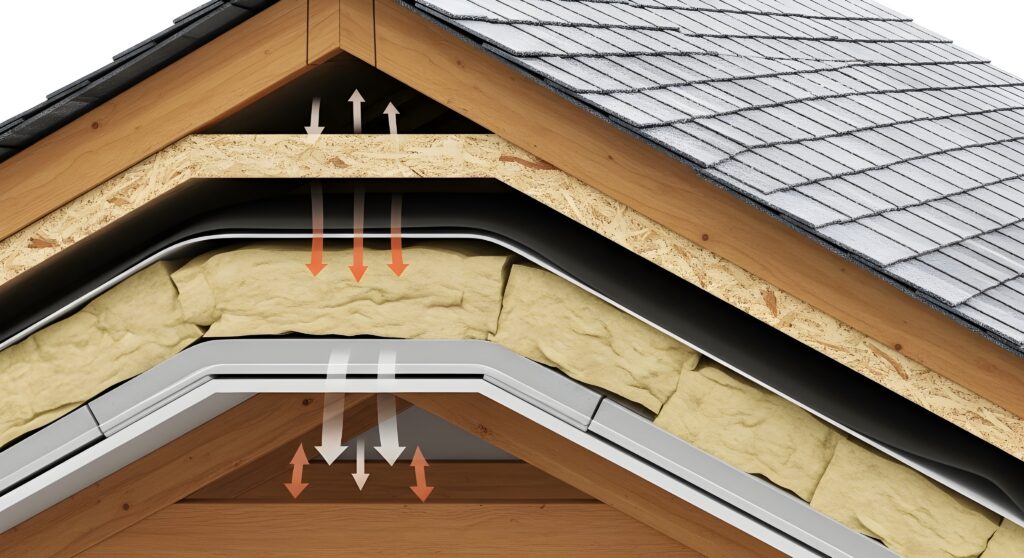
The attic is the single largest source of summer heat gain in most homes, and addressing it produces the most significant improvement in comfort and cooling efficiency of any single intervention.
On a sunny summer day, a poorly ventilated attic can reach 150°F or higher. This superheated air mass sits directly above the living space, separated only by the attic floor — which in many homes is insulated but not as thoroughly as modern standards recommend. Heat radiates downward through the attic floor into the living space below, raising ceiling temperatures and forcing the air conditioning to work continuously to compensate.
Attic insulation is the first line of defense. The Department of Energy recommends attic insulation levels of R-38 to R-60 for most of the contiguous United States — levels that many existing homes, particularly those built before the 1980s, don’t meet. Adding blown-in insulation to bring attic floors up to current standards is one of the highest-return home efficiency investments available, typically paying back its cost in energy savings within three to seven years depending on climate and energy prices. This is a job for a professional insulation contractor in most cases, though ambitious DIYers can rent blower equipment and purchase insulation for a self-install.
Attic ventilation is equally important and frequently overlooked. A well-ventilated attic allows hot air to escape through ridge vents and soffit vents, keeping attic temperatures significantly lower than an unventilated or poorly ventilated attic. Check that soffit vents — the openings along the underside of the roof overhang — are not blocked by insulation or debris. Confirm that ridge vents along the roof peak are clear. An attic that has adequate insulation but poor ventilation will still run hot because the insulation alone can’t prevent heat buildup — it needs to be paired with ventilation that removes the hot air.
Radiant barriers are a supplemental strategy for hot climates — reflective foil material installed in the attic to reflect radiant heat from the roof deck before it can warm the attic air. They are most effective in climates with high solar radiation and are less cost-effective in milder climates. In the southern United States and Southwest, radiant barriers can reduce attic temperatures by 20 to 30°F and produce meaningful cooling load reductions.
Windows: The Solar Heat Gain Problem
Windows are the most thermally active components of a home’s envelope — they allow solar radiation to enter freely while providing minimal insulation compared to insulated walls. On a sunny summer afternoon, south and west-facing windows can deliver more heat to a room than a small space heater running continuously.
Window films are the most accessible and cost-effective window heat control option for existing homes. Reflective or low-emissivity window films applied to the interior surface of glass reduce solar heat gain by 40 to 70 percent depending on film type and window orientation. They can be self-installed with patience and the right tools, or professionally installed. A film that blocks 50 percent of solar heat gain through a west-facing window that receives three hours of direct afternoon sun can reduce the cooling load on that room significantly.
Window film has some tradeoffs worth considering: reflective films reduce winter solar heat gain along with summer heat gain, which increases winter heating costs slightly in cold climates. In hot climates where cooling costs dominate, this tradeoff is clearly favorable. In cold climates with short but intense summers, the calculation requires more consideration.
Exterior shading is more effective than interior shading because it blocks solar radiation before it enters the glass rather than after. Awnings over south and west-facing windows can reduce solar heat gain through those windows by 65 to 77 percent according to Department of Energy data — a larger reduction than most interior interventions achieve. Retractable awnings allow summer shading without sacrificing winter solar gain. Fixed awnings on south-facing windows, sized correctly for the latitude, can block the high summer sun while allowing the lower winter sun to enter — a passive solar design principle that is geometrically elegant when properly executed.
Exterior shutters and shades accomplish the same purpose as awnings and are increasingly available in attractive, motorized versions that can be scheduled or controlled remotely. For west-facing windows that receive direct afternoon sun — the most significant summer heat gain pathway in most climates — exterior roller shades that deploy automatically at 2 p.m. and retract at sunset can dramatically reduce the afternoon heat load that peaks precisely when cooling demand is highest.
Wall Insulation and Air Sealing
Walls are a less dramatic heat gain pathway than windows and the attic, but in homes with inadequate wall insulation — common in houses built before the 1970s — they contribute meaningfully to summer heat load.
Wall insulation improvements are more invasive and expensive than attic insulation improvements, typically requiring either interior or exterior renovation work to access the wall cavities. Blown-in insulation through small holes drilled in the exterior or interior wall surface, then patched and repainted, is the least invasive approach and can significantly improve the thermal performance of existing walls without major renovation.
Air sealing — identifying and sealing the gaps and cracks that allow hot outdoor air to infiltrate the conditioned space — is often more cost-effective than adding insulation in existing homes and can be performed without significant disruption. Common infiltration points include gaps around electrical outlets and switches on exterior walls (addressable with foam gaskets behind the cover plates), gaps around plumbing penetrations in walls and floors, and the junction between the foundation and the first floor framing (the rim joist area). A professional energy audit with blower door testing can identify and quantify infiltration in a specific home and prioritize the most cost-effective air sealing interventions.
Landscaping as Passive Cooling
The cooling effect of mature shade trees is substantial and represents one of the few interventions that improves over time rather than degrading. A large deciduous tree shading a south or west-facing wall or window reduces the solar heat gain through that surface by eliminating the solar radiation load entirely during the hours it provides shade — a reduction that no film or coating can match.
The Department of Energy estimates that strategically placed trees can reduce summer cooling costs by 25 to 50 percent over the life of the trees. The limitation is the time required for trees to reach effective size — a newly planted tree provides minimal shading for its first several years. Trees planted now will provide meaningful shade within five to ten years for fast-growing species.
For more immediate results, deciduous vines on trellises positioned against south and west-facing walls provide summer shading that the vine’s leaves deliver while leafed out and withdraw in winter when the bare vine allows solar gain through. Wisteria, Virginia creeper, and climbing hydrangea are all effective for this purpose.
Turf grass and other vegetation around the home also contribute to cooling by reducing the surface temperature of the surrounding ground — replacing some of the hardscape that absorbs and radiates heat with vegetated surfaces that stay cooler through evapotranspiration. The urban heat island effect is driven partly by the replacement of vegetation with pavement; reversing that around your home provides a modest but real cooling benefit.
The Investment Perspective
The interventions above range from free (checking attic vent clearance) to modestly priced (window film, foam outlet gaskets) to significant investments (attic insulation, exterior shading systems). Evaluating them as investments against their energy savings returns makes the priorities clearer.
Attic insulation and air sealing consistently produce the highest return in energy savings relative to cost, with payback periods under a decade in most climates. Window film is moderate in cost and moderate in return — worth doing for high-solar-gain windows, less compelling for well-shaded ones. Exterior shading systems are more expensive but produce the largest reduction in solar heat gain of any window intervention. Landscaping has the longest time horizon but the greatest long-term impact and adds property value independent of energy savings.
The cooling system handles the heat that gets inside. The building envelope determines how much heat it has to handle. Improving both — the mechanical system and the passive envelope — produces comfort and efficiency that neither alone achieves. Mid-June, as summer heat season peaks, is exactly the right moment to assess where the biggest heat gain pathways are and address the most accessible ones before the hottest weeks arrive.