The Solstice Is a Biological Event, Not Just an Astronomical One
The summer solstice arrives in less than a week, and if you pay attention to the world outside your window, the evidence of its approach is everywhere. The birds that woke you at 4:30 a.m. in May are now singing before 4 a.m. Fireflies that appeared in late May are now peaking in the evenings. The cicadas that have been building their chorus through June are approaching maximum intensity. The white-tailed deer have fawns that are old enough to be moving through neighborhoods at dusk.
The 6/6 science piece covered the astronomy of the solstice — Earth’s geometry, the equation of time, why the earliest sunrise doesn’t fall on the longest day. This piece covers the biological side of the same event: how the lengthening and then stabilizing days of late June affect the behavior, physiology, and life cycles of the animals that share the summer landscape. The same light signal that drives changes in human sleep and mood, covered in the summer mental health piece, produces far more dramatic responses in the species whose entire reproductive and behavioral calendars are synchronized to day length.
Photoperiodism: The Biological Clock Keyed to Light
The response of living organisms to the length of day and night is called photoperiodism, and it is one of the most fundamental biological mechanisms in the natural world. Plants flower, animals breed, birds migrate, and insects emerge — not primarily in response to temperature, which is variable and unpredictable, but in response to day length, which is absolutely fixed and perfectly predictable for any location on Earth.
Day length is a more reliable seasonal signal than temperature because it cannot be fooled by unseasonable warmth or cold. A warm February doesn’t fool a robin’s reproductive system into thinking it’s time to breed — the day length is still winter-short. A cold June doesn’t delay the summer solstice or the biological events it triggers. The predictability of photoperiod makes it the master clock that synchronizes the natural world’s seasonal events with the actual progression of the year.
The specific mechanism is hormonal. In vertebrates, specialized photoreceptors in the eye and, in some species, directly in the brain tissue detect light and drive changes in melatonin secretion from the pineal gland. The duration of nightly melatonin secretion — long in winter, short in summer — is the signal that regulates the release of reproductive hormones, triggers molt and coat change, controls migration readiness, and governs dozens of other seasonal behaviors. As days have lengthened through spring and into summer, melatonin duration has shortened, and the biological events that short melatonin windows trigger have been unfolding in sequence.
Birds: The Dawn Chorus at Its Peak
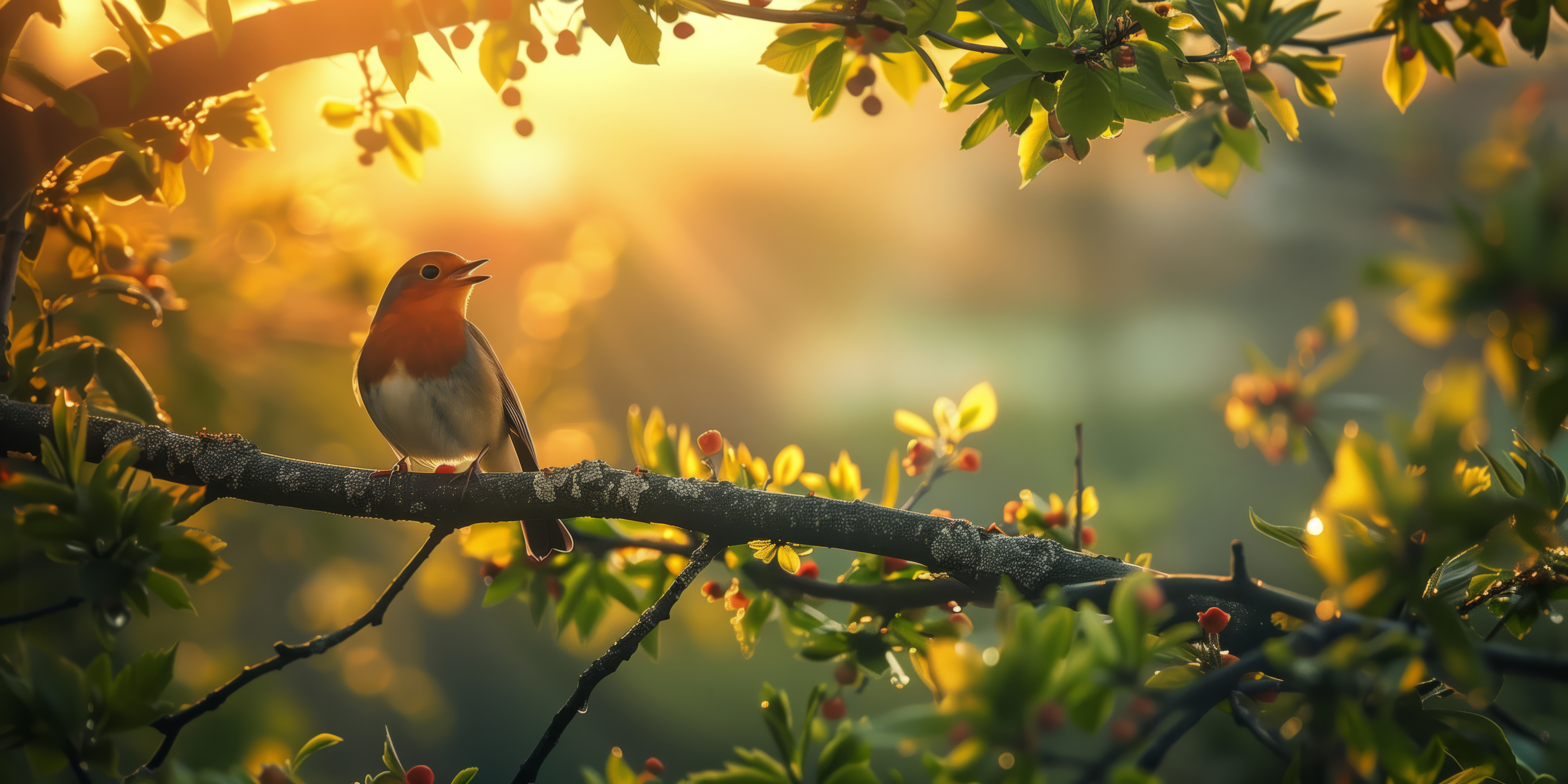
The dawn chorus — the cacophony of birdsong that begins well before sunrise in late spring and early summer — reaches its peak intensity around the solstice. Male songbirds sing to establish territories and attract mates, and the chorus begins while it is still dark because the photoreceptors driving singing behavior respond to the first faint light of civil twilight, well before sunrise.
At the solstice, civil twilight begins around 4 a.m. at mid-latitudes, and the first singing may begin even earlier in response to artificial lighting or moonlight. The chorus typically involves dozens of species singing simultaneously, each with its own song and timing within the pre-dawn sequence — some species consistently sing first, others join later as light increases, producing a predictable cascade of voices that experienced birders can read as precisely as a clock.
After the solstice, the dawn chorus begins to contract. As days shorten and reproductive seasons end or decline, the intensity and duration of morning singing decreases through July and August. The solstice is, in this sense, the biological peak of the breeding season for most North American songbirds — the moment when the annual investment in territorial defense and mate attraction is at its maximum.
Many songbirds have already completed their first breeding cycle by the solstice and are either on second clutches or beginning to wind down reproductive behavior. The robins, chickadees, and house wrens that were building nests in early May are fledgling their second or even third broods by mid-June. The biological pressure of the breeding season — which the lengthening days of spring triggered — is beginning to relax as the solstice approaches and the days’ growth stalls.
Fireflies: Synchronized to the Solstice
Fireflies — more properly lightning bugs, members of the beetle family Lampyridae — are one of the most visible biological expressions of the solstice season, and their peak activity is synchronized to day length in ways that vary fascinatingly by species.
The light displays of fireflies serve the same function as bird song: male fireflies produce species-specific flash patterns to attract females, who respond with their own flashes from the vegetation below. Different species have distinct flash intervals, flash durations, and flash colors — a system of species-specific Morse code that allows the right individuals to find each other in a landscape where multiple species are signaling simultaneously.
The timing of firefly activity is keyed to light levels — most species begin flashing when ambient light drops below a threshold that varies by species. Some species are active in the brief window just after sunset when light is fading but not yet dark. Others are active only after full dark. A few species are active just before dawn. The specific light threshold that triggers each species’ flashing is itself a form of temporal isolation — a mechanism that reduces cross-species interference by staggering the active periods of species that share the same habitat.
June is peak firefly season across most of the eastern United States, with maximum abundance and flash activity occurring in the weeks around the solstice. The synchronous fireflies of the Great Smoky Mountains — a species whose males produce coordinated simultaneous flash displays — hold their peak synchrony events in late May and early June, drawing visitors from across the country who come specifically to see the landscape pulse with coordinated light.
After the solstice, firefly abundance declines progressively through July as adults complete their reproductive season and die. The larvae that hatch from eggs laid during the summer remain in the soil through autumn and winter, emerging as adults the following spring — their entire above-ground existence compressed into the weeks around the longest days.
Deer: Fawns, Velvet, and the Lengthening Day
White-tailed deer are highly photoperiodic animals whose entire reproductive cycle is keyed to day length. The rut — the breeding season — is triggered by the shortening days of fall, specifically the decreasing light of October. The does that conceived in November are giving birth in late May and June, with fawning season peaking right around the solstice.
June fawns are at the developmental stage where they are beginning to accompany their mothers on foraging trips rather than being hidden in vegetation while the doe feeds separately. The spotted coat that provides camouflage during the first weeks of life is still present in June, slowly fading as the fawn grows. The distinctive white spots will be largely gone by September.
Male deer are in velvet through the summer — their antlers growing rapidly under a blood-rich skin covering that provides the nutrients for bone growth. Antler growth is one of the fastest tissue growth processes in the mammal kingdom, with some large males adding an inch of antler per day during peak growth. This growth is driven by testosterone levels that are themselves regulated by day length — the shortening days of late summer will trigger the hormonal shift that drives velvet shedding and antler hardening in September.
The solstice is the turning point in this hormonal trajectory. The longest day is when the photoperiodic signal begins shifting toward shorter days, and this shift — even while temperatures continue to rise and summer feels like it’s building — begins the biological preparation for fall behaviors months in advance of their actual occurrence.
Insects: The Peak of Summer Abundance
June and early July represent the annual peak of insect abundance across most of the temperate United States, and the solstice sits at the center of this peak. The warming temperatures and long days that support maximum plant growth simultaneously support maximum herbivorous insect abundance — the grasshoppers, caterpillars, beetles, and bugs that exploit summer vegetation at its most productive.
This insect abundance is not coincidental to the bird breeding season — it is the foundation of it. Most songbirds feed insects to their nestlings even if the adults eat primarily seeds or berries. The timing of egg-laying in many species is precisely calibrated to coincide with peak caterpillar abundance, which itself coincides with peak leaf growth on the trees the caterpillars feed on. The nested timing of plant growth, caterpillar emergence, and bird breeding is one of ecology’s most elegant synchronizations, and all three are keyed to the same day-length signal.
Disruptions to this synchronization — as when spring temperatures advance faster than bird migration timing can follow, or when caterpillar emergence shifts earlier due to warming while birds’ genetically programmed migration timing doesn’t shift at the same rate — produce mismatches that reduce breeding success. This is one of the more concerning ecological consequences of rapid climate change: species whose seasonal timing is governed by different environmental cues may find that their calendars no longer align with the ecological resources they depend on.
The Natural World’s Peak and Turn
The solstice is both the peak and the turning point of the biological summer. Song is loudest, insects most abundant, fawns most visible, fireflies most active — and at the same moment, the days have stopped growing and begun their slow retreat. The natural world is simultaneously at its summer maximum and beginning, at the hormonal and physiological level, to prepare for what follows.
This is part of what makes the weeks around the summer solstice so distinctly alive — the accumulated energy of the lengthening days has fully expressed itself in the landscape, and the biological momentum of the season is at its peak. The birds singing before dawn, the fireflies in the field at dusk, the fawn at the wood’s edge in the evening light — these are the full expression of a process that began at the spring equinox and peaks now, in the longest days, before slowly beginning its long turn toward autumn.