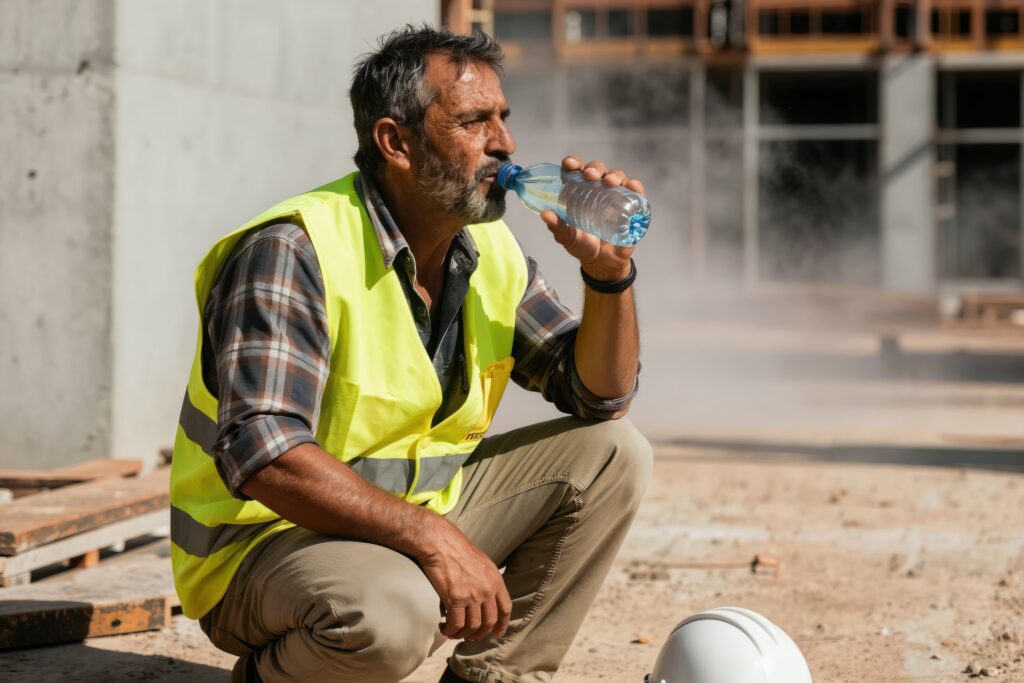
The Workers Most Exposed to Summer Heat
When heat waves make headlines and public health agencies issue warnings, the focus is typically on vulnerable populations at home — the elderly, the very young, people without air conditioning. What receives less public attention is the population that faces sustained, unavoidable heat exposure as a condition of their employment: the construction workers framing houses in July heat, the agricultural workers harvesting crops in afternoon sun, the landscapers and roofers and utility crews who spend eight to ten hours daily in full summer sun regardless of the heat index.
Outdoor workers die of heat illness in the United States every summer. The Bureau of Labor Statistics documents dozens of occupational heat fatalities annually, with the true number almost certainly higher because heat-related deaths in the workplace are often attributed to cardiac events rather than heat illness as the underlying cause. The workers most affected — construction, agriculture, landscaping, roofing — are disproportionately low-wage and in many cases immigrant workers who face economic pressure not to slow down, report symptoms, or stop working in conditions that are genuinely dangerous.
Understanding heat illness in the outdoor worker context — the specific risk factors, the legal protections, and what both workers and employers are responsible for — addresses one of summer’s most persistent and least-discussed health crises.
Why Outdoor Workers Face Amplified Heat Risk
The heat illness risk for outdoor workers substantially exceeds the risk faced by people recreating in the same conditions, for reasons rooted in the specific nature of occupational heat exposure.
Duration. A recreational runner who goes out for 45 minutes in the heat and then returns to an air-conditioned home has a fundamentally different cumulative heat exposure than a roofer who works eight hours in the same conditions. The cumulative heat burden — the total physiological load accumulated over the workday — determines whether the body’s cooling mechanisms are overwhelmed, and an eight-hour outdoor shift in 95°F heat with high humidity is a sustained test of thermoregulatory capacity that most recreational heat exposures don’t approach.
Physical exertion. Manual labor generates substantial internal body heat through muscular activity. A construction worker swinging a hammer, a roofer carrying shingles up a ladder, or an agricultural worker stooping repeatedly through crop rows generates internal heat that adds to the ambient heat load. The combination of external heat and internally generated exertion heat produces a total heat burden that is significantly higher than the ambient temperature alone suggests. This is why heat illness can develop in workers at temperatures that recreational exercisers manage without difficulty — the exertion component of worker heat load is higher and more sustained.
Limited ability to self-regulate. A recreational athlete who feels heat stress stops and rests. An outdoor worker operating under production pressure, piece-rate pay structures, or fear of job loss faces economic disincentives to slow down or stop when experiencing early heat stress symptoms. This pressure — which is both real and well-documented in occupational health research — means that warning symptoms that would prompt a recreational participant to stop are sometimes pushed through in occupational settings, allowing heat exhaustion to progress to heat stroke.
Lack of acclimatization at the start of season. As covered in the heat and exercise physiology piece, heat acclimatization takes 10 to 14 days of daily heat exposure to develop. Outdoor workers who were working in cooler conditions in spring are not acclimatized to peak summer heat when it arrives. New workers — hired as summer labor increases — may have no relevant heat exposure history at all. The first weeks of extreme summer heat and the first weeks of a new worker’s employment are both elevated risk periods that require specific management.
The OSHA Framework: What Employers Are Required to Provide
The Occupational Safety and Health Administration has long-standing authority over workplace heat safety under the General Duty Clause of the OSH Act, which requires employers to provide a workplace free from recognized serious hazards. OSHA has been developing a specific heat illness prevention standard — a process that has been ongoing — but even in the absence of a completed rule, the General Duty Clause creates enforceable obligations for outdoor employers during hot weather.
The core obligations that OSHA has consistently enforced under the General Duty Clause include:
Water. Employers must provide potable drinking water to outdoor workers — the standard guidance is one quart (approximately one liter) of water per worker per hour during heat conditions. Water must be cool or cold, readily accessible, and available without requiring workers to travel significant distances from their work station. Water must be provided at no cost to workers.
Rest. Employers must provide access to rest breaks in cool or shaded areas during hot weather. The specific frequency and duration of required rest breaks is not prescribed in a single numerical standard but is determined by the heat index and work demands — at higher heat index values and higher exertion levels, more frequent and longer breaks are required to maintain physiological safety. Rest areas must provide genuine relief — a shaded area with air movement is adequate; a shadeless area that merely removes the worker from direct sun while leaving them in still, hot air is not.
Shade. Shaded rest areas must be available and accessible. For fixed work sites, shade structures are expected. For mobile operations, portable shade — canopies, shade tents — must be provided and moved with the operation rather than requiring workers to walk significant distances to reach shade.
Acclimatization. OSHA guidance specifically requires employers to implement acclimatization protocols for new workers and for all workers returning after a period away during hot weather. The recommended approach is a gradual increase in heat exposure over the first 7 to 14 days — starting new workers at 20 percent of full heat exposure duration on day one and increasing by 20 percent per day until full duration is reached. This protocol is not merely recommended — failure to acclimatize workers who subsequently develop heat illness has been cited by OSHA as a violation of the General Duty Clause.
Training and a heat illness prevention plan. Employers must train workers to recognize the signs of heat illness in themselves and their coworkers, understand the importance of early reporting, and know what to do when symptoms appear. Supervisors must be trained in heat illness recognition and emergency response procedures.
Recognizing Heat Illness in the Field
The heat stroke recognition content from the 6/2 piece applies fully in the occupational context, but the specific challenges of recognizing heat illness in a work setting deserve additional emphasis.
Workers experiencing early heat exhaustion may attribute their symptoms — headache, nausea, dizziness, weakness — to other causes and continue working. Coworkers and supervisors who notice that a worker has become uncharacteristically slow, confused, or clumsy should treat these signs as potential heat illness indicators rather than as performance issues. Behavioral changes — a normally talkative worker going quiet, a worker making unusual errors, a worker who stops drinking water — are sometimes the most visible early signs of heat illness in a field setting.
The transition from heat exhaustion to heat stroke can occur rapidly in the occupational context, where the combination of continued exertion and heat exposure after early symptoms appear accelerates the physiological deterioration that leads to dangerously elevated core temperature. A worker who reports feeling unwell during a heat wave should be moved to shade and cool conditions immediately, not after finishing a task or waiting for a scheduled break.
Heat stroke in the field is a medical emergency. The response is: stop work, call 911, move the worker to the coolest available environment, remove excess clothing, apply cool water to the neck, armpits, and groin, and continue cooling until emergency services arrive. Do not leave the worker alone. Do not give fluids by mouth to a worker who is confused or unconscious.
Worker Rights and Reporting
Workers have the right to raise heat safety concerns without retaliation — federal law protects workers who report safety violations, refuse work they reasonably believe poses imminent danger, and participate in OSHA inspections. In practice, the fear of retaliation — particularly among immigrant workers, temporary workers, and those in precarious employment — suppresses reporting and contributes to the conditions that allow heat illness to escalate to fatality.
Workers who experience inadequate water, rest, or shade; who are pressured to work through heat illness symptoms; or who witness a coworker’s heat illness that is not responded to appropriately can file a complaint with OSHA. Complaints can be filed online, by phone, or in person, and can be filed anonymously. OSHA is required to inspect workplaces in response to formal complaints alleging imminent danger.
Workers who are new to outdoor work, who are returning from time off, or who are assigned to more physically demanding tasks or hotter conditions than they are accustomed to should specifically communicate to supervisors that they are not yet acclimatized — this information is relevant to how the employer manages their heat exposure and is information that supervisors may not have unless workers provide it.
The Week That Matters Most
Occupational health research consistently identifies the first week of a heat wave and the first week of a new outdoor job as the two highest-risk periods for heat illness fatalities. Both periods share the characteristic of workers operating in conditions that exceed their current acclimatization level.
The middle of July — when temperatures are at or near their seasonal maximum across most of the country — is when both conditions frequently coincide: experienced workers who have been doing the job all spring suddenly face conditions that exceed what they’ve encountered, and newly hired summer workers are beginning their first week of outdoor work simultaneously. This convergence makes mid-July the period when heat illness prevention — adequate water, mandatory rest in shade, genuine acclimatization, and supervisors who are watching for early symptoms — is most critical and most life-saving.
The workers who are outside right now, in this heat, building and maintaining the physical infrastructure of communities, deserve the same heat safety attention that the broader public receives in heat emergency communications. They face more of the heat, for longer, with less ability to opt out.