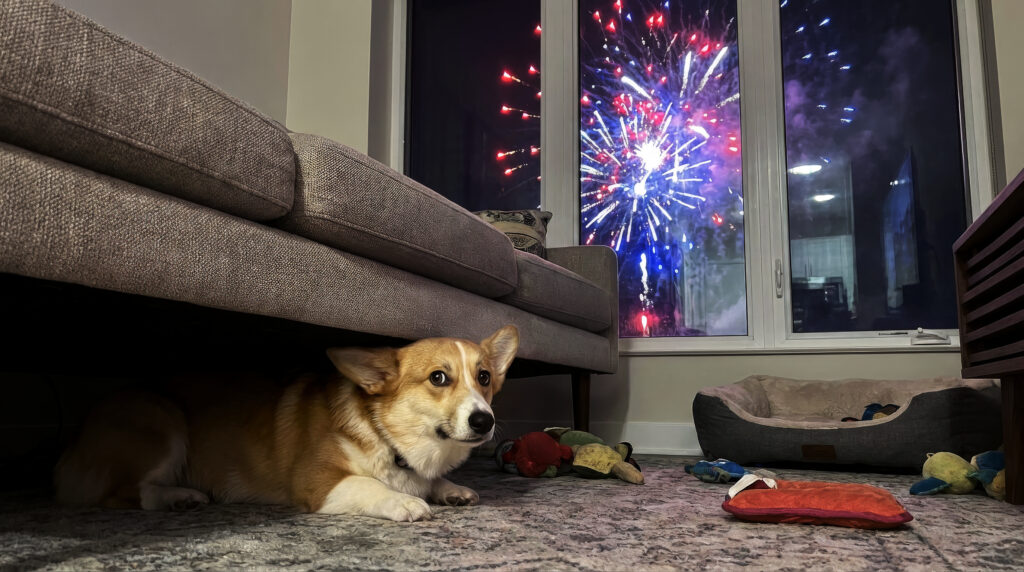
Ten Days Out Is the Right Time to Prepare
The Fourth of July is the single worst night of the year for most pets. Animal shelters across the country report that July 5th is their busiest intake day — the day after the holiday, when frightened animals that bolted during fireworks displays are brought in by the people who found them. More pets go missing around the Fourth of July than at any other time of year, and a significant number are never reunited with their owners.
The fireworks anxiety that drives this annual crisis is not a character flaw in the animals experiencing it. Fireworks are objectively terrifying from a pet’s perspective: sudden, extremely loud, unpredictable, accompanied by flashes of light and the smell of smoke, and occurring in a context — the familiar neighborhood — where the animal has no previous framework for such stimuli. The fear response is appropriate to the stimulus. The challenge for owners is managing it safely.
Ten days is enough time to prepare meaningfully. The interventions that work best — veterinary consultations for medication, desensitization approaches, safe space establishment — require time that won’t exist if you wait until July 3rd. Here is what to do now.
Why Fireworks Trigger Such Extreme Responses
Fireworks anxiety is more intense and more physiologically overwhelming than most other fear responses in pets, and understanding why helps explain why some of the common management approaches fail.
The sound of fireworks — extremely loud, sudden, and with a frequency profile that includes significant low-frequency components — triggers the same acute stress response as any sudden loud noise, but amplified by several factors. The unpredictability of timing is one: a dog that is afraid of thunderstorms can detect the approaching storm through barometric pressure changes, the smell of rain, and distant thunder, giving them some warning. Fireworks arrive without warning — one moment the night is quiet, the next a shell detonates overhead at 150 decibels.
The combination of sound, light flash, and smoke smell simultaneously activates multiple sensory channels associated with threat. Unlike thunderstorms, which dogs have some evolutionary context for, fireworks have no adaptive framework in canine or feline experience. The animal has no category for the stimulus and no learned response that resolves the threat — which means the fear response continues without the self-limiting effect that recognition and learned safety provide.
The result is often a state of acute panic that overrides learned behaviors, the owner-pet relationship, and even the animal’s normal sense of self-preservation. A dog that would never otherwise run into traffic has done so to escape fireworks. A cat that never goes outdoors has bolted through a briefly opened door. The panic is that complete.
What to Do Now: The Ten-Day Window
Consult your veterinarian this week if your pet has significant fireworks anxiety. This is the most important preparation step and the one that requires the most lead time. Veterinarians can prescribe medications — including trazodone, gabapentin, alprazolam, and in some cases dexmedetomidine (Sileo), an FDA-approved gel specifically for canine noise aversion — that significantly reduce anxiety during fireworks events. These medications are most effective when the appropriate drug and dose have been identified in advance, which may require a trial run before the holiday itself.
Do not wait until July 3rd to have this conversation. Veterinary offices are typically very busy in the days immediately before the Fourth, prescriptions require time to fill, and some medications benefit from a trial dose given on a calm day to confirm the response before using them during an actual fireworks event. Schedule the appointment this week.
Establish and introduce the safe space now. As covered in the spring storm anxiety piece, pets manage fear better when they have an established, familiar location associated with safety that they have been introduced to during calm periods rather than during the frightening event itself. An interior room — ideally one with minimal windows, on the ground floor, as far from the noise as the house allows — set up with familiar bedding, water, and comfort items should be introduced to your pet over the next week as a positive, pleasant space before it’s needed as a refuge.
Consider sound desensitization if you have time. Gradually exposing pets to recordings of fireworks sounds at low volume, paired with treats and positive attention, over repeated sessions can reduce the fear response — but this requires consistent daily sessions over at least several weeks for meaningful effect. Ten days is not enough time for full desensitization, but even a week of brief daily sound sessions at low volume may take the edge off the most extreme responses in mildly anxious animals.
The Night Itself: Management During Fireworks
Keep pets inside, secured, and identified. This sounds obvious but requires specific planning. Pets should be inside and in a secured location before fireworks begin — not brought in reactively once they’ve started. Fireworks typically begin well before official displays, sometimes hours earlier, and the reactivity window expands accordingly. By 8 p.m. on July 4th, pets should be inside in their established safe space.
Secure the safe space. A panicked dog can open lever-style door handles, push through pet doors, and scratch through screen doors. If the safe space has any openings the animal could exploit in a panic, secure them before the fireworks begin.
Verify ID before the holiday. Check that your pet’s microchip registration is current with your current phone number and address — not the number you had three years ago. Ensure ID tags are legible and attached to a collar that fits properly and won’t slip off. The pet that gets lost on July 4th has a dramatically better chance of being reunited if its microchip registration is current. The ASPCA recommends checking and updating microchip registration annually; do it this week.
Provide the safest environment possible inside. White noise machines, fans, or television can mask some of the sound. Heavy curtains block the light flashes. A thundershirt or anxiety wrap may reduce arousal in dogs that respond to compression. Be present with your pet if possible — your calm presence communicates safety information even if it doesn’t eliminate the fear.
Do not punish fear responses. A dog that destroys a doorframe trying to escape, that has an accident indoors, or that barks continuously through a three-hour fireworks display is not being disobedient. It is responding to overwhelming fear as its nervous system dictates. Punishment during or after a fear response does not reduce the fear and can add anxiety to an already maximal stress state.
Cats: Different Profile, Same Risk
Cat owners sometimes underestimate fireworks anxiety because cats express it differently than dogs. A dog’s fireworks anxiety is often visible and loud — panting, pacing, whining, destructive behavior. A cat’s is often expressed through hiding — finding the most inaccessible concealed space in the house and remaining there for hours.
This quieter expression doesn’t mean cats are less stressed. A cat that has been hiding under the bed for five hours has been in a sustained fear state for five hours. The physiological stress of that prolonged fear response — elevated cortisol, elevated heart rate, sustained sympathetic nervous system activation — is real regardless of how visible it is.
The specific cat risk on the Fourth is the bolting cat — the indoor cat that finds an exit through a briefly opened door during the holiday when household traffic and distraction create more opening opportunities than usual. Keep interior doors between your cat and exterior exits closed through the evening, and brief all household members and guests that exterior doors must be managed carefully.
The Day After: What to Do If Your Pet Goes Missing
If your pet escapes during fireworks, act immediately rather than waiting to see if they return on their own. A frightened animal that has bolted may travel much farther from home than their normal range — driven by panic rather than navigation — and may be too stressed to respond to their name or to familiar people.
File a report with your local animal shelter and any nearby shelters that day, not when the shelter opens the following week. Post on community social media pages with recent photos immediately. Walk the neighborhood calling the animal’s name in the early morning and evening when traffic is lighter and the animal may be more likely to respond. Contact local veterinary offices, as found pets are sometimes brought directly to vets.
The first 24 hours are the most critical for recovery — the animal is most likely to be in the immediate area and most likely to be found by neighbors who are actively aware of the search if you’ve publicized it quickly.
A Manageable Holiday
The Fourth of July doesn’t have to be the crisis it becomes for millions of pets every year. The preparation — the veterinary visit this week, the safe space introduction over the next ten days, the ID verification, the plan for the night itself — is modest in effort and significant in outcome. Pets that go through the holiday in a secured, familiar space with appropriate support do not escape, do not get lost, and do not spend three hours in acute panic.
The fireworks happen regardless of preparation. What you do about them, starting now, determines whether your pet experiences them as terrifying or merely unpleasant.