We Use Forecasts Every Day, but Often Misread Them
Checking the forecast is one of the most common daily habits there is, yet a few widespread misunderstandings about what forecasts actually say lead people to conclude that meteorologists are wrong far more often than they are. Clearing up how to read a forecast is one of the simplest ways to get more out of it.
Myth: A 40% Chance of Rain Means It Will Rain 40% of the Day
This is probably the most common misreading of all. The percentage in a forecast is called the probability of precipitation, and it doesn’t describe how long it will rain or how hard. Roughly speaking, it describes the chance that measurable precipitation, usually at least 0.01 inches, will fall at any given point in the forecast area during the forecast period.
In practice, that number reflects two things multiplied together: the forecaster’s confidence that precipitation will develop, and the portion of the area expected to get it. A 40% chance could mean forecasters are certain that rain will fall over 40% of the area, or that they’re 40% confident rain will develop at all, or some combination. Either way, it says nothing about duration, so a 40% day can bring a brief shower or hours of steady rain at the locations that do get wet.
Myth: If It Rained When the Forecast Said 20%, the Forecast Was Wrong
A forecast of 20% isn’t a promise that it won’t rain. It means that on roughly two out of ten days with similar conditions, measurable rain would be expected somewhere in the area. A single rainy day with a low percentage doesn’t prove the forecast failed, just as a single day without rain after a 70% forecast doesn’t.
Probabilities can only really be judged over many forecasts. If days forecast at 30% see rain about 30% of the time over a long stretch, the forecasts are doing their job, even though on any particular day it either rained or it didn’t.
Myth: Forecasts Have Gotten Worse Over the Years
Many people feel that forecasts are less reliable than they used to be, but measured accuracy points the opposite way. Improvements in satellites, radar, computer modeling, and the observation network have steadily raised forecast skill over several decades. A forecast several days out today is generally as accurate as forecasts for much shorter time frames were a generation ago. Hurricane track forecasts show the improvement clearly, with errors shrinking considerably over time.
The impression that forecasts are getting worse may come partly from the fact that we check them more often and from more sources, and that the misses are more memorable than the many forecasts that turn out fine.
Myth: A 10-Day Forecast Is as Reliable as a 3-Day Forecast
Forecast accuracy drops as the forecast reaches further into the future, because small uncertainties in the starting conditions grow as a model steps forward in time. Near-term forecasts, within about three days, tend to be quite reliable for temperature and precipitation timing. By the time a forecast reaches a week or more out, accuracy has dropped noticeably, and beyond about ten days, the details are much less dependable.
That doesn’t make long-range forecasts useless, since they can show general trends such as a pattern turning colder or wetter. But the specific high temperature or the exact timing of rain on day nine deserves much more skepticism than the same detail for tomorrow.
Myth: Every Weather App Gives the Same Forecast
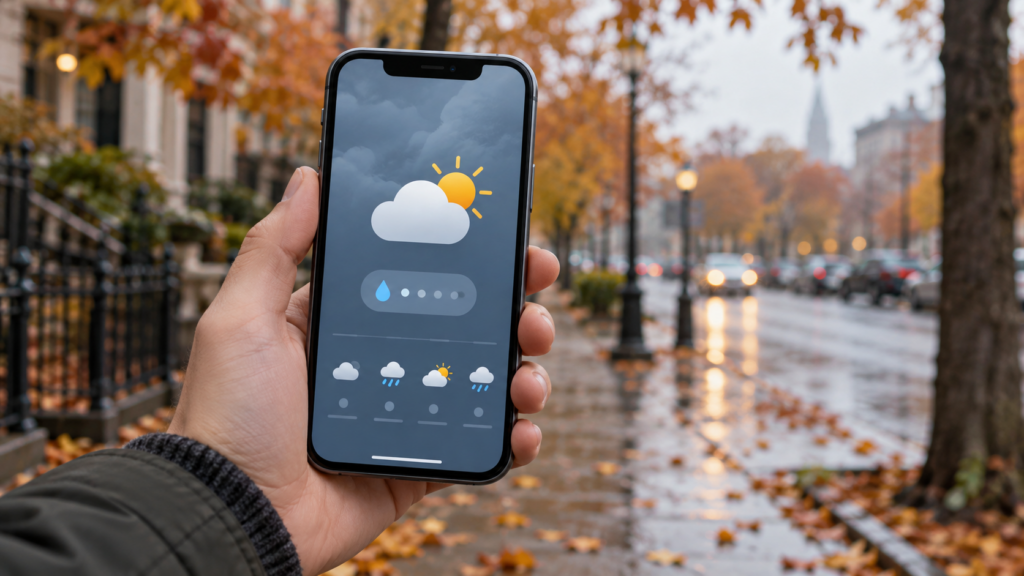
Different apps and sites draw from different computer models, apply different adjustments, and present information in different ways, so they can disagree. Some use raw model output directly, while others blend sources or add their own processing. The National Weather Service forecast, which is prepared by local forecasters who adjust model guidance using knowledge of the local area, is often a good reference point when apps disagree.
Where several sources agree, confidence is generally higher. Where they disagree, it often signals real uncertainty in the forecast, which is useful information on its own.
Myth: “Partly Cloudy” and “Partly Sunny” Mean Different Things
These two phrases are often assumed to carry meaningfully different expectations, but in standard National Weather Service usage, they describe overlapping ranges of sky cover. The difference is mostly one of emphasis, with “partly sunny” typically used for daytime periods and “partly cloudy” for nights or as a more neutral term. Neither phrase signals a notably better or worse day than the other.
Reading a Forecast Well
The most useful habits are simple: treat precipitation percentages as chances rather than predictions, pay more attention to near-term details than distant ones, compare a couple of sources when the stakes are high, and remember that a forecast is a statement of probabilities. Understood that way, forecasts turn out to be far more useful, and far more accurate, than the common frustrations with them suggest.