The Pipes Inside Your Home That Still Face Real Risk
While winterizing outdoor spigots addresses the most obvious freeze risk, a meaningful number of frozen pipe incidents each winter actually involve pipes located inside the home—specifically, pipes running through unheated or poorly insulated spaces like crawl spaces, garages, attics, and exterior walls. These interior-but-exposed pipes face genuine freeze risk despite technically being “inside” the structure, and identifying and protecting them now addresses a hazard that’s easy to overlook until a pipe has already burst.
Why Location Matters More Than Simply Being Indoors
A pipe’s freeze risk depends on its exposure to cold temperatures, not simply whether it’s located inside or outside your home’s exterior walls. Pipes running through an unheated garage, an uninsulated crawl space, or along an exterior wall with inadequate insulation can experience temperatures nearly as cold as the outdoor air, despite technically being within the building’s footprint. This is why frozen pipe incidents frequently occur in these specific locations even in homes where the main living spaces stay comfortably heated throughout a cold snap.
Identifying which pipes in your home fall into this vulnerable category—typically found by checking which plumbing runs through garages, basements, crawl spaces, and exterior-wall cavities—provides the foundation for targeted protection efforts, rather than needing to address every pipe throughout the entire home uniformly.
Pipe Insulation Addresses the Most Direct Risk
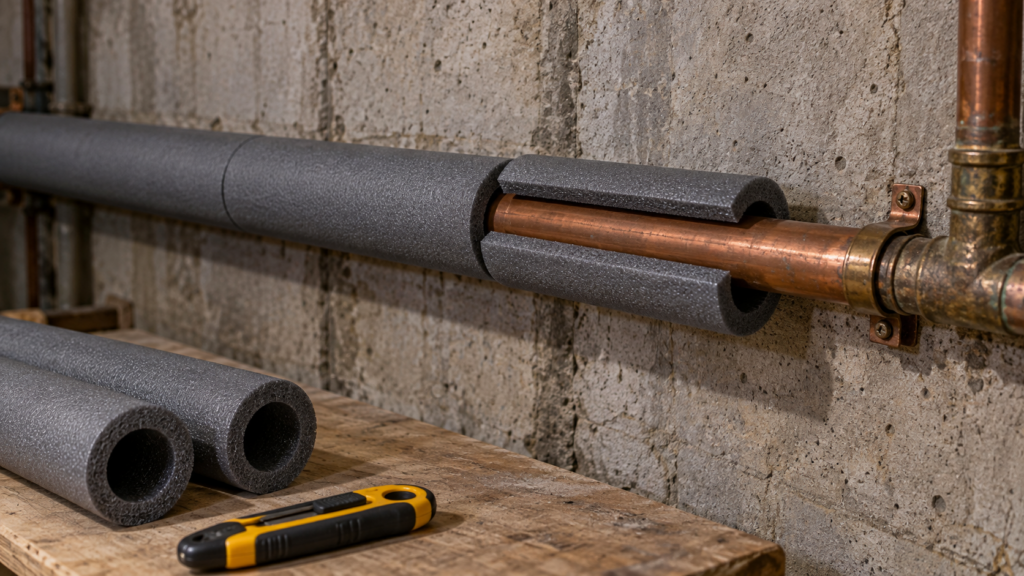
Foam pipe insulation sleeves, widely available and relatively inexpensive, slip directly over exposed pipe sections and provide a meaningful barrier against the ambient cold air that would otherwise directly contact the pipe surface. This insulation won’t make a pipe entirely freeze-proof in truly extreme conditions, but it significantly raises the threshold at which freezing becomes a genuine risk, often providing sufficient protection for all but the most severe cold events.
For pipes in particularly vulnerable locations or climates with consistently severe winter cold, heat tape—an electrical heating element that wraps around a pipe and activates automatically or via a thermostat-controlled switch when temperatures drop toward freezing—provides a more robust level of protection than insulation alone, though it requires an available electrical outlet and some additional installation effort compared to simple foam sleeves.
Sealing Air Leaks Reduces Cold Air Infiltration
Beyond insulating the pipes themselves, sealing air leaks in the spaces where vulnerable pipes are located addresses the broader problem of cold air infiltration into these spaces in the first place. Gaps around foundation vents, garage doors, and crawl space access points allow cold outdoor air to infiltrate these marginally heated or unheated spaces, and sealing these gaps where practical reduces how cold these spaces actually become during a cold snap, providing an additional layer of protection beyond the pipe insulation itself.
Keeping Some Heat in Vulnerable Spaces
For spaces like garages or crawl spaces with at least some capacity for minimal heating, maintaining even a modest temperature above freezing during the coldest stretches of winter can provide meaningful additional protection. Some homeowners use a small space heater in an attached garage during particularly severe cold snaps specifically to protect pipes running through that space, though this requires careful attention to space heater safety guidelines given the fire risk associated with unattended space heater use.
Letting Faucets Drip During Extreme Cold
During genuinely severe cold events, allowing faucets connected to vulnerable pipe runs to drip slowly provides a well-established, simple protective measure. Moving water is considerably more resistant to freezing than standing, static water within a pipe, and this small, continuous flow can provide meaningful protection during the specific overnight hours or extended cold periods when freeze risk is highest, even for pipes that don’t have more comprehensive insulation protection in place.
Knowing Where Your Main Water Shutoff Is Located
Regardless of how thoroughly you’ve insulated and protected vulnerable pipes, knowing the location of your home’s main water shutoff valve, and confirming it operates smoothly before you actually need it in an emergency, provides an important safety net. If a pipe does freeze and subsequently burst, being able to shut off water supply to the entire home quickly can significantly limit the resulting water damage compared to a delayed response while searching for an unfamiliar or stuck shutoff valve during an active emergency.
Addressing This Before the Season’s First Serious Cold Snap
Taking the time now to identify vulnerable pipe locations throughout your home, applying appropriate insulation, and addressing air leaks in the spaces these pipes run through means you’re prepared before the season’s first genuinely severe cold event arrives, rather than discovering a vulnerability only after a frozen or burst pipe has already caused the kind of water damage this preparation is specifically intended to prevent.