A Task That Becomes Urgent the First Dark Evening
Daylight saving time ends in a couple of weeks, and when clocks fall back, evening darkness arrives dramatically earlier—often an hour or more sooner than people have grown accustomed to throughout fall. This abrupt shift makes exterior lighting considerably more relevant almost overnight, and checking your home’s outdoor lighting now, before that change takes effect, means you’re not discovering a burned-out fixture or inadequate coverage on the first genuinely dark evening when it suddenly matters most.
Why This Particular Transition Matters More Than Gradual Seasonal Darkening
Unlike the gradual daily daylight reduction that’s been happening steadily since the summer solstice, the end of daylight saving time creates a sudden, one-hour shift rather than a gradual change spread across many days. This means evening activities that have occurred in daylight throughout most of fall—arriving home from work, walking a dog, children playing outside after school—will abruptly shift into darkness the week clocks change, rather than easing into darker evenings gradually as has been happening throughout the preceding weeks.
This abruptness is exactly why exterior lighting deserves deliberate attention now rather than a reactive response once the change has already occurred and inadequate lighting has already become a genuine inconvenience or safety concern.
Checking Entry Points and Walkways
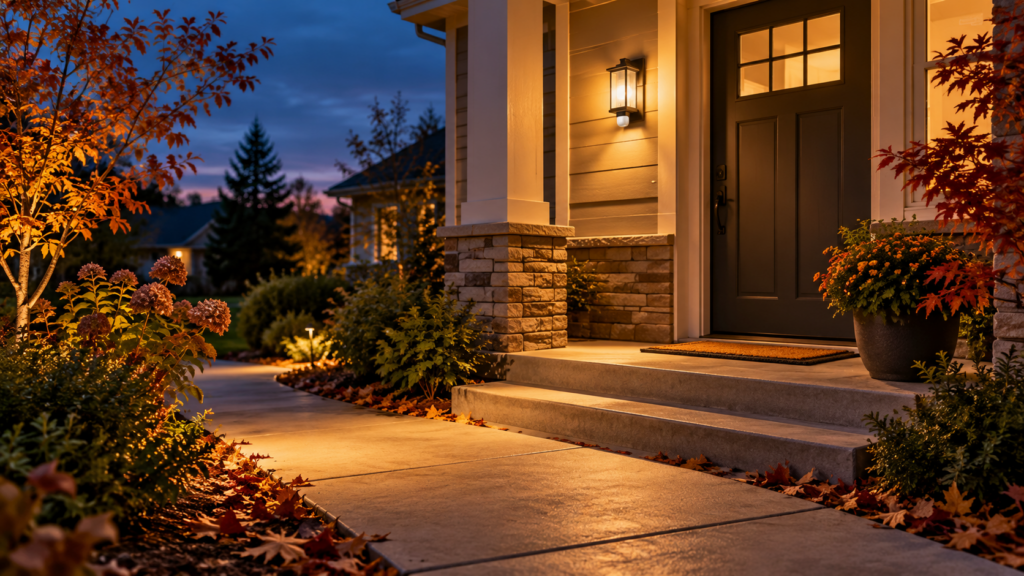
Walking your property’s exterior in the evening, after dark, provides the most accurate assessment of how your current lighting actually performs, rather than assuming daytime visual inspection alone tells the full story. Check that all entry doors have adequate lighting for safely finding keys and navigating steps, that walkways and paths leading to entrances are sufficiently illuminated to avoid trip hazards, particularly steps or uneven surfaces, and that any areas where packages are typically left have enough light for safe navigation by anyone making a delivery after dark.
Replacing any burned-out bulbs discovered during this check, and considering whether existing fixture placement actually provides adequate coverage for how the space is used, addresses both the most obvious lighting gaps and the ones that might not be apparent until you’re actually standing in the relevant space after dark.
Motion-Sensor Lighting Offers Practical Benefits
For areas that don’t need constant illumination but benefit from lighting when someone approaches—side entrances, backyard areas, or spaces near a garage—motion-sensor fixtures provide security and convenience benefits without the energy cost of keeping lights on continuously throughout longer evening hours. These fixtures also offer a practical safety benefit: sudden illumination when someone approaches can help deter unwanted visitors to a property, in addition to the more straightforward convenience of lighting automatically activating exactly when and where it’s needed.
Solar-Powered Options for Difficult-to-Wire Areas
For pathway or landscape lighting in locations without convenient access to electrical wiring, solar-powered fixtures have become considerably more reliable and effective in recent years, providing a straightforward lighting solution for areas like garden paths or distant yard sections where running electrical wiring would be impractical or expensive. These fixtures do require adequate daytime sun exposure to charge effectively, so checking that intended locations receive sufficient sunlight during the day—a consideration that becomes somewhat more relevant as fall’s sun angle lowers and shadows from trees or structures lengthen—helps ensure these fixtures actually perform as needed once evening arrives.
Timer and Smart Lighting Adjustments
If your exterior lighting relies on timers rather than motion sensors or manual switches, this transition is a good moment to update those timer settings to reflect the new, earlier darkness rather than leaving timers set to a schedule established weeks earlier under different daylight conditions. Smart lighting systems that automatically adjust based on actual sunset time, rather than a fixed schedule, eliminate this particular maintenance task going forward, automatically accounting for both the daylight saving time shift and the continuing gradual daylight changes through the rest of fall and winter.
Safety Benefits Beyond Simple Convenience
Adequate exterior lighting provides genuine safety value beyond simple convenience, reducing trip and fall risk on walkways and steps, improving visibility for anyone approaching your home after dark, and providing a general security benefit by reducing the dark, unlit areas that could otherwise provide concealment near entry points. These safety considerations become considerably more relevant once the daylight saving time shift pushes a meaningful portion of typical daily activity—arriving home from work or school, evening walks, trick-or-treating if your check happens before Halloween—into the newly earlier darkness.
A Quick Check With Meaningful Payoff
Taking the time now for a deliberate evening walk-around of your property’s exterior lighting addresses a transition that otherwise tends to catch people off guard precisely because of how abruptly it occurs compared to the rest of fall’s more gradual daylight changes. A few replaced bulbs, a motion sensor addition, or an updated timer schedule now means your home is genuinely ready for the earlier darkness before it actually arrives, rather than scrambling to address inadequate lighting once the change has already taken effect.