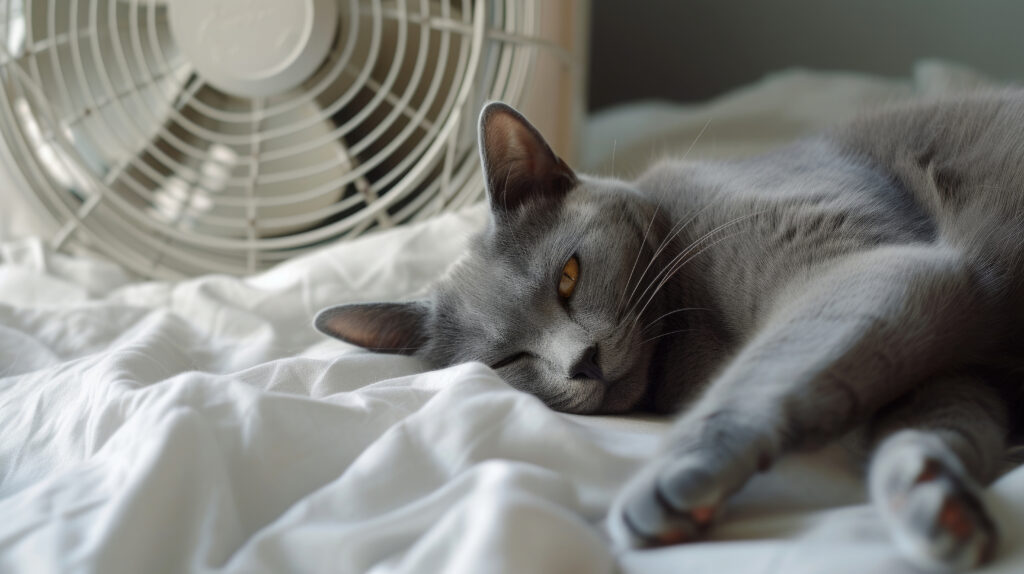
Cats Face Real Heat Danger, Even Indoors
Most summer pet safety advice focuses on dogs—walks, pavement, cars—but cats face genuine heat risks of their own that get far less attention, particularly because so many cat owners assume that an indoor cat is automatically safe from extreme heat. By mid-August, after weeks of sustained hot weather, it’s worth paying closer attention to how heat affects cats specifically and where the overlooked risks tend to hide.
Why Indoor Doesn’t Automatically Mean Safe
An indoor cat’s safety during a heat wave depends entirely on whether their indoor environment actually stays cool, and several common scenarios can leave a cat in genuinely dangerous conditions despite technically being “inside.” A cat left in a room without air conditioning during a power outage, a cat that gets shut into a sunroom or porch that heats up dramatically during the day, or a cat in a home where the air conditioning fails while owners are away at work for eight or more hours can all experience heat stress or heatstroke despite never setting foot outdoors.
Sunrooms, enclosed porches, and rooms with large west-facing windows are particular hazards, since they can reach temperatures significantly higher than the rest of the home during peak afternoon sun, turning what feels like a pleasant, sunny spot for a cat into a genuine heat trap if the door gets closed and the cat can’t leave.
Cats Hide Heat Distress More Than Dogs Do
One of the more important differences between cats and dogs during heat exposure is behavioral: cats are far less likely to show obvious, visible signs of distress until a situation has become serious. Dogs pant heavily and pace in ways that are hard to miss; cats tend to become quiet, seek out cool surfaces like tile or a bathtub, and reduce their activity—behaviors that are easy to interpret as a cat simply being a cat rather than a warning sign.
By the time a cat is panting—something cats do far less naturally than dogs, and typically only when significantly overheated—the situation has often progressed further than an equivalent stage would represent in a dog. Excessive grooming (as cats attempt to use saliva evaporation for cooling), lethargy, drooling, and seeking out unusual cool spots like sinks or floor vents are earlier and more reliable warning signs specific to cats.
Flat-Faced Breeds Face Elevated Risk
Just as with dogs, flat-faced (brachycephalic) cat breeds—Persians, Himalayans, and similar breeds—face substantially higher heat risk because their airway structure makes the cooling benefit of panting and open-mouth breathing less effective than it is for cats with more typical facial structures. These breeds, along with senior cats, overweight cats, and cats with underlying heart or respiratory conditions, warrant closer monitoring during any stretch of hot weather.
Water Access Matters More Than People Assume
Cats are notoriously prone to under-drinking relative to their actual hydration needs, a tendency that predates domestication and traces back to their desert-adapted ancestors, who obtained most of their water from prey rather than drinking directly. This natural tendency toward minimal drinking becomes a real liability during hot weather, when fluid needs increase but a cat’s instinct to drink doesn’t necessarily increase to match.
Providing multiple water sources around the home, keeping water fresh and cool, and considering a cat water fountain—many cats drink more readily from moving water than from a still bowl—can meaningfully improve hydration during the hottest stretches of summer, when adequate fluid intake plays a more significant role in a cat’s ability to regulate body temperature.
What to Do if You Suspect Heat Stress
If a cat shows signs of heat distress—excessive panting, drooling, lethargy, or collapse—move them immediately to the coolest available room, offer water, and apply a cool (not ice-cold) damp cloth to their ears, paws, and belly, areas with less fur and more direct access to blood vessels near the skin’s surface. Contact a veterinarian promptly, since heatstroke in cats, like in dogs, can progress quickly and become life-threatening without timely treatment.
Watching for the Signs Cats Actually Show
Cat heat safety requires paying attention to a different set of signals than the ones most people associate with pet heat safety, largely because cats are quieter about distress and because the specific indoor scenarios that put them at risk don’t look like the obvious outdoor hazards dogs face. Keeping an eye on hot, enclosed rooms, watching for the subtler early signs cats display, and making sure water is genuinely accessible and appealing are the practical steps that matter most for cat owners through the rest of a hot summer.