One of the Year’s Best Meteor Showers Is Underway
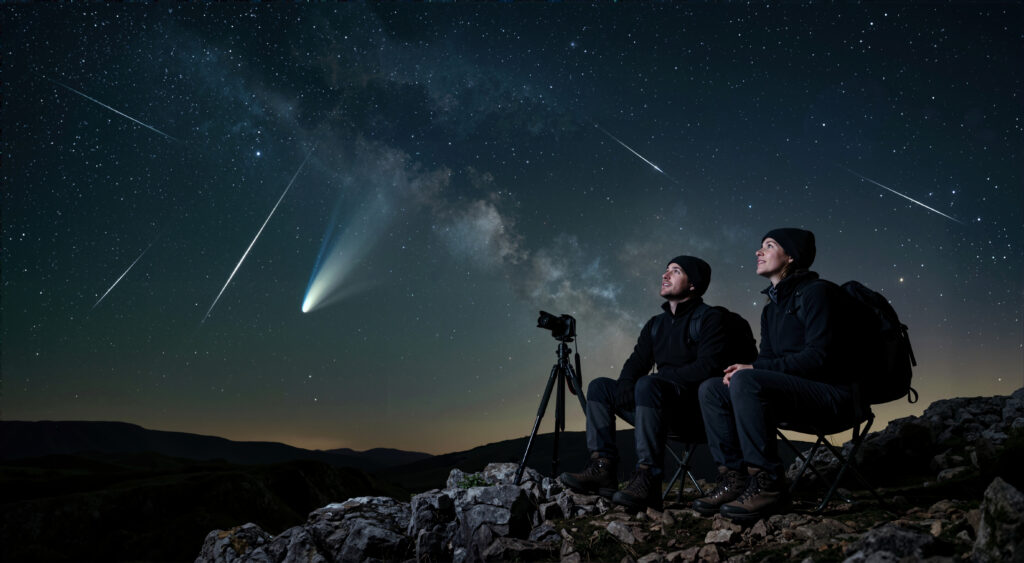
Mid-August brings the peak of the Perseid meteor shower, widely considered one of the most reliable and rewarding meteor showers of the year, capable of producing 50 to 100 visible meteors per hour under ideal conditions. While the shower itself is an astronomical event, whether you actually see anything worthwhile comes down almost entirely to weather and atmospheric conditions on any given night—making this as much a weather story as a stargazing one.
What’s Actually Happening Overhead
The Perseids occur every year as Earth passes through a trail of debris left behind by comet Swift-Tuttle, a large comet that orbits the sun roughly once every 133 years. As Earth moves through this debris field, small particles—most no larger than a grain of sand—enter the atmosphere at extremely high speed, around 37 miles per second, and burn up due to friction with atmospheric gases, creating the streak of light we see as a “shooting star.”
The shower gets its name because the meteors appear to radiate outward from a point in the constellation Perseus, though they can actually appear anywhere in the sky. This radiant point effect happens because of geometric perspective, similar to how parallel train tracks appear to converge toward a single point in the distance.
Cloud Cover Is the First and Biggest Obstacle
None of the debris field science matters if clouds are blocking your view, and cloud cover is the single most important weather factor determining whether a given night’s viewing will be worthwhile. Even thin, high cirrus clouds can meaningfully reduce the number of visible meteors by scattering and blocking faint streaks of light, while a night with scattered low clouds might still allow decent viewing during clear breaks.
Checking a clear-sky or astronomy-specific forecast, rather than a general weather forecast, provides more useful detail, since these forecasts typically break down cloud cover by altitude and timing specifically for the overnight viewing window rather than just providing a general daytime forecast.
Humidity and Haze Matter More Than People Expect
Beyond outright cloud cover, atmospheric haze and high humidity can significantly reduce the visibility of fainter meteors even on a technically “clear” night. Humid air scatters more light—both from the meteors themselves and from ambient light pollution—reducing contrast and making faint streaks harder to detect. This is part of why meteor shower viewing tends to be noticeably better on nights following a cold front passage, when drier air has moved in behind the front, compared to nights within a humid, hazy air mass.
The Moon Is a Weather-Adjacent Factor Worth Checking
While not strictly a weather condition, moonlight functions similarly to atmospheric haze in washing out fainter meteors, and checking the moon’s phase and rise time alongside the weather forecast is worth doing before planning a viewing night. A bright, nearly full moon in the sky for much of the night can reduce the number of visible meteors substantially compared to a year when the moon sets early or is in a dark phase during the shower’s peak.
Temperature and Wind Affect How Long You’ll Actually Stay Out
Meteor shower viewing rewards patience—letting your eyes adjust to darkness takes 20 to 30 minutes, and meteor rates tend to increase in the hours after midnight as Earth’s rotation brings your location into the “leading edge” of the planet’s path through the debris field. Comfortable conditions matter for whether you’ll actually stay outside long enough to benefit from this. Clear, calm nights with moderate temperatures make for far more enjoyable extended viewing sessions than windy or unusually cold nights, even when the sky conditions themselves are similarly clear.
Getting the Most Out of Peak Nights
For anyone hoping to catch the Perseids at their best, checking a nighttime cloud and humidity forecast specifically for the hours after midnight, finding a location away from artificial light pollution, and allowing enough time outside for your eyes to fully adjust to darkness are the practical steps that matter most. The comet debris responsible for the show has been traveling through space for over a century, but whether any of it actually becomes visible to you depends entirely on the atmospheric conditions directly above your head on any given night.