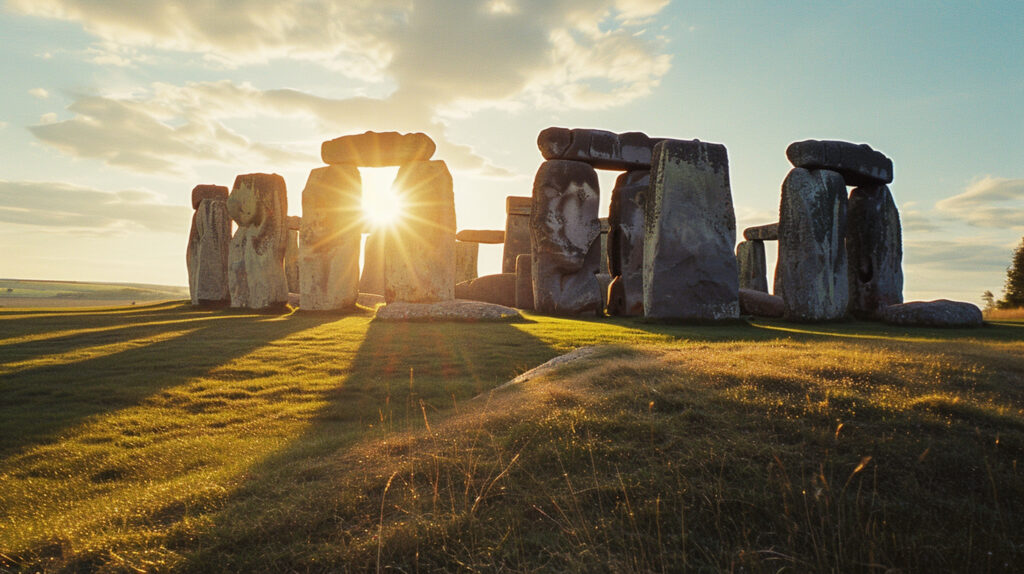
Today is the summer solstice — the moment when the sun reaches its northernmost point in the sky and the Northern Hemisphere experiences its longest day. People across the world have been marking this day for as long as humans have watched the sky, which turns out to be a very long time indeed. The monuments and alignments they built to track it — Stonehenge in England, the Caracol at Chichen Itza in Mexico, the cairns at Newgrange in Ireland, the medicine wheels of the Great Plains — represent some of the most impressive engineering achievements of the ancient world, built not for decoration but for a specific and urgent practical purpose.
Understanding why the solstice mattered so much to ancient peoples, and how they tracked it with remarkable precision using nothing but stone and shadow, reveals something important about the relationship between weather, astronomy, and survival — and makes today’s calendar date feel less like a arbitrary milestone and more like what it actually is: one of the most carefully observed moments in human history.
Why the Solstice Mattered: The Agricultural Imperative
The modern calendar makes it easy to know when to plant, when to harvest, and when winter is coming. Ancient agricultural societies had no such luxury. Their calendar was the sky — the position of the sun, the phases of the moon, the rising and setting of specific stars — and reading it accurately was a matter of survival.
The summer solstice was a critical calendar anchor. It marked the point after which days would shorten toward winter, signaling the beginning of the countdown to frost. Knowing precisely when the solstice occurred allowed ancient farmers to calculate planting and harvest windows with enough precision to feed their communities through the winter. A miscalculation that led to late planting could mean insufficient harvest before the killing frosts arrived.
But the solstice was more than a practical marker. Across virtually every culture that developed in the Northern Hemisphere, the longest day acquired religious and ceremonial significance that reflected its cosmic importance. The sun, the source of warmth, light, and agricultural fertility, reaching its maximum power and then beginning to retreat was an event that demanded acknowledgment — and that acknowledgment took the form of architecture designed to make the moment undeniable and public.
Stonehenge: The Solstice Machine
Stonehenge on Salisbury Plain in southern England is the most famous solstice-aligned monument in the world, and its alignment with the summer solstice sunrise is precise enough to have been intentional beyond any reasonable doubt.
The monument as it stands today is the product of multiple construction phases spanning roughly 1500 years, from approximately 3000 BCE to 1500 BCE. The massive sarsen stones — some weighing 25 tons — were transported from Marlborough Downs 25 miles away, an engineering feat that required the coordination of hundreds of workers over years. The bluestones in the inner circle came from the Preseli Hills in Wales, 150 miles distant.
The key alignment runs from the center of the monument through the Heel Stone — a single standing stone positioned outside the main circle — toward the northeast. On the summer solstice, the sun rises almost exactly over the Heel Stone as seen from the center of the monument, shining directly along the monument’s main axis. This alignment is not approximate: the azimuth of the solstice sunrise at Stonehenge’s latitude matches the monument’s orientation to within a fraction of a degree.
How did Neolithic builders achieve this precision? The answer is careful observation over many years. By tracking the sunrise position along the horizon over multiple years, observers could identify the point of maximum northward displacement — the solstice — and mark it with a fixed reference point. The Heel Stone and the monument’s axis encode the result of years of systematic sky-watching translated into permanent stone.
Stonehenge almost certainly served multiple purposes — burial site, ceremonial center, community gathering place — but the solstice alignment is fundamental to its design and was clearly intentional. On the solstice, the monument functions as a precision instrument for identifying the longest day of the year in a way that requires no calculation and is visible to an entire community simultaneously.
Chichen Itza: The Feathered Serpent’s Shadow
The Caracol at Chichen Itza in Mexico’s Yucatan Peninsula is a round tower built by the Maya around 900 CE that functions as a sophisticated astronomical observatory. Its windows and doorways are aligned with Venus risings, the equinoxes, and other astronomical events critical to the Maya calendar system.
But the most dramatic solstice spectacle at Chichen Itza involves not the Caracol but the great El Castillo pyramid — the stepped temple of Kukulkan that dominates the site’s central plaza. At the spring and fall equinoxes, the pyramid’s corner casts a shadow on the northern staircase that creates the illusion of a feathered serpent descending the stairs — an effect that draws tens of thousands of visitors twice a year and represents a deliberate architectural calculation.
The Maya calendar system was one of the most sophisticated ever developed, tracking multiple interlocking cycles of different lengths — the 365-day solar year, the 260-day ritual calendar, Venus synodic periods, lunar cycles — with extraordinary accuracy. This precision required systematic astronomical observation over centuries, carefully recorded and transmitted through generations of priests whose primary function was to maintain the calendrical knowledge on which agricultural timing, religious ceremony, and political authority all depended.
The solstices and equinoxes were reference points in this system — astronomical anchors against which the complex interlocking calendars were calibrated. Maya astronomers could predict solar and lunar eclipses with high accuracy, track Venus through its complete synodic cycle, and calculate astronomical events years and decades in advance — achievements that required both careful long-term observation and the mathematical framework to make sense of it.
Newgrange: The Winter Counterpart
While Stonehenge is aligned to the summer solstice sunrise, the passage tomb at Newgrange in Ireland — built around 3200 BCE, predating Stonehenge by several centuries — is aligned to the winter solstice sunrise: a narrow roof box above the entrance admits the rising sun on the shortest days of the year, sending a beam of light down the 19-meter passage to illuminate the chamber at the back.
The winter solstice alignment at Newgrange reflects a different but equally important agricultural concern: the turning point when days begin lengthening again, marking the beginning of the sun’s return after its maximum retreat. In the agricultural calendar, the winter solstice announced that the darkest period was ending — a cause for ceremony that Newgrange’s builders encoded in stone with extraordinary precision.
The Newgrange roof box is a technical achievement that deserves specific attention. It is positioned and angled so that the rising sun on only the five to six days around the winter solstice sends light down the passage at the correct angle to illuminate the chamber. This precision required not just accurate tracking of the solstice but careful architectural planning that accounted for the passage’s length, the horizon profile to the southeast, and the specific angle of the winter solstice sunrise at that latitude. The monument encodes years of astronomical observation in its geometry.
The Medicine Wheels of the Great Plains
The astronomical alignment tradition appears independently in North America in the form of medicine wheels — large circular stone structures built on the high plains and in the Rocky Mountain foothills by indigenous peoples of the Great Plains. The most studied example, the Bighorn Medicine Wheel in Wyoming, sits at 9,642 feet elevation and consists of a central stone cairn connected to an outer ring by 28 stone spokes.
Astronomer John Eddy’s analysis in the 1970s identified alignments in the Bighorn Medicine Wheel with the summer solstice sunrise and with the rising of three bright stars — Aldebaran, Rigel, and Sirius — that were used as markers for different phases of the summer season by Plains peoples. The summer solstice sunrise alignment allows the wheel to be used as a calendar anchor, and the stellar alignments extend this calendar function through the summer months.
The Bighorn wheel is not unique — dozens of medicine wheels have been documented across the northern Plains and Rocky Mountain region, varying in size and design but sharing the basic circular architecture. Their astronomical alignments vary, suggesting that different wheels served different calendrical purposes or encoded the sky knowledge of different communities. Together they represent a distributed astronomical tradition that tracked the same seasonal turning points that Stonehenge and Newgrange encoded in megalithic stone — adapted to the specific materials, landscape, and sky knowledge of the Plains environment.
The Precision Without Instruments
What makes these achievements remarkable from a modern perspective is their precision in the absence of any instruments more sophisticated than careful human observation. No telescope, no theodolite, no GPS — just generations of people watching the sun rise from the same location over many years, recording the shifting horizon point, and eventually identifying the limits of its northward and southward travel.
The method that would have produced these alignments is straightforward in principle if laborious in practice: mark the sunrise position each morning with a stake or stone, observe where the position stops moving northward and begins moving southward, and orient the monument toward that point. The precision of the resulting alignment depends on how many years of observation went into it and how carefully the orientation was executed — and at sites like Stonehenge and Newgrange, the precision suggests both extended observation and careful execution.
The solstice is particularly suited to this observation method because of its natural pause — the sun’s daily position changes very slowly in the days around the solstice, making it relatively easy to identify the turning point through several days of consecutive observation. This is the astronomical reality behind the Latin root of the word solstice: sol sistere, the sun standing still.
The Same Moment, Differently Marked
Today, June 21, 2026, the sun reaches its northernmost point at 4:24 a.m. Eastern time — a moment calculated years in advance from orbital mechanics with precision that the builders of Stonehenge could not have imagined. The same moment was observed from the stone circles of Neolithic Britain, the pyramids of Mesoamerica, the cairns of Ireland, and the medicine wheels of the American West — each culture finding its own way to mark the turning point that determined when to plant, when to harvest, and when to prepare for winter.
The astronomical event is the same. The sky is continuous. The solstice that the Neolithic farmers watched from Salisbury Plain in 3000 BCE and the one that rises this morning over Kansas City are the same phenomenon in the same solar system, observed from the same rotating planet. What has changed is not the sky but the technology with which we read it — and the urgency that once made reading it correctly a matter of survival.
That urgency has diminished. The knowledge it produced has not.