Peak Wind Season Is Here. The Myths Are Dangerous.
Damaging winds from severe thunderstorms kill people and cause billions of dollars in property damage across the United States every year — more combined damage than tornadoes in most years. Despite this, wind is the least respected of the major severe weather hazards. People stand outside watching approaching storms. They stay in structurally inadequate shelter. They make decisions based on beliefs about wind that have no basis in physics.
The myths below are not harmless misconceptions. They cause people to underestimate wind’s danger, make poor shelter decisions, and sustain preventable property damage. Peak severe weather season — when straight-line winds, downbursts, and tornadoes are most frequent — is exactly the time to address them.
Myth: Straight-Line Winds Aren’t as Dangerous as Tornado Winds
The distinction between tornado winds and straight-line winds matters for insurance purposes and meteorological classification, but from the perspective of the damage they cause, the comparison is misleading. A straight-line wind event producing 100 mph gusts causes the same structural damage as a weak tornado producing 100 mph winds — the wind doesn’t care what meteorological process produced it.
Straight-line winds from severe thunderstorm downbursts and derechos routinely exceed 80 mph and occasionally reach 100 to 130 mph. At these speeds, standard residential construction sustains significant damage: roofs are partially or fully lost, trees fall on structures, windows fail, and unanchored objects become lethal projectiles. The same precautions appropriate for a tornado warning — sheltering in an interior room away from windows, away from trees — are appropriate when a severe thunderstorm warning for damaging winds is issued.
The cultural hierarchy that treats tornado warnings as serious and severe thunderstorm warnings as minor is not justified by the physics of wind damage. A severe thunderstorm warning for 70 mph winds deserves the same behavioral response as a tornado warning in terms of personal safety — getting away from windows and exterior walls and into an interior shelter location.
Myth: Cracking a Window During High Winds Protects Your House
This myth — a cousin of the window-opening-during-tornado myth addressed in the tornado piece — holds that cracking windows on the leeward side of the house during high winds equalizes pressure and prevents the house from being damaged. Like its tornado equivalent, it is false and wastes time that should be spent sheltering.
Houses are not sealed pressure vessels. They have gaps around doors, windows, plumbing penetrations, and electrical fixtures that allow continuous pressure equalization without any window being opened. The pressure differential between inside and outside a house during a severe thunderstorm is not meaningfully different from what normal gaps accommodate — and opening windows during high winds creates a new pathway for wind-driven rain infiltration and flying debris to enter the house.
The correct action when damaging winds are imminent is to close and lock all windows and doors, which provides structural integrity against wind loading, and move to an interior room away from glass.
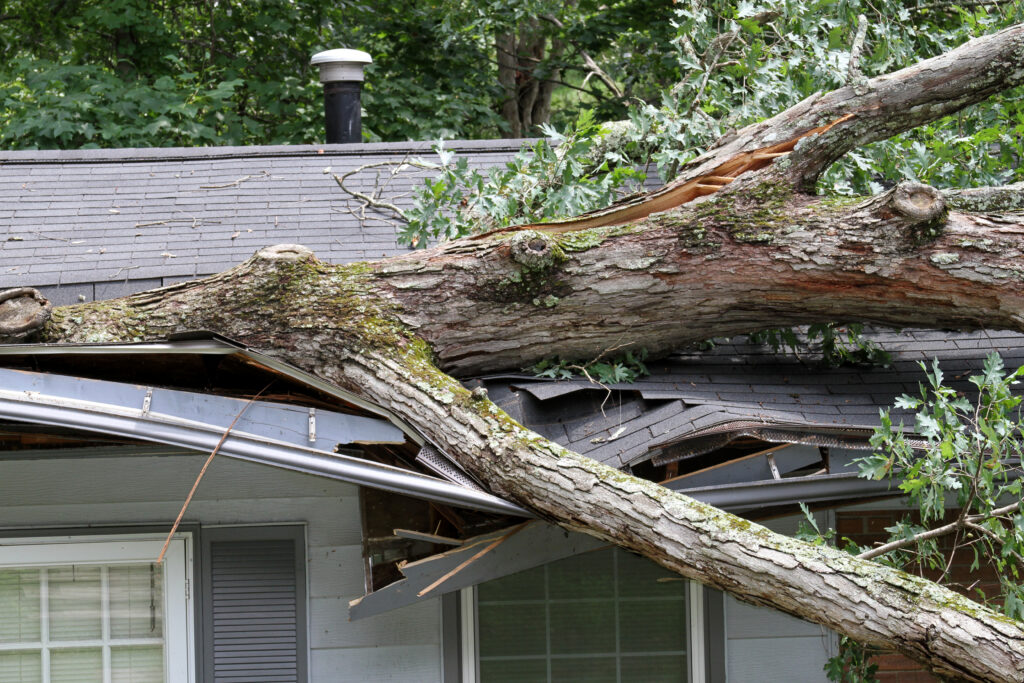
Myth: A Sturdy-Looking Tree Won’t Fall on My House
Tree failure during wind events is one of the leading causes of residential property damage and storm-related fatalities, and the trees that fall on houses are often the ones that appeared healthy before the storm. This is because the most dangerous tree failures — root plate failures and internal decay — are largely invisible from the outside.
Root plate failure occurs when the disc of soil and roots that anchors a tree is insufficient to resist the lever action of wind on the tree’s crown. Large trees with relatively shallow root systems — a category that includes many species that grow in urban and suburban soils compacted by construction and foot traffic — can fail at their base with no external warning signs. The tree looks perfectly healthy until it’s lying on your roof.
Internal decay — rot that has progressed through the heartwood of the trunk while the outer wood remains sound — produces the same invisible vulnerability. A tree with 60 percent internal decay may show no external evidence except possibly a slightly hollow sound when struck and a history of slow growth. It can stand through dozens of storms and fail suddenly in a moderate wind event when the reduced structural cross-section can no longer resist the bending force.
Certified arborists can assess root conditions and conduct resistograph testing — drilling a thin probe into the trunk to measure resistance along the path, which reveals internal decay — that external inspection cannot replicate. Any tree within striking distance of the house, vehicles, or power lines that hasn’t been professionally assessed in several years warrants evaluation before peak storm season.
Myth: Wind Speed Doubles Mean Wind Damage Doubles
The relationship between wind speed and wind force is not linear — it follows a square law. Wind force on a surface is proportional to the square of wind speed. This means doubling wind speed quadruples the force applied to any surface the wind acts on.
The practical implication is that the jump from 60 mph to 90 mph winds — seemingly a 50 percent increase in speed — actually produces 2.25 times the force on your roof, walls, and windows. The jump from 60 mph to 120 mph — doubling wind speed — produces four times the force. This is why wind damage escalates so dramatically at the high end of the wind speed range: a storm with 100 mph winds doesn’t cause twice the damage of a 50 mph storm. It causes roughly four times the structural loading.
This nonlinearity explains the damage categories in the Enhanced Fujita scale for tornadoes and the Fujita scale before it — the damage thresholds for each rating don’t increase proportionally because the relationship between wind speed and damage is itself not proportional. EF4 and EF5 tornadoes destroy well-built structures not because they’re slightly stronger than EF3 storms but because the structural loading they apply is categorically beyond what standard construction can resist.
Myth: Wind Only Damages Things It Hits Directly
Wind damages structures through several mechanisms, and direct impingement — wind pushing on a surface — is only one of them. Understanding the others explains why some wind damage seems to occur on the wrong side of the structure relative to wind direction.
Suction is the mechanism that pulls roofs off houses. When wind flows over a roof, it accelerates because the roof surface forces it to travel a longer curved path. This acceleration reduces pressure above the roof — the same Bernoulli principle that generates lift on an airplane wing. The pressure difference between the lower pressure above and the higher pressure inside the house acts as suction that pulls the roof upward. This is why roof failure in high winds typically begins at the edges and corners — where the flow separation and pressure reduction are greatest — and often results in the roof lifting away rather than being pushed down.
Internal pressurization amplifies this effect. When wind finds an opening in the windward side of a structure — a failed window, an open garage door, a broken exterior wall — it pressurizes the interior. This internal pressure acts outward on all interior surfaces, including pushing upward on the roof from below while suction pulls it upward from above. The combined effect dramatically increases the likelihood of roof failure — which is why garage doors, the largest and often weakest opening in a residential structure, are specifically reinforced in hurricane-resistant construction.
Understanding suction also explains why the leeward (downwind) wall of a structure experiences outward suction loads during high winds rather than just neutral conditions — wind flowing around the building creates a low-pressure wake on the leeward side that pulls the wall outward. Structures with weak connections between walls and roof framing are vulnerable to failure on all sides simultaneously in severe wind events.
Myth: Wind Warnings Are Routine and Don’t Require Action
The National Weather Service issues High Wind Warnings when sustained winds of 40 mph or greater are expected for one hour or more, or when wind gusts of 58 mph or greater are expected. Wind Advisories cover somewhat lower speeds. These products are routine enough — issued dozens of times per year across the country — that many people treat them as background information rather than action items.
The routine nature of these products reflects the frequency of elevated wind events, not their lack of danger. A 60 mph wind gust is capable of felling trees and branches, turning unsecured outdoor objects into projectiles, and causing vehicle accidents — particularly for high-profile vehicles including SUVs, trucks, RVs, and trailers that are more susceptible to crosswind effects. Each year, wind events well below tornado strength kill people who were struck by falling trees, hit by wind-driven debris, or involved in vehicle accidents during high-wind conditions.
The appropriate response to a High Wind Warning is practical rather than dramatic: secure or bring in outdoor furniture and objects, avoid parking under trees, exercise caution when driving high-profile vehicles, and avoid being outdoors unnecessarily during peak gusts. None of this requires the urgency of a tornado warning, but none of it should be ignored either.
The Wind That Doesn’t Announce Itself
Perhaps the most important thing to understand about wind damage is that the most dangerous wind events — the downburst that flattens a neighborhood in 30 seconds, the derecho that produces a 400-mile swath of damage without a tornado warning — often arrive with less public visibility than tornado events.
Tornadoes are visible, named, tracked by radar, and warned for individually. Straight-line wind events from severe thunderstorm downbursts can produce EF1 or EF2 equivalent damage in seconds with only a severe thunderstorm warning — or sometimes with no warning at all when the event develops faster than warning lead time allows.
The shelter-in-place behavior appropriate for tornadoes — interior room, away from windows, away from exterior walls — is also the appropriate response to any severe thunderstorm with damaging wind potential. The distinction between what the meteorological process is called and what the wind actually does to structures and people is, from a safety perspective, not a meaningful distinction.
Wind doesn’t respect the categories we assign it. The myths above suggest it does.