The Atmosphere Is Full of Light Shows Most People Never Learn to See
A rainbow after a spring shower is the most familiar atmospheric optical phenomenon — so familiar that most people stop looking once they’ve spotted one. But the spring and early summer atmosphere produces a remarkable range of light effects that are less well known and in some cases more visually stunning than a standard rainbow. Sun dogs flanking the winter sun, halos encircling the moon, iridescent clouds shimmering with color, and moonbows arcing over dark landscapes all form through variations of the same optical principles — light interacting with ice crystals, water droplets, or the geometry of your own position relative to sun and moisture.
These phenomena are not rare in the sense of once-in-a-lifetime events. They occur regularly to anyone who knows what conditions produce them and takes the time to look. Spring and early summer, with their mix of ice-crystal clouds at altitude, frequent showers, and moist air, produce the full range of atmospheric optics — and understanding what you’re looking for turns occasional lucky sightings into a more consistent observational practice.
Sun Dogs: The False Suns Flanking the Real One
Sun dogs — formally called parhelia — are among the most commonly seen but least recognized atmospheric optical phenomena. They appear as bright spots of light, sometimes with rainbow-like coloring, positioned approximately 22 degrees to the left and right of the sun, typically at the same altitude as the sun on the horizon. On the right day, they can be as bright as the sun itself, creating what looks like three suns in the sky simultaneously.
Sun dogs form when sunlight passes through flat, hexagonal ice crystals suspended horizontally in the atmosphere — primarily in cirrus clouds at high altitude. As light enters through one face of a hexagonal ice crystal and exits through another face at a 60-degree angle, it refracts and separates into colors in the same way a prism does. When millions of these similarly oriented crystals are present in the same portion of sky, the collective refraction concentrates light at a specific angular distance from the sun — 22 degrees — producing the bright, sometimes colorful spots on either side.
The name “sun dog” has obscure origins — one theory suggests that the bright companions “follow” the sun as a dog follows its owner. Whatever the etymology, the phenomenon is easy to spot once you know to look for it: any time you see cirrus clouds and the sun is low in the sky, check 22 degrees to either side. A complete sun dog display includes a 22-degree halo encircling the sun, sun dogs on both sides, and sometimes upper and lower arcs, producing a spectacular geometric light show that draws few observers because most people don’t know it’s there.
Spring produces frequent sun dog conditions because the active weather patterns of the season regularly deliver thin cirrus cloud layers ahead of approaching storm systems. The morning and evening hours — when the sun is near the horizon — are when sun dogs are most prominent, because the long horizontal path of sunlight through the ice crystal layer concentrates the effect.
The 22-Degree Halo: The Ring Around the Sun and Moon
The same ice crystal geometry that produces sun dogs also produces the 22-degree halo — a ring of light encircling the sun or moon at a radius of 22 degrees. Unlike the diffuse glow of a corona (described below), the 22-degree halo has relatively sharp inner and outer edges, is colorless to faintly reddish on the inner edge, and appears in conjunction with cirrus clouds.
Halos around the moon are seen more frequently than halos around the sun simply because they’re easier to observe — looking near the sun requires squinting or blocking the direct light, while moonlight is dim enough that the halo is immediately visible against the night sky. A moon halo is not a weather predictor in the precise sense that folk wisdom claims (“ring around the moon, rain will come soon”), but it does indicate the presence of high cirrus clouds that often precede warm fronts and their associated precipitation by 12 to 24 hours. The correlation is real enough to have generated the folk saying, though it’s far from reliable enough for forecasting.
The 46-degree halo — a larger, fainter ring at twice the radius of the 22-degree halo — occasionally appears when ice crystals have a specific column shape rather than the plate shape that produces the 22-degree phenomenon. It’s rarer and subtler but visible under ideal conditions to an observer who knows to look for it.
Iridescent Clouds: The Hidden Color in Plain Sight
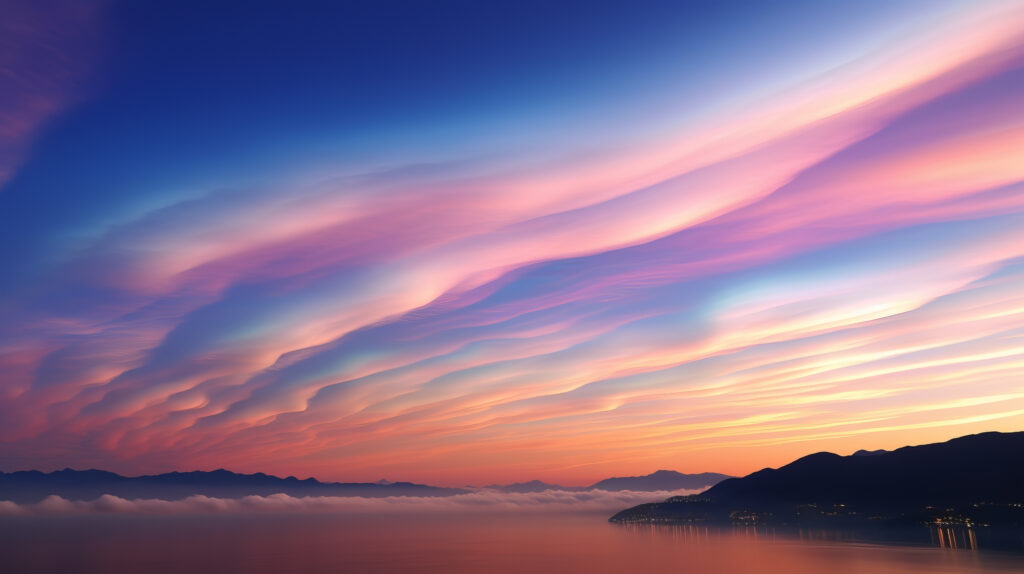
Cloud iridescence is one of the most beautiful and most overlooked optical phenomena in the everyday sky. It appears as patches of color — pinks, greens, blues, and purples — in thin clouds near the sun, resembling the iridescence of a soap bubble or an oil slick on water. The colors shift and change as the cloud moves or the observer changes position.
Cloud iridescence forms through diffraction — the bending of light waves around tiny obstacles. When cloud droplets or ice crystals are very small and relatively uniform in size, light waves of different wavelengths diffract by different amounts as they pass around the particles, separating into colors in the same way a diffraction grating on a CD separates light. The effect requires droplets of very consistent size — a condition found in newly forming cumulus clouds and in lenticular clouds over mountains, where air flowing over terrain creates a standing wave of cloud with highly uniform droplet size.
Look for iridescence in thin, wispy clouds within about 30 degrees of the sun — and use your hand or a building to block the direct sun when doing so. The colors are subtle and easily washed out by direct glare. The best conditions are broken cumulus clouds on spring afternoons, particularly on days with high cloud bases and clean, transparent air. Once you’ve seen it clearly for the first time, you’ll notice it regularly in situations where you previously would have looked at a cloud and seen nothing unusual.
The Glory: The Shadow of Your Own Head, Rainbowed
The glory is an optical phenomenon that most people have seen from aircraft without knowing what it was: a set of concentric colored rings centered on the shadow of the aircraft — or more precisely, centered on the antisolar point, the point directly opposite the sun from the observer’s position. The rings repeat the color sequence of a rainbow but form a complete circle rather than an arc, and they appear on cloud tops or fog layers below the observer.
From the ground, glories are visible when you are positioned above a cloud or fog bank with the sun directly behind you — on mountain summits with clouds below, on hillsides overlooking fog-filled valleys, or from any elevated position where sunlight can cast your shadow onto a cloud surface. Each observer sees the glory centered on their own shadow — the “Specter of the Brocken,” named for a peak in Germany where mountain climbers regularly encountered the phenomenon and attributed it to supernatural causes before the optics were understood.
The glory forms through a complex combination of diffraction and internal reflection within cloud droplets — a different mechanism than the simple refraction of rainbows. The specific physics is intricate enough that it wasn’t fully explained until the 20th century. The result is a perfectly circular rainbow centered on the antisolar point, visible only to the specific observer whose eye, the glory, and the sun are all aligned.
Moonbows: Rainbows by Moonlight
A moonbow is exactly what it sounds like: a rainbow produced by moonlight rather than sunlight. The optics are identical — light refracting and reflecting inside water droplets, separating into colors — but the light source is the moon rather than the sun, and the result is dramatically different in appearance because moonlight is roughly 400,000 times dimmer than sunlight.
Moonbows appear white or very pale to the dark-adapted naked eye because moonlight is too dim to activate the cone cells in the retina that perceive color. Long-exposure photography of moonbows reveals that the colors are genuinely present — the same spectrum as a solar rainbow — but the human eye, seeing by rod cells in low light, cannot resolve them. To the naked eye, a moonbow appears as a white or silver arc against the dark sky, often accompanied by a softly illuminated sky within the arc.
Moonbows require a full or near-full moon for sufficient light intensity, rain falling in the direction opposite the moon (as rainbows always appear opposite the light source), and a dark sky — a moonbow is washed out by light pollution just as stars are. The best conditions are full moon nights with passing showers, viewed from locations with dark eastern skies when the moon is in the west. Waterfalls that produce continuous mist — Niagara, Yosemite, Victoria — are reliable moonbow locations because they provide consistent water droplets in the right position.
How to See More of What’s There
Atmospheric optics rewards attention more than luck. Several habits dramatically increase the frequency of sightings.
Always check the sky opposite the sun after rain for rainbows — including low on the horizon after afternoon showers when the sun is high enough to place the rainbow’s center below the horizon, making it appear as a full semicircle.
Check the sky within 30 degrees of the sun (blocking direct sunlight with your hand) for iridescence in thin clouds, corona effects around the sun, and the beginning of halo arcs.
When cirrus clouds are present and the sun is within 30 degrees of the horizon, scan 22 degrees to each side for sun dogs and look for the complete halo circle.
Before sunrise and after sunset when the sky is orange and pink, look for crepuscular rays, the Belt of Venus, and the green flash on clear flat horizons.
The spring atmosphere, with its variety of cloud types, frequent moisture, and clean post-frontal air, is the most optically productive sky of the year. It produces every phenomenon described here in the right conditions. The limiting factor is almost never the atmosphere — it is almost always whether anyone is looking.