The Galaxy Is Back. Here’s How to Actually See It.
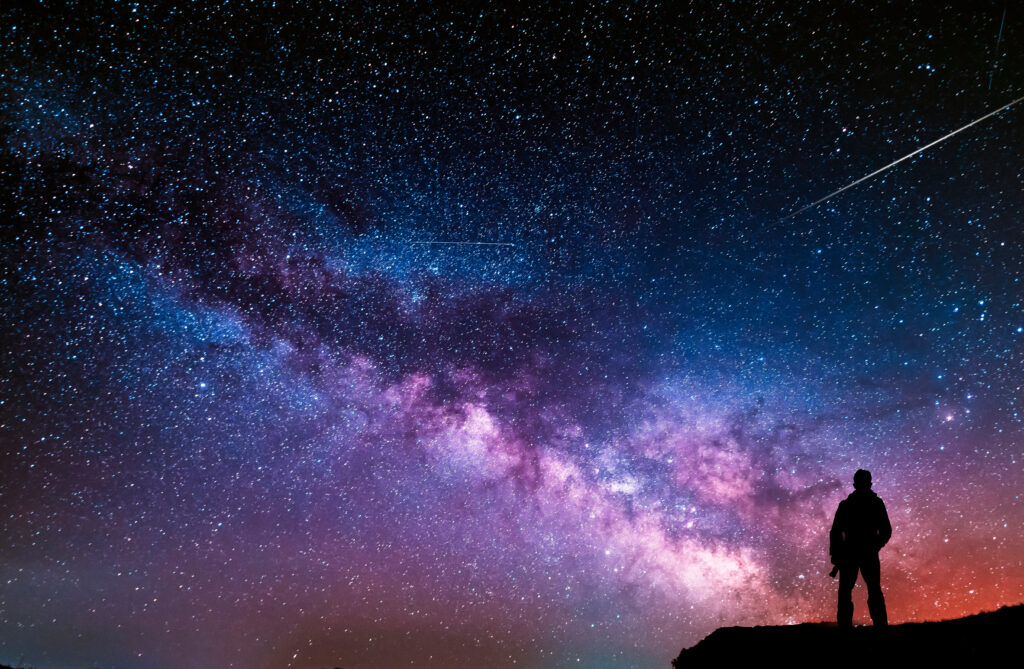
Sometime in late April, if you’re far enough from city lights and the sky is clear, you’ll notice something that wasn’t visible all winter: a faint, softly luminous band arching across the southern sky after midnight. It’s subtle at first — easily mistaken for a thin cloud — but once your eyes dark-adapt and you know what you’re looking for, it becomes unmistakable. The Milky Way is back.
The return of the Milky Way to the night sky is one of spring’s quieter but most rewarding astronomical events, and it’s directly connected to the same seasonal geometry that governs everything else about the season. Understanding why the Milky Way disappears in winter and returns in spring, and what atmospheric conditions make the difference between a spectacular view and a washed-out disappointment, transforms a pleasant outdoor experience into something genuinely awe-inspiring.
Why the Milky Way Is Seasonal
The Milky Way — the band of light created by the combined glow of billions of stars in the disk of our galaxy — is visible year-round in principle. What changes is which part of the galaxy faces Earth’s night side at different times of year, and how high above the horizon it climbs.
Our solar system sits roughly two-thirds of the way out from the center of the Milky Way’s disk. When we look toward the constellation Sagittarius, we’re looking toward the galactic center — the most densely packed, most luminous part of the galaxy, where the Milky Way band is widest, brightest, and most visually dramatic.
In winter, the galactic center in Sagittarius is on the daytime side of Earth — it’s above the horizon only during daylight hours when it’s impossible to see. The winter night sky faces away from the galactic center, toward the outer arms of the galaxy, where the Milky Way is thinner, dimmer, and less impressive.
As Earth orbits the sun through spring, the geometry shifts. By late April, Sagittarius begins rising above the eastern horizon in the hours before dawn. By June and July, the galactic center transits high in the summer sky during the middle of the night — peak Milky Way season. But spring is when it first becomes accessible again, rising late and staying low, offering a preview of the summer galaxy season for those willing to stay up past midnight.
What the Atmosphere Does to Starlight
Even on a night when the Milky Way is geometrically positioned for viewing, what you actually see depends almost entirely on atmospheric conditions. The atmosphere between you and the stars is never perfectly transparent — it scatters, absorbs, and distorts starlight in ways that vary dramatically with weather conditions.
Water vapor is the biggest atmospheric obstacle to stargazing. Humid air doesn’t just make the sky hazy — water vapor absorbs and scatters light at wavelengths that include much of the visible spectrum, reducing contrast and washing out faint objects like the Milky Way. The difference between a night with a dew point of 35°F and one with a dew point of 65°F is dramatic: the drier night will show the Milky Way with striking clarity while the humid night reduces it to a barely perceptible smudge.
This is why summer, despite offering the galactic center at its highest and most accessible, is often disappointing for Milky Way viewing across the eastern half of the country. July and August bring dew points in the 60s and 70s across the Midwest and Southeast — excellent conditions for heat index warnings, terrible conditions for stargazing. The galaxy is positioned perfectly, but the atmosphere is too laden with moisture to let its light through cleanly.
Spring’s drier air — dew points still in the 40s and low 50s across most of the country in April — is what makes it the practical sweet spot for Milky Way viewing despite the galactic center being lower in the sky than it will be in summer.
Aerosols and particulates — dust, pollen, smoke, and pollution particles — scatter light and reduce transparency further. Spring brings elevated pollen counts that contribute to atmospheric haze, particularly in the mid-levels of the atmosphere. The best spring stargazing nights follow cold frontal passages that sweep particulates out of the atmosphere: the sky the night after a strong cold front clears through is often dramatically clearer than the night before, as the front scours the atmosphere clean.
Atmospheric stability affects the steadiness of starlight — what astronomers call “seeing.” Unstable air causes stars to twinkle dramatically and produces a shimmering, dancing quality in the atmosphere that blurs fine detail in telescopic views. Stable air, common on nights with light winds and no strong temperature gradients, produces steady starlight and sharp views. Spring’s temperature contrasts and active weather patterns mean nights of excellent atmospheric stability are interspersed with nights of poor seeing, making forecast-checking before a planned stargazing session worthwhile.
Light Pollution: The Obstacle Weather Can’t Fix
Atmospheric conditions can improve dramatically with the right weather, but light pollution — the artificial brightening of the night sky from urban and suburban development — requires distance to overcome. Light pollution scatters off aerosols and water vapor in the lower atmosphere, creating the orange-gray glow visible over any city, and this scattered light overwhelms the faint glow of the Milky Way for observers within roughly 50 to 100 miles of major metropolitan areas under typical conditions.
For most Americans, seeing the Milky Way requires intentional travel away from population centers. The Bortle scale, which rates sky darkness from 1 (pristine dark sky) to 9 (inner-city sky), gives a useful framework: the Milky Way becomes clearly visible around Bortle 4 or better, and becomes truly spectacular at Bortle 2 or 1. Light pollution maps available online show dark sky locations within driving distance of most metropolitan areas — state and national parks, rural areas, and designated dark sky preserves that limit artificial lighting.
After a cold frontal passage that clears the atmosphere, the effective range of light pollution slightly decreases because cleaner air scatters less light. The most exceptional Milky Way views happen on nights that combine genuine dark sky locations with post-frontal atmospheric clarity.
Reading the Forecast for Stargazing
Standard weather forecasts give you cloud cover and precipitation, but stargazing quality depends on subtler factors. Several tools exist specifically for astronomical forecasting.
Clear Outside, Astrospheric, and the Clear Sky Chart are apps and websites that translate meteorological forecast data into stargazing-specific predictions, rating transparency (atmospheric moisture and aerosol content), seeing (atmospheric stability), and cloud cover separately. Checking these before planning a late-night outing to a dark sky site is significantly more informative than checking a standard weather app.
The key metrics to look for: transparency rated good or excellent (corresponding to low humidity and clean post-frontal air), seeing rated average or better (corresponding to stable atmospheric conditions), and cloud cover below 20 percent. Nights that hit all three metrics are genuinely rare and worth prioritizing.
Moon phase is the other critical variable. The full moon illuminates the sky brightly enough to wash out the Milky Way entirely, and the week on either side of full moon significantly reduces Milky Way visibility. New moon nights — and the week surrounding them — are when the darkest skies occur. Combining a new moon night with post-frontal atmospheric clarity and a dark sky location is the formula for the best possible Milky Way view.
What You’ll See
The first sighting of the Milky Way after a winter absence is reliably striking, even for people who have seen it before. At a genuinely dark site under excellent conditions, it appears as a broad, softly luminous band stretching from the southern horizon northward across the sky — not uniformly bright, but mottled with darker rifts (dust clouds within the galaxy blocking starlight from behind) and brighter concentrations. The galactic center region in Sagittarius is visibly richer and more complex than the surrounding band, even to the naked eye.
Dark adaptation — allowing your eyes 20 to 30 minutes to adjust fully to darkness, away from any white light sources — is essential. The eye’s rod cells, responsible for low-light vision, require time to reach their full sensitivity, and a single glance at a phone screen resets the process. Red light, which doesn’t reset dark adaptation, is the standard solution for stargazers who need occasional illumination.
The Milky Way is best seen lying flat on your back, which allows your full field of vision to take in the band’s arc across the sky. The experience of seeing it clearly for the first time — or the first time this year — has a way of reorienting perspective that’s difficult to describe and easy to understand once you’ve had it.
Spring nights are clear. Spring air is dry. The galaxy is rising. It’s worth going to find it.